Cover Daniel Wu at the New York Asian Film Festival (NYAFF) late July, when he was presented with the Best from the East Award (Photo: Crystal Li)
Daniel Wu at the New York Asian Film Festival (NYAFF) late July, when he was presented with the Best from the East Award (Photo: Crystal Li)
1 / 1
From ‘Gen-X Cops’ to Hollywood and back again, Hong Kong-American actor Daniel Wu reflects on returning to Hong Kong cinema in ‘Cold War 1994,’ and the lessons he carries between two worlds
There is something quintessentially Hong Kong about Cold War 1994.
It is there in the familiar collision of police and triads, where the lines between black and white begin to blur even as the two sides remain, fundamentally, two different worlds. It is there in the old-money dynasties, where reverence is afforded to elders and the deceased, and inheritance is passed down as much as it is fought for.
There is even something faintly wuxia about it, with the martial codes and sensibilities long inherent to Hong Kong’s cinematic tradition transplanted into a contemporary crime thriller.
Read more: Right person, wrong time: 9 nostalgic Hong Kong romance movies defined by bitter-sweet fate


Above ‘Cold War 1994’ serves as a prequel to the successful predecessors, taking place in 1994

Above Daniel Wu plays Peter Choi, deputy commissioner of the Hong Kong Police Operations
‘Cold War 1994’ serves as a prequel to the successful predecessors, taking place in 1994
1 / 2
For anyone who grew up watching Hong Kong cinema, there is also a certain familiarity to the way Cold War 1994 wears its drama and action. The performances can be heightened, the stakes operatic and the action unapologetically excessive—but that excess is precisely part of the appeal, delivering the kind of breathless, edge-of-your-seat action that Hong Kong cinema has long excelled at.
Directed by Longman Leung, Cold War 1994 travels back to 1994, when the kidnapping of a tycoon sets off a chain of events involving the police, business elites, British authorities and the triad underworld.
The film serves as a prequel to Cold War (2012) and Cold War II (2016), exploring the origins of the relationships and rivalries that underpin the earlier films, with the story continuing in Cold War 1995, slated for release in 2027.

Above Daniel Wu (Photo: Chris Kammerud)
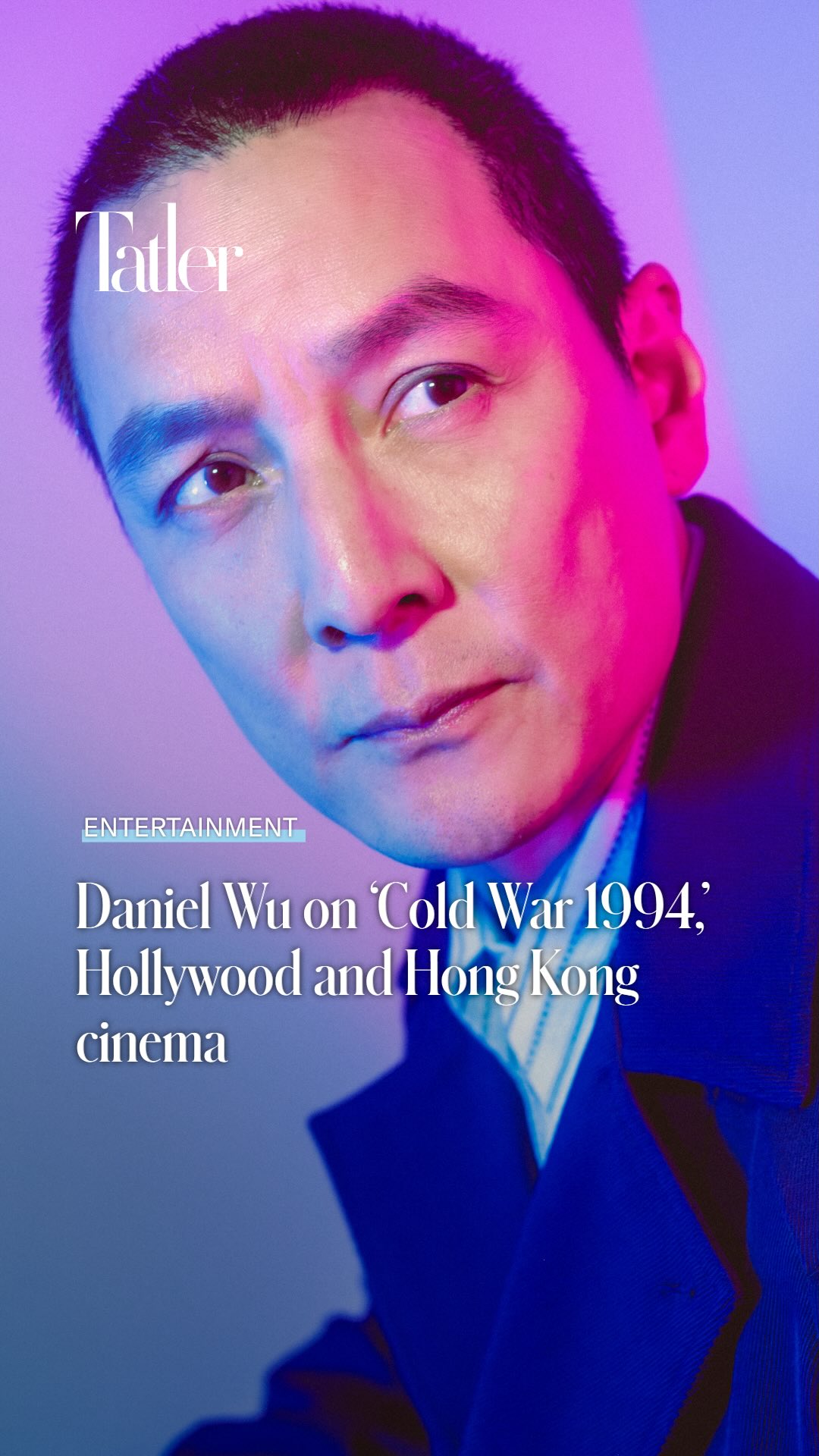
Daniel Wu (Photo: Chris Kammerud)
1 / 1
Set three years before the Handover of Hong Kong, it carries particular resonance for Daniel Wu, who flew back to Hong Kong from the US in 1997 to witness the historic event himself. Nearly three decades later, the Hong Kong-American actor returns to that period on screen as Peter Choi, deputy commissioner of the Hong Kong Police Operations, who finds himself navigating the film’s increasingly murky moral landscape.
It is also a homecoming of sorts for Wu, marking his return to Hong Kong cinema six years after Caught in Time (2020), the Hong Kong-Chinese crime action film based on the real-life crimes of Zhang Jun, who was dubbed China’s “number one outlaw.”
Don’t miss: From Hong Kong to Hollywood: Celebrating the indomitable actor Tony Leung

Above Daniel Wu at the New York Asian Film Festival, ahead of a special screening of ‘Cold War 1994’ (Photo: Naomi Bayas)
Above Daniel Wu accepts the Best from the East Award during the New York Asian Film Festival (Photo: Crystal Li)
Daniel Wu at the New York Asian Film Festival, ahead of a special screening of ‘Cold War 1994’ (Photo: Naomi Bayas)
1 / 2
While his career has long straddled both worlds—from Gen-X Cops (1999), New Police Story (2004) and Shinjuku Incident (2009) to Tomb Raider (2018), Reminiscence (2021) and Love Hurts (2025)—the three-time Golden Horse nominee has remained a distinctive presence across both Hong Kong and Western cinema, quietly building a career that has lasted more than two decades.
That return was celebrated at this year’s New York Asian Film Festival (July 10-26), where Cold War 1994 received a special screening following the world premiere in April, and Wu, the Best from the East Award—a fitting occasion to reflect on where Hong Kong cinema has been, where it is now, and why, despite having heard otherwise since the beginning of his career, he believes it will never die.
Read more: Eunice Tan on why Malaysian films struggle to break out globally—and how we can change that
Hong Kong cinema is always going to persevere; it’s the Hong Kong spirit, and we don’t give up.
You mentioned that Cold War 1994 is your return to Hong Kong cinema after six years. What was it that made you feel that this particular film was the right one for a comeback?
I never intentionally left Hong Kong film; I’ve always planned to do one project in Asia for a year and another in the United States for another year. Then COVID happened and took four years out, and I didn’t return to Asia during that time. There were offers to come back, but I just didn’t want to quarantine during that period—that was my biggest fear—and leave my family during such a crazy time.
But when I got the call from [producer] Bill Kong about Cold War, it just seemed so exciting to me because he’d pitched it to be “a great movie with three generations of Hong Kong actors”—right when you feel the Hong Kong film industry is—quote, unquote—dying, and big projects like this are coming back to bring it all back for us.
It’s exciting to join an already established film series, with Cold War and Cold War II being so successful, and now with a new generation of actors. That was what really got me interested in working on this: the opportunity to work with Terrance [Lau, who plays Tony Leung Ka-fai’s younger M.B Lee], as well as Louise [Wong, who plays Jodie Yuen, leader of the Lo Yuen triad].


Peter Choi marks a different stage of Wu’s acting career, presenting a different and bigger challenge to the actor (Photo: Edko Films Limited and Wanda Pictures Co Ltd)
1 / 3
It’s interesting that you say that Hong Kong cinema is dying, but for the longest time, I’ve always considered it an ecosystem of its own, still persevering after so many decades.
(Laughs) It’s funny, because I’ve heard that since the day I entered the industry [in the late 1990s]—things like, “This is a bad time in Hong Kong film,” and how “we’re not as good as before.” Not to mention, when I was younger, I’ve been told that I’m the last generation of Hong Kong actors, and that there won’t be anymore after me—which was a sad thing to hear, that there won’t be any other young, up-and-coming actors.
But I think that’s in comparison to the ‘80s and early ‘90s, when the industry was churning out 300 films a year. I don’t think we’ll ever go back to that in that respect, but otherwise, the thing about the Hong Kong film industry is that it will never die out.
Don’t miss: The extraordinary details of Rebekah Yeoh Hess and Lucas Hess’ two-day Kuala Lumpur wedding celebration
In the past couple of years, I’ve been coming back and meeting new directors, writers and actors from the so-called dying industry, and to see a fine actor like Terrance onscreen after having done well in Twilight of the Warriors, and to get the opportunity to work so closely with him—it’s really encouraging to see this new generation of people who are still passionate about telling stories on film.
Hong Kong cinema is always going to persevere; it’s the Hong Kong spirit, and we don’t give up.


From left: Hong Kong cinema heavyweights Louis Koo, Chow Yun-Fat and Aaron Kwok reprise their roles from the preceding ‘Cold War’ films (Photo: Edko Films Limited and Wanda Pictures Co Ltd)
1 / 2
In the past several years, while you were working largely in American productions, was there anything you learned from working in the US that you consciously brought back to Cold War 1994?
I’m usually the leading man in Asian projects, and you have a lot of responsibilities as a main character; you have to carry the whole plot. There’s a lot of things you have to do, and it becomes a little bit restrictive, in terms of acting. And, oftentimes, when I work in Hong Kong or mainland China, while I wouldn’t say it was a hindrance for me, language was something that I always had to think about.
Read more: Beyond the stage: 8 Asian films that turn William Shakespeare into cinematic gold
Whereas, in American projects, when I’m more of a supporting character, even the acting is a little bit different from that of a main character. Besides just focusing on making the characters interesting, it also allows me to work in English, without having that extra layer of thinking about the language, which is very liberating for me.
There is a freer style to my acting that I’d learned from working in the West, and coming back to Asian film, I’m able to take that looseness I developed while working in the US into my main roles.
That’s just the path of getting older as an actor; your preference changes and the roles that you want to play change too.
In comparison to when you first entered Hollywood all those years ago, what did you carry with you from Hong Kong cinema that you later realised was uniquely valuable?
Probably the speed and efficiency of having worked on a Hong Kong film set. We’ve worked in so many adverse conditions—from not having a trailer, and sitting on a sidewalk eating your rice box for lunch, to the speed and pace of working 18 hours a day—we can work in any kind of situation despite the time crunch.
So when I went to the States, nothing really bothered me there, because there’s nothing that I haven’t already been involved with. It made me very adaptable to the US film industry, flexible even as an actor, I would say. If this is what we have to do within this amount of time, we’ll get it done.
See also: Home tour: An enchanting Los Angeles home inspired by Luca Guadagnino’s ‘Call Me by Your Name’

Above Wu at the NYAFF press conference with NYAFF executive director Samuel Jamier (left), and Maisie Ho, director of the Hong Kong Economic and Trade Office in New York (Photo: Naomi Bayas)

Above Wu has remained a distinctive presence across both Hong Kong and Western cinema, quietly building a career that has lasted more than two decades (Photo: Naomi Bayas)
Wu at the NYAFF press conference with NYAFF executive director Samuel Jamier (left), and Maisie Ho, director of the Hong Kong Economic and Trade Office in New York (Photo: Naomi Bayas)
1 / 2
I’m surprised you weren’t in any of the action sequences in Cold War 1994, seeing that you are a racecar driver and a practising martial artist. Granted, Peter Choi is a senior police officer, and car chases and hand-to-hand combat aren’t part of his milieu, but it must’ve been difficult to watch some of those scenes unfold without being the person in the middle of the action.
(Laughs) When I was younger, I would have definitely jumped on all the action Terrance did for his role in this movie. Back then, it was more of a physical challenge, which I’ve already dabbled with in the many young policeman and detective roles in the past.
But coming back after six years, I’m a different person; I’m middle-aged now, I’m married and I’m also a father. So, the characters I take on now are completely different from those I played before I left. I think that’s just the path of getting older as an actor; your preference changes and the roles that you want to play change too.
Don’t miss: 8 Hong Kong action movies that changed cinema forever
Peter marks a different stage of my career. He presents a different and bigger challenge for me, because I’ve never played this kind of role before: a head of police who is also making these morally ambiguous decisions is just as interesting.
Subtle characters that make dubious choices—they are much more interesting to me these days than those who go through big, swooping changes; and Peter is a cool transition for me to do something I hadn’t done before.


Wu speaking at the Q&A session after a special screening of ‘Cold War 1994’ (Photo: Crystal Li)
1 / 2
Did you ever try to convince [director] Longman Leung to throw some physical action your way?
Well, actually, in the sequel, Cold War 1995, there’s a couple of action scenes for Peter, so I was able to have some fun there. Personally, I don’t see the Cold War films as action films, but the point of them being Hong Kong films is that the action can’t disappoint, and I think Longman did a really good job with the dramatisation of the action sequences. They are set pieces that can make any Hong Kong viewer proud, you know, and they play a part in the crescendo of the storylines, bridging the gap between the existing prequels.

As senior writer at Tatler Homes, Celeste Goh covers architecture, interior design, luxury homes and emerging design trends. She also serves as digital content manager for Tatler Malaysia, overseeing the brand’s digital editorial strategy and social media presence across its platforms.
Curated for you
The stories, profiles, and cultural moments featured on our Instagram feed