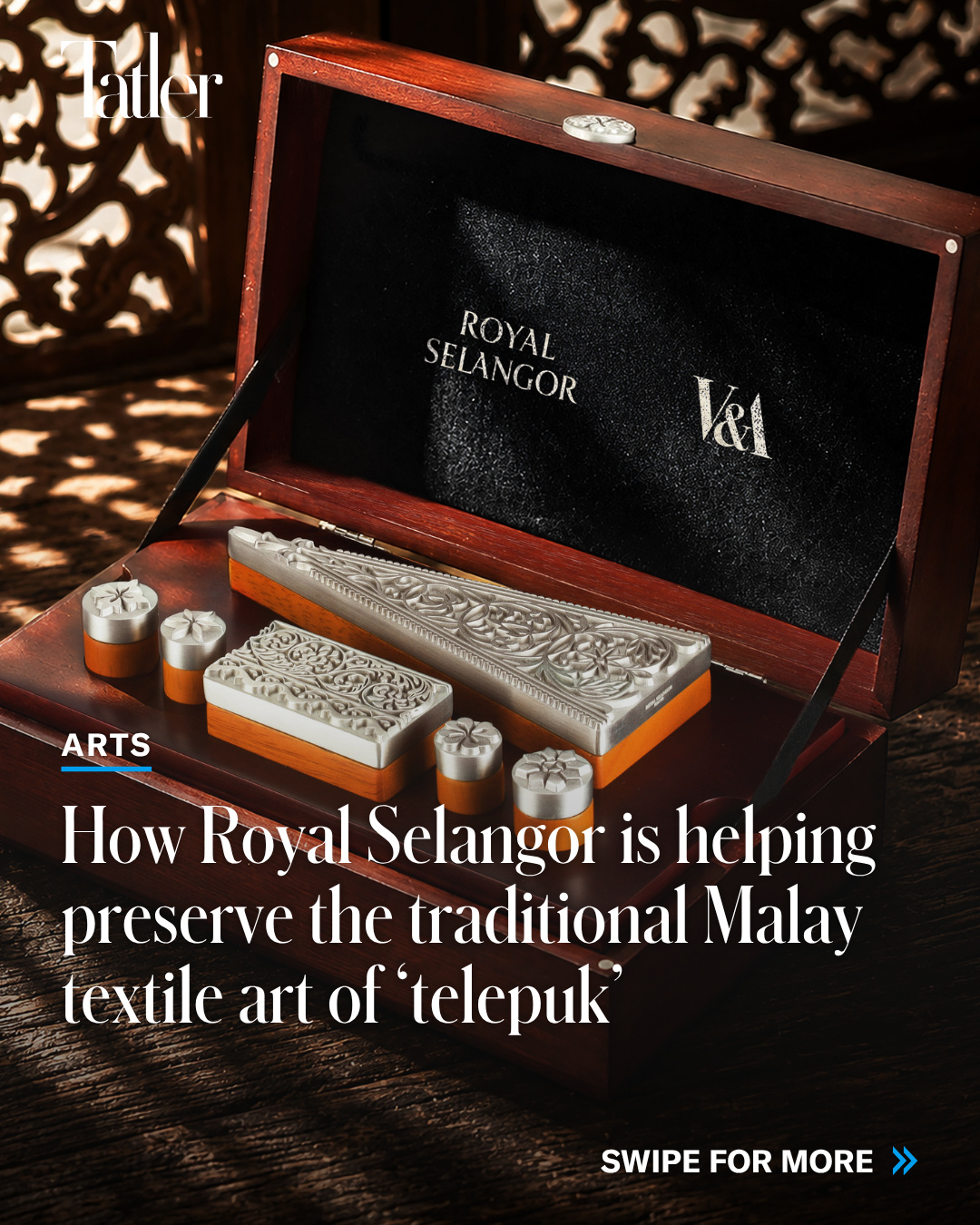
Cover The Royal Selangor Telepuk Collector’s Set, featuring six considered interpretation of the historic ‘telepuk’ woodblocks
The Royal Selangor Telepuk Collector’s Set, featuring six considered interpretation of the historic ‘telepuk’ woodblocks
1 / 1
At Royal Selangor’s ‘Telepuk: The Imprint of Heritage’ exhibition, a traditional Malay textile art is reinterpreted through historic woodblocks and contemporary pewter craftsmanship, bringing renewed attention to the skills and knowledge behind the centuries-old practice
There was a time when gold gleamed across the finest woven cloth of the Malay courts. Applied by hand over intricate patterns imprinted onto fabric, the precious metal transformed textiles into garments befitting royalty and ceremonial occasions.
This form of textile art is known as telepuk, a traditional Malay craft that draws on a chain of interconnected disciplines: from weaving and cloth preparation to woodcarving, woodblock printing and the delicate application of gold leaf. Together, these techniques translate the beauty of the natural world into elaborate floral forms, scrolling tendrils and geometric patterns, finished with a distinctive gilded lustre.
Read more: Why titanium timepieces are finding favour with watchmakers and wearers alike


The ‘Telepuk: The Imprint of Heritage’ exhibition at the Royal Selangor Visitor Centre in Setapak, Selangor
1 / 3
Today, telepuk is less familiar beyond historical collections and specialist research, with fewer practitioners carrying its knowledge forward. Preserving the finished textiles alone is not enough; the skills that brought them to life must also be understood, practised and shared.
See also: A night of style, fashion and glamour: Tatler Most Stylish Malaysia 2026
It is this distinction between preserving an object and sustaining the knowledge behind its creation that lies at the heart of Telepuk: The Imprint of Heritage, an exhibition by Royal Selangor at its Visitor Centre in Setapak, Selangor.
Opened on August 27, 2026 in conjunction with Malaysia’s 69th National Day celebrations, the exhibition brings together historic textiles, carved woodblocks, tools, materials and demonstrations to illuminate the artistry behind the craft.


Above ‘Telepuk’ is a traditional Malay textile art that draws on a chain of interconnected disciplines
‘Telepuk’ is a traditional Malay textile art that draws on a chain of interconnected disciplines
1 / 1

Above The techniques translate the beauty of the natural world into elaborate floral forms, scrolling tendrils and geometric patterns

Above Applied by hand and imprinted onto fabric, the intricate patterns transformed textiles into garments befitting royalty
The techniques translate the beauty of the natural world into elaborate floral forms, scrolling tendrils and geometric patterns
1 / 2
The initiative grew from the research and advocacy of the Langkasuka Movement, whose work caught the attention of the homegrown pewter maker. The resulting collaboration brings together a wider network of heritage institutions, researchers and artisans, including Galeri Diraja Sultan Abdul Aziz, Jabatan Muzium Malaysia, Perbadanan Adat Melayu dan Warisan Negeri Selangor, Seni Ukir Bakawali and Yayasan Hasanah.
Don’t miss: New quarters: inside the restoration of 1926 Heritage Hotel Penang
Among the exhibition’s most significant references is a historic series of 77 telepuk woodblocks, or sarang, now held at the Victoria and Albert Museum (V&A) in London. Dating from 1920 to 1923 and formerly owned by the Sultan of Selangor, the collection offers a tangible connection to the craft’s past.
“The V&A collection opens an important window into the relationship between Malaya and Britain during the early 20th century,” say representatives of the Langkasuka Movement. “Their journey from the Selangor royal milieu to a major British museum reflects the movement of objects, knowledge and cultural interests during the colonial era.”


A demonstration of the traditional textile art of ‘telepuk’ using gilded gold leaf
1 / 3
The opportunity to study these woodblocks offers a renewed connection to the cultural traditions from which they emerged. For Royal Selangor, it also presents an opportunity to reinterpret telepuk through a different material while retaining the character of its historic motifs.
Drawing on six of the historic blocks, the resulting Telepuk Collector’s Set comprises six pewter plaques that adapts the traditional method of textile gilding with gold leaf.
Mounted on a wooden backing that references the material of the original blocks, the designs feature Bunga Melati, two interpretations of Bunga Tanjung Pecah Lapan, Awan Larat, Bunga Cengkih and Pucuk Rebung—each preserving the relief and intricate details of the original carvings.
The collection also includes two Heritage Telepuk coasters, translating the motifs into objects for everyday use.
Read more: Monumental museums: 7 recently opened and forthcoming institutions redefining cultural architecture
Besides that, visitors can explore the craft further through a special-edition pewter bowl-making workshop at the School of Hard Knocks, where the Foundry has also introduced two new moulds inspired by the V&A collection, adapting selected motifs into pieces for workshops, including a necklace and keychain.
Above The Royal Selangor Telepuk Collector’s Set, featuring six considered interpretation of the historic ‘telepuk’ woodblocks
The Royal Selangor Telepuk Collector’s Set, featuring six considered interpretation of the historic ‘telepuk’ woodblocks
1 / 1
Yet, the significance of the project extends beyond its contemporary interpretations. It raises a larger question about what it means to revive a heritage craft: how can knowledge passed down through generations remain relevant to those encountering it for the first time today?
In this conversation with Tatler Malaysia, Hilda Razali, head of global marketing at Royal Selangor, alongside En Abdul Razak Aziz and Puan Intan Jailani of the Langkasuka Movement discuss the origins of the initiative and the work still needed to ensure that this distinctive art remains part of Malaysia’s living cultural heritage.
See also: Home tour: a Dutch colonial home in Surabaya, Indonesia rejuvenated with a modern rear extension

Above The six pewter plaques preserve the relief and intricate details of the original carvings
The six pewter plaques preserve the relief and intricate details of the original carvings
1 / 1
What makes telepuk particularly important to preserve today, and why was this the right time to bring the craft back into public consciousness?
Hilda: Our interest was sparked when we first encountered the research of the Langkasuka Movement. Their dedication to documenting and reviving telepuk showed us that this was not merely a decorative art form, but a crucial part of our shared cultural inheritance. Through these textiles, we see a history of gilding that spans the Nusantara and connects with broader Asian traditions, demonstrating that the appeal of telepuk extends far beyond geographical borders.
Like pewtersmithing, telepuk relies on tactile knowledge passed down through practice. For 141 years, Royal Selangor has depended on skills handed down from one generation of artisans to the next. Heritage stays relevant only when its techniques are actively used, shared and developed. We felt a responsibility to support the preservation of this craft and safeguard the deep body of knowledge behind it.
Don’t miss: History unravelled: textile artist Marcos Kueh explores what it means to be Sarawakian
Langkasuka: When we first encountered telepuk, we were struck by its beauty. As we delved deeper, however, we discovered a much larger story—of artisans, royal traditions, textiles, woodcarving, materials, motifs and techniques passed down through generations.
Telepuk is living knowledge, not simply something to be preserved in museums. If the knowledge, skills and stories behind an art form are no longer practised or understood, the heritage itself is at risk of disappearing. For us, the revival of telepuk has therefore become a responsibility: to research, document and share it, and, most importantly, to help ensure that its knowledge continues to live.


The pewter plaques adapt the traditional method of textile printing upon fabric
1 / 3
Both telepuk and pewtersmithing rely on knowledge acquired through practice. What did translating the principles of telepuk into pewter reveal about the similarities and differences between the two craft traditions?
Hilda: Telepuk connects distinct disciplines, requiring the combined skills of weavers, woodcarvers, gilders and tailors. A single piece of cloth holds layers of knowledge about materials, tools and symbolism.
This multidisciplinary nature resonates with pewtersmithing, where design, mould-making, casting and hand-finishing rely on hands-on experience. Whether working with textiles or metal, both traditions require precision and structural balance, transforming raw materials into refined objects.
Read more: A history untold: the timeless allure of Malaysian batik

Above The collection also includes two Heritage Telepuk coasters

Above A reinterpretion of ‘telepuk’ through a different material
The collection also includes two Heritage Telepuk coasters
1 / 2
Which aspects of the traditional knowledge of telepuk are most at risk of being lost today, and what needs to happen to ensure they are passed down?
Langkasuka: Authentic telepuk involves four interconnected Malay craft practices: tenun (weaving cloth), gerus (calendaring cloth), ukir (carving the mould motifs) and telepuk (imprinting gold leaf).
Of these four, gerus—the centuries-old practice of calendaring and burnishing cloth—is highly endangered and on the brink of extinction due to modern production shifts and cultural displacement.
Cultural institutions and researchers must continue documenting the practice, while efforts should be made to identify and train artisans. We should regard gerus not in terms of its commercial viability, but as an invaluable part of living history, closely tied to regional identity.

Above Visitors can explore the craft further through a special-edition pewter bowl-making workshop at the School of Hard Knocks

Above Inspired by the V&A collection, Royal Selangor introduced two new moulds with motifs adapted into a necklace or a keychain
Visitors can explore the craft further through a special-edition pewter bowl-making workshop at the School of Hard Knocks
1 / 2
Beyond this exhibition and campaign, what would you hope to see happen for telepuk as a living craft practised, studied and appreciated by future generations?
Hilda: We hope this initiative encourages a new generation of creatives, researchers and visitors to explore, study and celebrate Malaysia’s traditional crafts. For telepuk to survive, it must be actively practised, shared and renewed. We want to ensure it is recognised not merely as an art form of the past, but as a living expression of ingenuity, identity and cultural memory.
Don’t miss: Cory Richards on how his extreme explorations led to a brand partnership with Vacheron Constantin
Langkasuka: Royal Selangor has a unique ability to translate heritage into contemporary forms and bring traditional craftsmanship to audiences beyond the usual cultural and museum circles. If this exhibition encourages more people to ask questions, discover telepuk, appreciate the artisans behind it and perhaps even take up the craft themselves, its impact will extend far beyond the gallery.
We hope the partnership can continue beyond the exhibition through public programmes, educational initiatives, publications, storytelling, workshops, collaborations with young designers and artisans, and perhaps new interpretations of telepuk-inspired motifs and techniques.
‘Telepuk: The Imprint of Heritage’ is open at the Royal Selangor Visitor Centre in Setapak until December 31, 2026. A satellite exhibition will run at the Royal Selangor Pavilion KL Flagship Store from October 19 to December 31, 2026
NOW READ
How independent artisan Jessie Koh found her calling making jewellery
Credits
Photography: Royal Selangor

As senior writer at Tatler Homes, Celeste Goh covers architecture, interior design, luxury homes and emerging design trends. She also serves as digital content manager for Tatler Malaysia, overseeing the brand’s digital editorial strategy and social media presence across its platforms.
Curated for you
The stories, profiles, and cultural moments featured on our Instagram feed