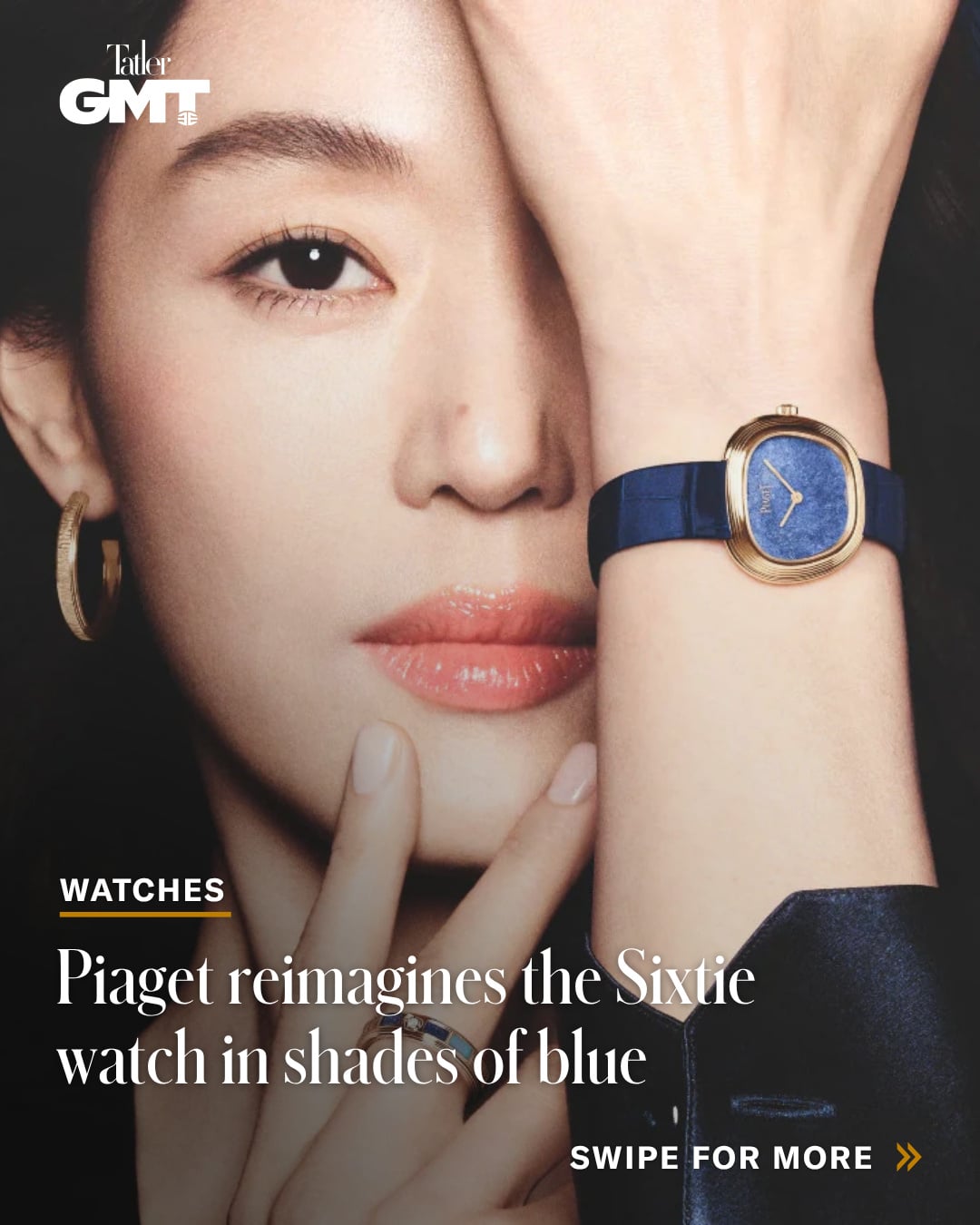
Cover South Korean actress and Piaget global ambassador Gianna Jun wears the Piaget Sixtie in rose gold with a blue quartz dial, paired with Possession Decor Palace hoop earrings in rose gold and a Possession Vibrant Decor Palace ring in rose gold set with turquoise, sodalite, dumortierite and a diamond.
South Korean actress and Piaget global ambassador Gianna Jun wears the Piaget Sixtie in rose gold with a blue quartz dial, paired with Possession Decor Palace hoop earrings in rose gold and a Possession Vibrant Decor Palace ring in rose gold set with turquoise, sodalite, dumortierite and a diamond.
1 / 1
With two new interpretations of the Sixtie, Piaget revisits the free-spirited glamour of the 1960s, recasting one of its most distinctive jewellery watch silhouettes in deep blue
There was a period in Piaget’s history when telling the time seemed almost secondary. Watches appeared as ornaments on long sautoirs, were worked into elaborate gold cuffs and assumed unconventional forms more readily associated with jewellery than traditional watchmaking. Dials came alive in vividly coloured ornamental stones, while gold was engraved, textured and sculpted until the line between watch and jewellery all but disappeared.
That creative fervour reached a high point during the 1960s and ’70s, and it is this chapter that Piaget revisited with the Sixtie, introduced at Watches and Wonders in 2025. Its name nods both to the decade that inspired it and to time’s recurring sixties—60 seconds to a minute, 60 minutes to an hour. Unlike a conventional round or rectangular watch, however, the Sixtie is defined by its softly proportioned trapezoidal case, drawn from Piaget designs of the period.
The origins of this distinctive silhouette can be traced to 1969, when Piaget unveiled its 21st Century collection at Basel Fair in Switzerland. Conceived by a creative team that included designer Jean-Claude Gueit, the collection challenged conventional ideas of what a watch could be. Timepieces became sautoirs, cuffs and richly worked bracelets, while unexpected forms—including the trapezoid—recast the watch as a piece of jewellery. Colour was equally important, with ornamental stone dials becoming one of Piaget’s most recognisable signatures.
In case you missed it: A Lange & Söhne returns to the classics with the 1815 Up/Down


Above Piaget Sixtie in rose gold with a silvered solar satin-brushed dial.
Piaget Sixtie in rose gold with a silvered solar satin-brushed dial.
1 / 1
The Sixtie distils that spirit into something distinctly contemporary. At 29mm across and just 6.5mm thick, it has the proportions of a jewel rather than an imposing wristwatch. Its 18K rose gold case is framed by finely chiselled gadroons, lending texture and definition to the softly curving trapezoidal form. The detail also creates a subtle kinship with another of Piaget’s shaped icons, the cushion‑shaped Andy Warhol watch, while the Sixtie’s gentler proportions give it a character all its own.
For 2026, Piaget shifts the mood. On these two new references, the Sixtie leaves its precious metal bracelet for a deep blue alligator strap. It sounds like a relatively simple switch, but it changes how the watch reads on the wrist: where the bracelet versions lean emphatically into jewellery, the strap lends the Sixtie some of the ease of a classic dress watch while retaining its unconventional silhouette. A new trapezoidal pink rose gold ardillon buckle, decorated with gadroons that echo those on the case, carries the detailing through to the clasp.
There are two interpretations, each making a different style proposition. The more understated pairs the blue strap with a silvered solar satin-brushed dial, golden hour markers and elongated Roman numerals at 12 and six. Against the warmth of the rose gold case, the cool silvered dial brings an elegant clarity, while the navy strap keeps the effect from feeling overly formal.

Above The watch’s richly veined blue quartz dial features natural variations, ensuring each one is unique.
The watch’s richly veined blue quartz dial features natural variations, ensuring each one is unique.
1 / 1
The second is unmistakably Piaget. Its blue quartz dial is richly marbled and veined with darker streaks, ensuring that no two appear exactly alike. Paired tonally with the blue alligator strap and contrasted against rose gold, the natural stone gives the Sixtie an almost monochromatic intensity. It also continues a design language Piaget has explored for decades: ornamental stones are not treated merely as embellishments, but become the face of the watch itself. The blue quartz follows the turquoise dial introduced with the Sixtie in 2025, extending that dialogue between the contemporary collection and Piaget’s famously colourful past.
Both watches are equipped with Piaget’s manufacture 57P quartz movement and are water-resistant to 50m. Their compact proportions allow them to sit easily alongside bracelets and bangles, while the distinctive silhouette gives either enough presence to stand alone—a versatility particularly suited to the increasingly fluid boundary between watches and jewellery.
Topics

Annabel Tan is the Editor of Watches and Jewellery at Tatler Singapore, where she covers all things luxury timepieces and fine jewellery across both print and digital platforms. She is also the Editor of Tatler GMT Singapore, a role that deepens her fascination with the ever-evolving world of watchmaking. Outside of work, she’s usually on the hunt for her next favourite watch that she can’t afford, planning her next beach getaway, or catching up on the latest Formula 1 race.
Curated for you
The stories, profiles, and cultural moments featured on our Instagram feed