

Cover Chanel Les Beiges Summer in Grand Style 2022. Image courtesy of Rustan's The Beauty Source
Chanel Les Beiges Summer in Grand Style 2022. Image courtesy of Rustan's The Beauty Source
1 / 1
Tatler investigates how beauty brands from all over the world are standing for diversity and inclusion
Make-up counters used to be filled with items that catered only to the standard concept of beauty. In many parts of the world, for instance, having fair skin is deemed ideal, so there was an obsession for all-things whitening and a demand for products that complement this aspiration. It was also the norm to see cookie-cutter foundation shades—light, medium, tan—with no perfect match for those with irregular colouring, extremely light and dark complexion, rare undertones besides the usual yellow and pink, and those with varying skin conditions.
Nude shades of lipstick available were flattering only to those who belonged to the status quo; so if you don’t, there is a big chance you will never meet your MLBB (short for “my lips but better”) colour. The same goes for that perfect red lipstick. It’s either too bright, too cool or too warm, giving you not much of a choice. Eyeliners, face powders, nail polish, concealer and eyebrow makeup—they were all created gender-specific, primarily for women.
But beyond the lack of colour options as well as gender stereotypes, this situation in the beauty sphere has left a deep void for the underserved. Thus, it was inevitable that a loud call for inclusion and diversity would be heard—a movement that pushed the beauty industry to evolve progressively in recent years.
See also: How to do the Smoky Eye Like a Pro?: Makeup Experts Share Tips
In 2017, Rihanna launched Fenty, debuting with an impressive 40-shade foundation line through a campaign that touched many: Beauty for All. Without even mentioning the buzzword “inclusive” in its campaign, Fenty showed how beauty must be for everyone regardless of race, skin colour, undertone, skin condition and skin type. This campaign has caught global attention, with many women lauding Fenty for allowing them to find themselves and for giving them the belongingness they have so long been wanting. A solid proof was the viral social media post of Krystal Robertson, a woman with albinism, who finally found “a nice match” of foundation without making her look too orange. In Glamour, another viral post cited was that of Nyma Tang, who was happy to discover there is a shade for her “very dark skin with cool red undertones” within the Fenty foundation line.
In 2020, MAC senior artist Fatima Thomas formed the MAC Melanin Beauty Collective, a taskforce of Black MAC artists of various backgrounds aiming to advise and educate on Black beauty. This initiative was in line with the brand’s credo: beauty for all ages, all races and all genders.
See also: Get to Know Why Lipstick is Dubbed as the New Hottest Accessory


Above RMS Beauty's diverse colour range for every
skintone. Image courtesy of Rustan's The Beauty Source
RMS Beauty's diverse colour range for every skintone. Image courtesy of Rustan's The Beauty Source
1 / 1
In the Philippines, homegrown brands resolve the longstanding struggle of Filipinos when finding the right shade of cosmetics. Sunnies Face, for instance, released its flagship Fluffmatte lipstick, which gained a cult following for its morena-friendly palette as well as its lightweight formula that can withstand the hot, humid weather in the country.
Beauty for men has long been concealed under “grooming” but over the years, more and more brands have joined the gender-neutral wagon. Life and business partners Matthew Malin and Andrew Goetz, the brains behind genderless skincare Malin+Goetz, share that they came up with their concept 17 years ago in New York. “We returned to the original inclusive concept of the apothecary, where products were always gender neutral, and where quality formulations meant it worked for just about everyone. New York is wonderfully saturated with so much diversity—the perfect template for a brand designed to be for every person, skin type, ethnicity and every extreme season,” says Goetz.
Read more: Male Make Up: 7 Celebrities That Prove Men Can Rock the Look

Above Genderneutral
skincare essentials from
Malin+Goetz. Image courtesy of Rustan's The Beauty Source
Genderneutral skincare essentials from Malin+Goetz. Image courtesy of Rustan's The Beauty Source
1 / 1
According to Rustan’s The Beauty Source (a distributor of several beauty brands in the Philippines including Chanel, Malin+Goetz, RMS Beauty, and Mario Badescu among others), a lot of brands have also started to expand their lines to carry male personal or beauty products. Most campaigns feature people of all colours and ethnicity to promote diversity in the beauty industry.
The phenomenal Korean wave has also eased the gender divide in the domain of beauty. In fact, according to a study conducted by sociologist Rupsikha Baruah, South Korea is considered to be “the pioneer of the male beauty cultural revolution” where the idea of “soft masculinity” emerged as a result of the “Flower Boy” or kkonminam trend. The kkonminam is described as a man with soft appearance, smooth skin and wearing fashionable (often unisex) clothes and make-up. Think BTS and the many times they broke gender norms with their fashion and beauty choices. This trend also partially explains why international labels have tapped South Korean celebrities as their endorsers like Rowoon for Estee Lauder, Song Kang for Benefit, Gong Yoo for Tom Ford Beauty and Lee Dong Wook for Chanel. It is a move that encourages consumers to use cosmetics regardless of gender.
See also: Seven Decades of Extraordinary: Rustan's Looks Back with Gratitude
Dominique Cojuangco, one of the co-founders of the Manila-based online beauty e-commerce platform The Collective, sees a strong representation of new and upcoming brands with values aligned to inclusivity. “This is something that is hard-fought, given the tendency of consumers to look to the traditional, long-standing brands. It is at times a challenge, but one we are willing to take head-on,” she says.
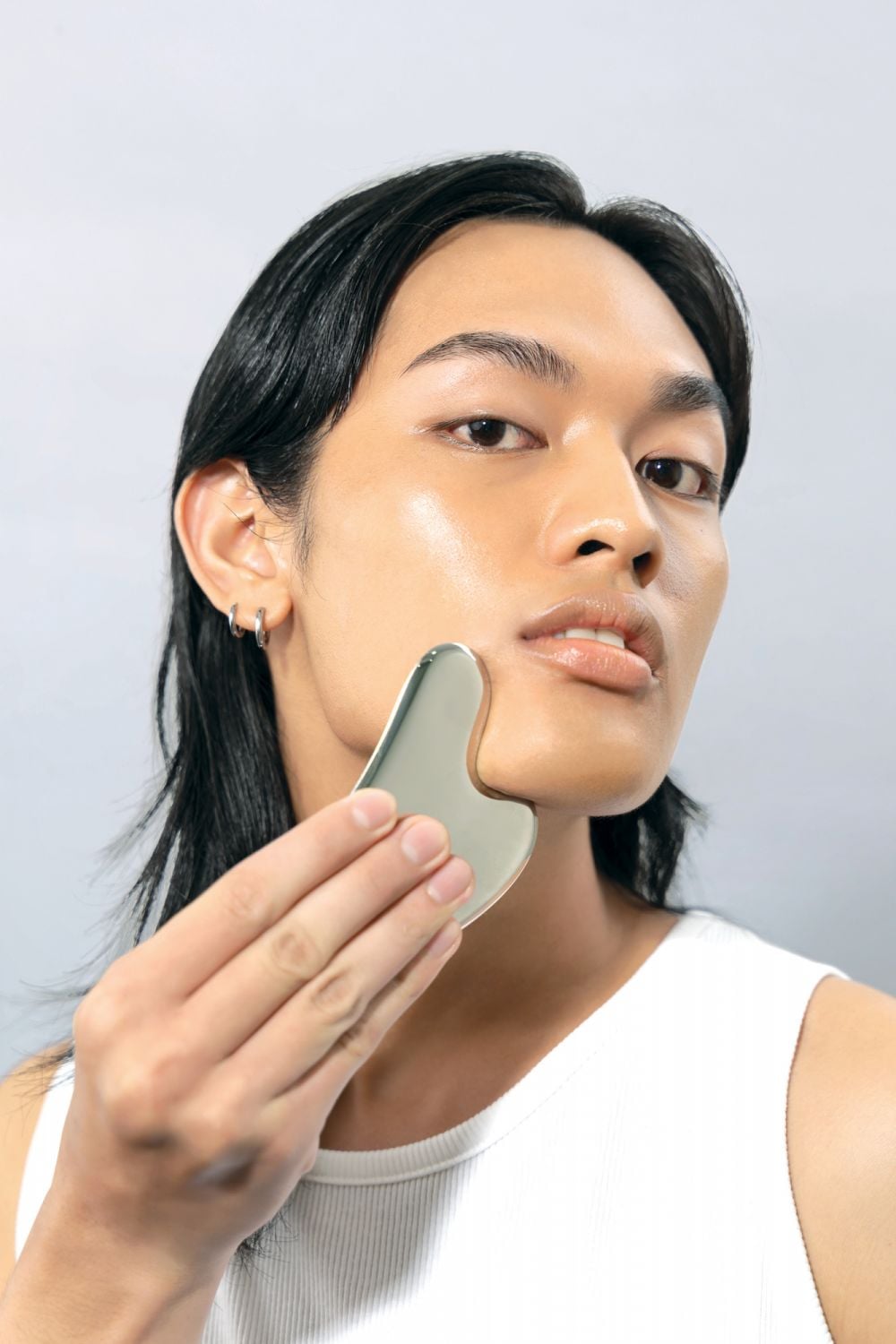
Above The Collective’s
Gua Sha antimicrobial
beauty tool
The Collective’s Gua Sha antimicrobial beauty tool
1 / 1
While there is truth in the saying that “beauty is in the eye of the beholder”, it is inspiring to know that the beauty industry is being progressive and finally addressing issues on diversity and inclusivity. Now, no one is left behind because beauty is, and should be, for everyone.
NOW READ
Exclusive: A Conversation Between French Actress Marion Cotillard and Chanel's 'Nose" Olivier Polge
Check Out The Collective, the Beauty E-commerce Platform Co-founded by Dominique Cojuangco
How do Korean Actors Stay Fit? Workouts of Gong Yoo, Hyun Bin, and More, Revealed

Whether on assignment or not, Maritess is always on the lookout for off-the-beaten-path destinations as well as the yummiest finds in the Philippines and abroad. In 2020, she plunged into the black hole of Korean la la land. Follow her escapades at @matetreyes.





