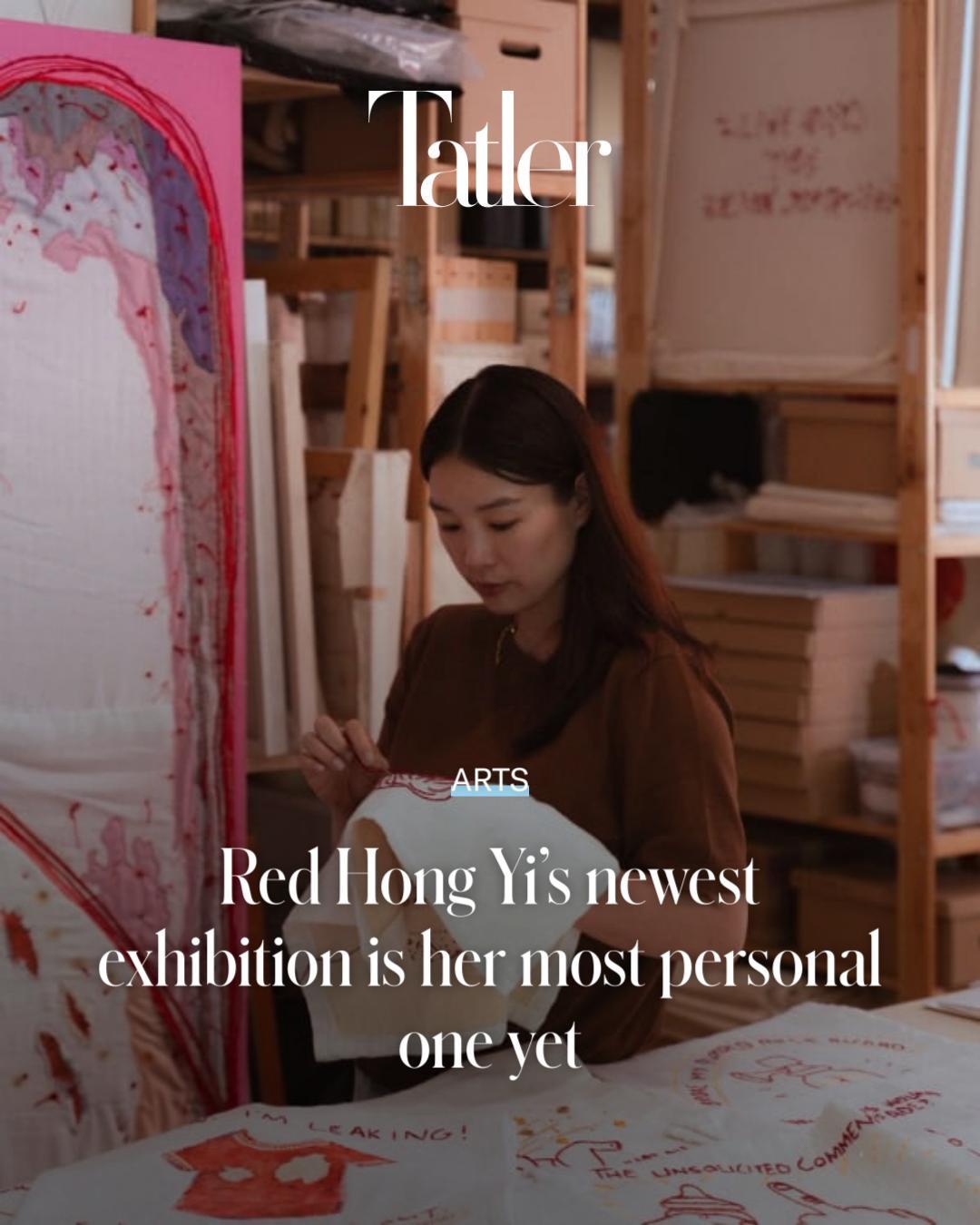
Cover The artist, Kara Inez, poses alongside her works (Image: courtesy of Kara Inez)
The artist, Kara Inez, poses alongside her works (Image: courtesy of Kara Inez)
1 / 1
Defying patriarchal norms and beauty standards, Kara Inez‘s empowering art challenges societal expectations, inspiring women to embrace their bodies and speak their truths
Conversations about women’s bodies have existed for millennia—from discussions about the ideal “body type” of different eras to societal expectations of clothing and presentation. Despite significant progress in women's rights, certain topics like women’s sexual health, menopausal care, gender wage gap, diversity, inclusivity, and the impact of patriarchal systems on society are only now receiving in-depth attention in the 21st century.
Nevertheless, women’s bodies remain somewhat hostage to patriarchal systems that view them as taboo or best kept hidden. Conditions such as postpartum depression, polycystic ovarian syndrome, fibroids, and endometriosis, as well as natural phenomena like body hair, menstruation, and menopause, still face a lack of understanding and acceptance in certain societies. Recently, the revelation of birth control pills’ serious, detrimental effects on women has further highlighted this issue.
Malaysian artist Kara Inez’s works, reflect these pertinent subjects. Her exhibition, titled (M)othered Meat, held at The Backroom Gallery, is a selection of past and present works of different mediums. From silicone sculptures with hair to a performance piece displayed on an old television set, Inez’s work is an intimate exploration of the female experience. She creates visceral assemblages of cultural objects unique to her home country and sculpts bodily forms that embrace the abject within a feminist aesthetic.
Drawing inspiration from the “Monstrous Feminine,” a term coined by author Barbara Creed that challenges the victimisation of women in the horror genre through the male gaze and rejects one-dimensional portrayals of women, Inez delves into the oppressive patriarchal systems entrenched in cultural traditions surrounding the taboo topic of the female body.
The Pontianak, one of Inez’s muses featured in the exhibition, is a vampiric entity from Malaysian and Indonesian folklore that the artist has portrayed as a symbol of resistance against the patriarchal paradigm of the idealised female.
To discover the behind-the-scenes of Inez's thought-provoking work, read below.
Related: Building a sisterhood—The social changemakers reshaping the narrative around women’s issues
Why the Pontianak in particular?
I was actually inspired by Yee I-Lann’s Like the Banana Tree at the Gate in 2016! She portrayed the Pontianak as a feminist icon instead of the symbol of horror that many associate her with. Instead of something to be reviled and feared, Yee’s Pontianak was, to me, a symbol of empowerment that rebelled against the system, who took control of her own sexuality and is sure of her place in society.
And for me, I wanted to embody this spirit of defiance through my sculptural work. I wanted to present the monstrous feminine in its most visceral and grotesque to pay homage to the natural, corporeal female body.
The Pontianak to me, I think, is a character created to be feared, because she represents the anxieties of the Malaysian patrilineal system. Instead of stereotypical female archetypes, like the ideal wife or the ideal mother, she represents the women who own the autonomy over their bodies as well as their behaviours. Going back to Yee's work, she repositioned the Pontianak in such as way that is relatable to the contemporary Malaysian woman, demythologising the character.
Visually, your works are quite a shocking sight—talk to me about the thought process behind your sculptures.
I wanted to move away from what suited the male gaze; I didn’t want it to be beautiful because human bodies aren’t necessarily the most pleasant experiences.
I wanted to challenge the toxicity of the “ideal” body image because I believe that moving away from the traditional representations of beauty is important for society to acknowledge the distinction between the biology of the female body and the social inscriptions that dictate what it should look like.
Society at large isn’t aware of this cultivated construct that imposes unrealistic standards on the female body. By using monstrous imagery in my sculptures, (M)othered Meat was my way of severing that connection between fantasy and reality, creating extensions of the body of Malaysian women that is seen as ‘other’ or ‘abnormal' in the lens of a patriarchal system.
See also: What women should know about freezing their eggs in Malaysia


The exhibition layout for "(M)othered Meat" at The Backroom Gallery KL
1 / 4
Other than giving people a reality check, what else was this exhibition intended for?
To create a safe space for women to speak as women and to describe the female experience as truthfully as I could to accurately represent the female image to separate it from the oppressive image conjured by patriarchal language.
See more: Why Women Aren’t Winning At Health (But Can): An exclusive book extract
How long did it take to put the entire thing together? And what was the concept behind the exhibition’s layout?
I’m actually doing my master’s [in fine art] now, so to be honest—it was such a mad dash to get everything in order while balancing my assignments. When Liza (founder and director of The Backroom Gallery) asked how I envisioned the set-up of the exhibition, the first thing I said to her was that I wanted it to look like an old auntie’s house.
And—hear me out—I know it sounds a little out of left field, but basically, I imagined the an older woman who lived in an ancient house, full of vintage furniture that she might have inherited from generations past; as time goes by, the furniture gets visibly worn down, as though they’re made to carry and endure the heavy burden experienced by the women of each generation. And when the woman passes on, she continues to hold onto that burden even in her grave because there’s no one left to carry it, nor does she want anyone else to carry it because, well, maybe they’re her darkest secrets. And the artworks, or the little "monsters" that appear throughout the corners of the house, can also allude to the generational trauma that have been passed down and inherited by the women confined to a cycle of burden and suffering.
ICYMI: Common struggles faced by new mothers and treatments that can ease postpartum problems
Talk to me about the performance piece displayed at (M)othered Meat.
Oh! It wasn't so much a performance piece as it was a series of interviews that I did about four years ago while I was still in Singapore. It was a side project where I needed models to create silicone moulds for my wearable sculptures, which were intended to be hairy and hyperrealistic as I wanted to address the beauty ideals affecting our society. The major inspiration behind my wearable sculptures was because when I brought the topic of body hair up, a guy told me, unsolicited, to just “go for waxing lah”.
It involved speaking with women from all walks of life, most of whom were strangers at the time, which took place as these women’s body parts were being moulded. We talked about our personal stories about how the concept of idealised beauty has affected our relationship with our bodies and how the media has played a part in perpetuating messages that have affected our perception of beauty. We also talked about how important it is for women to feel beautiful, how we go through the traumatic experiences reserved for private spheres alone and are unable to openly discuss about them.
Can you imagine a world where women really, truly felt beautiful inside and out? Where they didn't need to worry about what they looked like, what they wore, or what they ate? It would be so beautiful—and I wish people could see that.
By featuring this video in public, the point wasn't just to provide viewers an insider's look to what is expected of us by society when it comes to our appearance and behaviours, but to ensure that women who resonate with these interviews don't have to feel alone and suffer in silence.
See more: 5 inspiring ladies on creating a better future for women in Malaysia
What were the biggest takeaways from the experience of creating these sculptures and exhibiting them in public?
That there were so many people who experienced the same things as I had. Before I delved into sculpture, I was painting and then doing performance art as a way of conveying my anxieties, my fears, as well as the troubles that I was facing at my lowest point.
I wanted to relay that experience properly because while everyone’s personal battles are so different from one another, there are certain points which we can all relate to. Messages came pouring in when I put my performance pieces up on my YouTube, and they were telling me about how no one really talks about these issues that women faced—it made me realise that I had a voice and that if I used it, it affected this change, no matter how minuscule.
That’s also what I want for others to take away from my exhibition as well as my pieces. That we don’t have to face these issues alone, that we can talk about it, and that we don’t have to feel ashamed for doing so.
Read also: Opinion—We can work together to empower women in leading social change
(M)othered Meat will run till July 31st at The Backroom Gallery, located at The Zhongshan Building in Kampung Attap. To learn more, visit The Backroom Gallery’s Instagram page or the artist’s Instagram, @karzmarz, and her website at http:/karainez.com.
NOW READ
March Cover Story: Two mothers fight for equal citizenship not over yet
Afghan refugee director Saleh Sepas on creating opportunities with theatre in Malaysia
Credits
Images: courtesy of The Backroom Gallery


Usually found at home and one with her couch, Koy Yi would either crack open a good book or game in her spare time to wind down after a long day. She also loves to scour art conventions and book fairs alike when she's able, collecting art books of all regions to gain inspiration for her own illustrations. With a keen interest in people and the stories they tell, she enjoys a good talk and a good laugh (preferably over food). Follow her on her Instagram @peiyi57.
Curated for you
The stories, profiles, and cultural moments featured on our Instagram feed