

Cover Photo: Instagram / @Versace
Photo: Instagram / @Versace
1 / 1
The fashion importance of platform heels goes beyond style as it's become a testament to these trying times
After two years of donning "comfort clothes", not to mention lounge slippers and flats that abound, many have finally stepped out of their homes in their highest heels—a shoe that is "by design, uncomfortable".
People have found places to let loose in their best looks with the world gradually opening up. Recently, celebrities like Ariana Grande, Olivia Rodrigo, Zendaya, Dua Lipa, and even Bowen Yang have hopped on the killer heels trend, most of them wearing Versace's platform heels from the fall-winter 2021 collection. Since then, other brands have released their own variations.
See also: Sneaker Culture In The Philippines: What's With The Obsession With These Thousand-Peso Shoes?
It may be that wearing ultra-high heels reflects our departure from the comfort zone—giving us a sense of control and power—after being confined for quite some time, ultimately making its return unsurprising.
The history of the platform heels, after all, shows its association with power.
Crafted with a thicker base than typical heels under the sole, the platform heels were worn as early as the 15th century in Venice. The height of what was then called a "chopine" is associated with the level of one's nobility.


Above Photo: The Metropolitan Museum of Art
Photo: The Metropolitan Museum of Art
1 / 1
Some earlier versions of the chopine, which are displayed at the Bata Shoe Museum in Canada, are made of wood that is covered in silk velvet and has a height of five and a half inches.
See also: The Ascent and Decline of the Marikina Shoe-making Industry
However, historians believe that the platform heels originated from Turkish women's bathhouse as they wore what is known as the "Nalin" which are clogs made of wood and are worn for practical uses. The height of the Nalin also represents the hierarchy in their society.
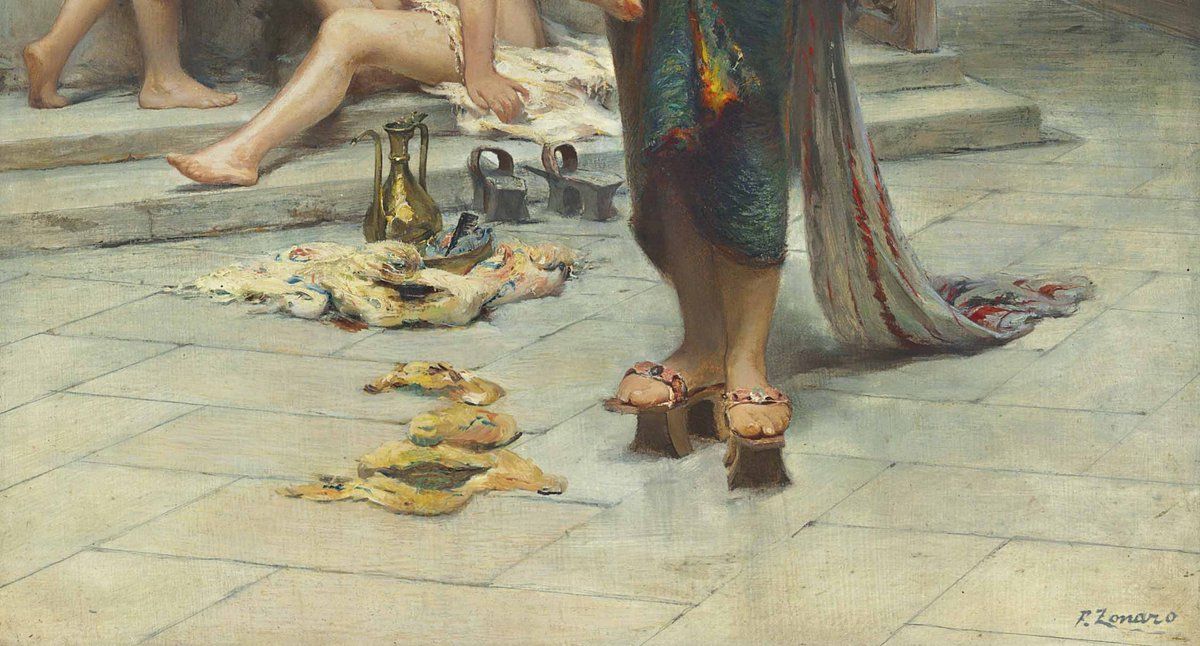
Above Photo: Nihat Karem A / Twitter
Photo: Nihat Karem A / Twitter
1 / 1
Much later, the platform heels rose to fashion importance. It has undergone many reinterpretations to suit the taste of the current generation; fashion houses like Vivienne Westwood has created a 12-inch mock-croc platforms in 1993; In 2017, Marc Jacobs released a 7-inch pair at the same time Balenciaga, Maison Margiela, and Mary Katrantzou released their versions; Gucci made 6-inch high wedge sandals reminiscent of the 70s rhinestone-studded era; and who could forget the newest release—the Medusa heels—by Versace in 2021.
Elizabeth Hemmelseck, director and senior curator of the BATA Shoe Museum in Toronto, noticed how the heels rise to fame during times of "social unrest and economic stress".
See also: What is The Price We Pay For a Democracy? Presumptive President BBM Dominates Polls
In 2011, consumer products expert with IBM Global Business Services Dr Trevor Davis explained the reason behind this through a report. "Usually, in an economic downturn, heels go up and stay up – as consumers turn to more flamboyant fashions as a means of fantasy and escape," said Davis.


Pair of bright blue punched leather Mock-Croc platform shoes, blue silk ribbon laces, platform solesby Vivienne Westwood (b.1941); U.K. (London); from the Autumn/ Winter 1993 - 94 Anglomania Collection. (Photo: Victoria and Albert Museum)
1 / 3
Pumps became fashionable during the 1920s, the Great Depression. And while platform heels became the centre of ridicule in the 1970s—during the oil crisis—more people preferred this towering shoe than the 1960s' low-heeled sandals. In the 1990s, there was interest in thick heels at a time when Sex and the City blew up as people entered a new century. And now, the 21st-century global health crisis.
The platform heels are a testament to these trying times and a power statement. So, by all means, slip on an outrageously-high pair without hesitation and march on.
NOW READ
Maintain a Minimalist Wardrobe with These 7 Shoe Staples
11 Moments from Heart Evangelista's Paris Fashion Week: Looks We Love
Topics

Christine Andas is a features writer and the style lead of Tatler Philippines. She mostly covers style-related content but enjoys writing about space, sneakers, and her favourite stars. She acquired a master's degree in Creative Writing at the University of Santo Tomas and has written young adult short stories which can be read online.





