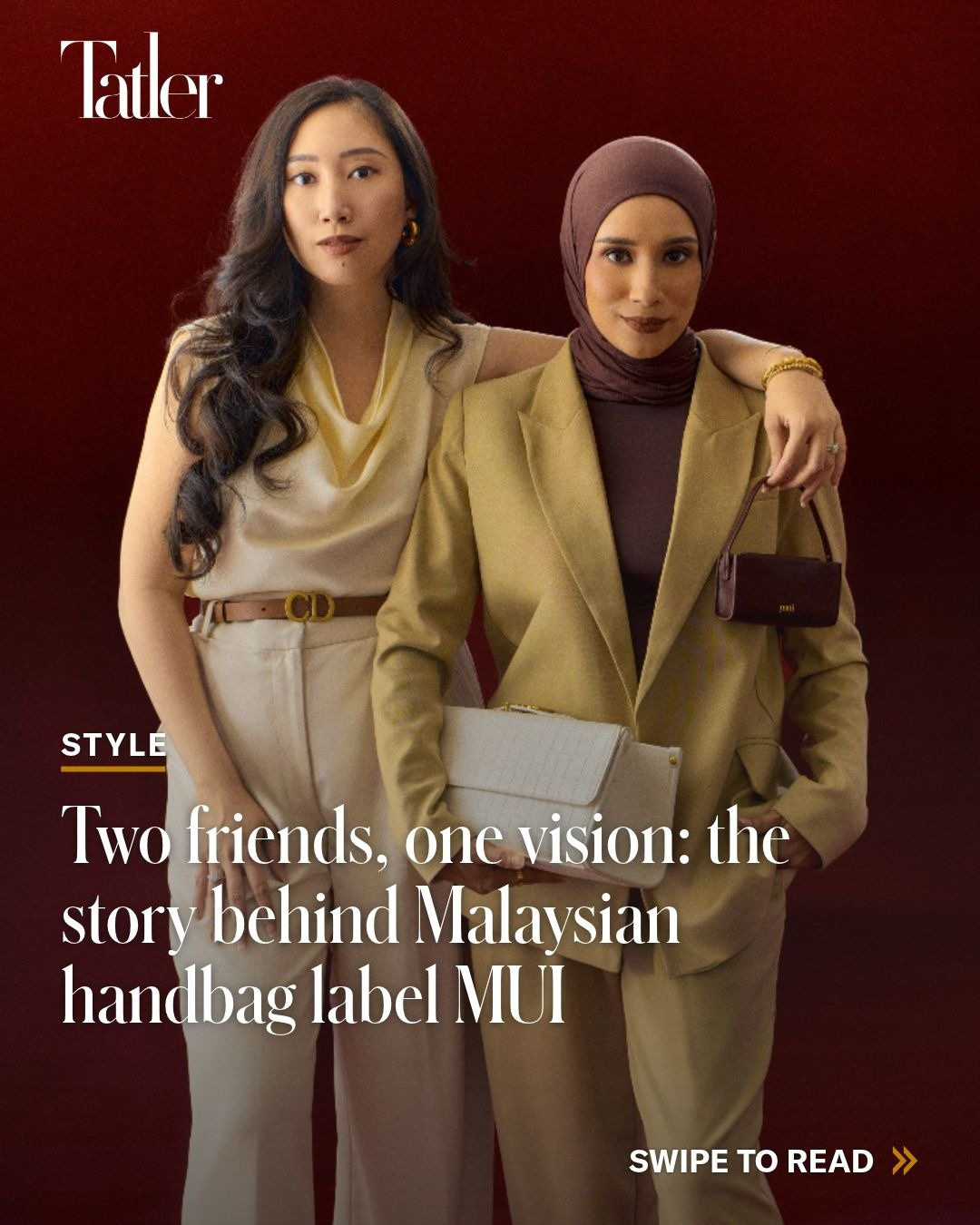
Cover The two founders, Qalisha Ray and Liyana Lyn
The two founders, Qalisha Ray and Liyana Lyn
1 / 1
Qalisha Ray and Liyana Lyn on building MUI, from its first sketches to the handbags women are now carrying
You really can’t go wrong with glitter and shimmer. And if it comes in the form of a sold-out Seya bag from Malaysian handbag label MUI, even better. But behind the bags catching the attention of local fashion girls is a story that started long before the sold-out pieces. It begins with two friends, a handbag idea that had been kept under wraps for years, and two daughters whose names would eventually become part of the brand.
Before MUI was an idea they had together, Qalisha Ray had always wanted to start a handbag brand. She had always loved bags and kept the idea quietly in the back of her mind, but had never actually told anyone about it. That was until she reconnected with her old friend Liyana Lyn, whom she had known for more than a decade. At the time, both were pregnant with their first daughters, and somewhere between catching up and sharing what was going on in their lives, Qalisha finally brought up the idea.


Above The Seya collection (Photo: MUI)
The Seya collection (Photo: MUI)
1 / 1
Liyana, who was a bag lover herself, needed little convincing. “When she said, ‘let’s do a handbag,’ I was like, yes,” she recalls. And just like that, an idea Qalisha had kept to herself became something the two could build together.
It is an interesting way to start a fashion brand. While many local labels are built by siblings or family members, MUI came from a friendship that had already lasted more than 10 years. In our conversation with the two founders, they were honest about the challenges that come with doing business with a friend.
“We don’t always agree with each other all the time,” they admit. Instead, they have learnt to find the middle ground, manage their differences and know when to put work aside. It is, as they describe it, “hard, but meaningful.”
Even the name MUI speaks to that sense of sisterhood. Meaning “sisters” in Cantonese, it reflects the relationship at the centre of the brand, while the names of the bags often come from a combination of their daughters’ names.
Don't miss: The Chanel bags Hailey Bieber keeps coming back to

Above Qalisha Ray, co-founder and creative director of MUI
Qalisha Ray, co-founder and creative director of MUI
1 / 1
When MUI first started, the founders noticed a gap between highly trend-driven bags and more timeless designs that often came with a much higher price tag. “We wanted something in between,” they explain. “Something premium, polished, but accessible.”
That thinking still shapes the brand. Before approving a design, they ask themselves a simple question: would they actually carry it? “We always ask ourselves, would we wear this bag? When we carry it, would it fit our lifestyle?”
For them, the MUI woman is not one specific type of woman. “The MUI woman is all the women in one person,” they say. She could be a working mother, a business owner, someone picking up her children, heading to a meeting or travelling for a holiday.
That understanding translates into bags designed to move with her. Multiple straps allow certain styles to be worn crossbody, over the shoulder or carried by hand, while the founders think about details such as accessibility and whether a bag can take her from daytime to dinner.
They also see MUI as a brand that can move between generations. One of their campaigns brought together Gen Z, millennials and baby boomers, reflecting their belief that a good bag should not belong to just one age group.
We want to do something timeless, if you wear it, you can pass it on to your daughter.

Above Qalisha Ray and Liyana Lyn
Qalisha Ray and Liyana Lyn
1 / 1
MUI’s design process starts with the silhouette. “We always start with silhouette" ,” they explain, before moving into functionality, materials and details. Custom hardware has also become part of the brand’s identity. “We always customise our hardware,” they say. “That’s one special thing about MUI.”
Marsella is one example. The founders experimented with different textures and materials, while incorporating the MUI logo into the strap adjuster, making it part of the bag’s function rather than simply placing a logo on it. The component took around a year to perfect with their supplier.
Customer feedback has also become part of the design process. Demand for more shoulder bags influenced Marsella, while the Yara 2.0 was updated with a shoulder strap after customers asked for another way to wear it.
As a primarily online brand, pop-ups have given the founders a chance to observe their customers more closely, from what they pick up to what they eventually buy. They have even noticed differences between online and physical shopping preferences.
“It’s very interesting to see our customers, like how they think when they buy something,” they say.

Above The latest collection, Marsella (Photo: MUI)
The latest collection, Marsella (Photo: MUI)
1 / 1
The founders’ differences also influence MUI. One is more of a big-bag person, while the other prefers smaller styles that can still work for everyday use or events.
“We try to find things that work,” they explain. “It’s always finding the middle ground.”
That same approach applies to their friendship. Running a business together means seeing each other more, disagreeing, becoming vulnerable and learning how to manage conflict.
“Business with your friend is different,” they say. But they make a conscious effort to reset, touch base and put work aside when necessary. For them, sustaining the friendship is just as important as sustaining the business.
See also: Winona Ryder ’90s style: 8 of her most iconic outfits that made her a defining fashion icon

Above Liyana Lyn, Co- Founder and Operations Director of MUI
Liyana Lyn, Co- Founder and Operations Director of MUI
1 / 1
That idea of sustainability extends to the brand itself. One of their biggest lessons in building a Malaysian label has been the importance of community, with pop-ups becoming a way to meet customers and connect with the local fashion scene.
“It’s not just about sales conversion,” they say. “It’s everything.”
As MUI grows, the founders are also conscious of everything behind the brand, from inventory and content to operations and the team. They want to meet demand without overproducing, while continuing to raise the bar for what customers can expect from a Malaysian label.

Above The Yara 2.0 collection (Photo: MUI)
The Yara 2.0 collection (Photo: MUI)
1 / 1
“I take material, texture, function, everything, into making a bag very seriously,” Qalisha says.
For now, the founders are focused on strengthening MUI in Malaysia before gradually expanding regionally. Ultimately, they want the brand to be recognisable without relying on its logo.
“We want people to know from afar that that’s MUI,” they say. “You don’t have to put the logo.”
It is an ambition that ties back to the brand’s tagline, “Thoughtfully Made, Timelessly Yours.” And perhaps that is what MUI is ultimately trying to build: not simply bags that look good for a season, but pieces that stay relevant long enough to become part of someone’s life, and maybe even make their way to the next generation.
Credits
Photography: Amru Shakir

Aliya Qarina is the Junior Style Writer at Tatler Malaysia with an interest in fashion and beauty. Her writing often focuses on contemporary style, beauty culture and emerging trends.
Curated for you
The stories, profiles, and cultural moments featured on our Instagram feed