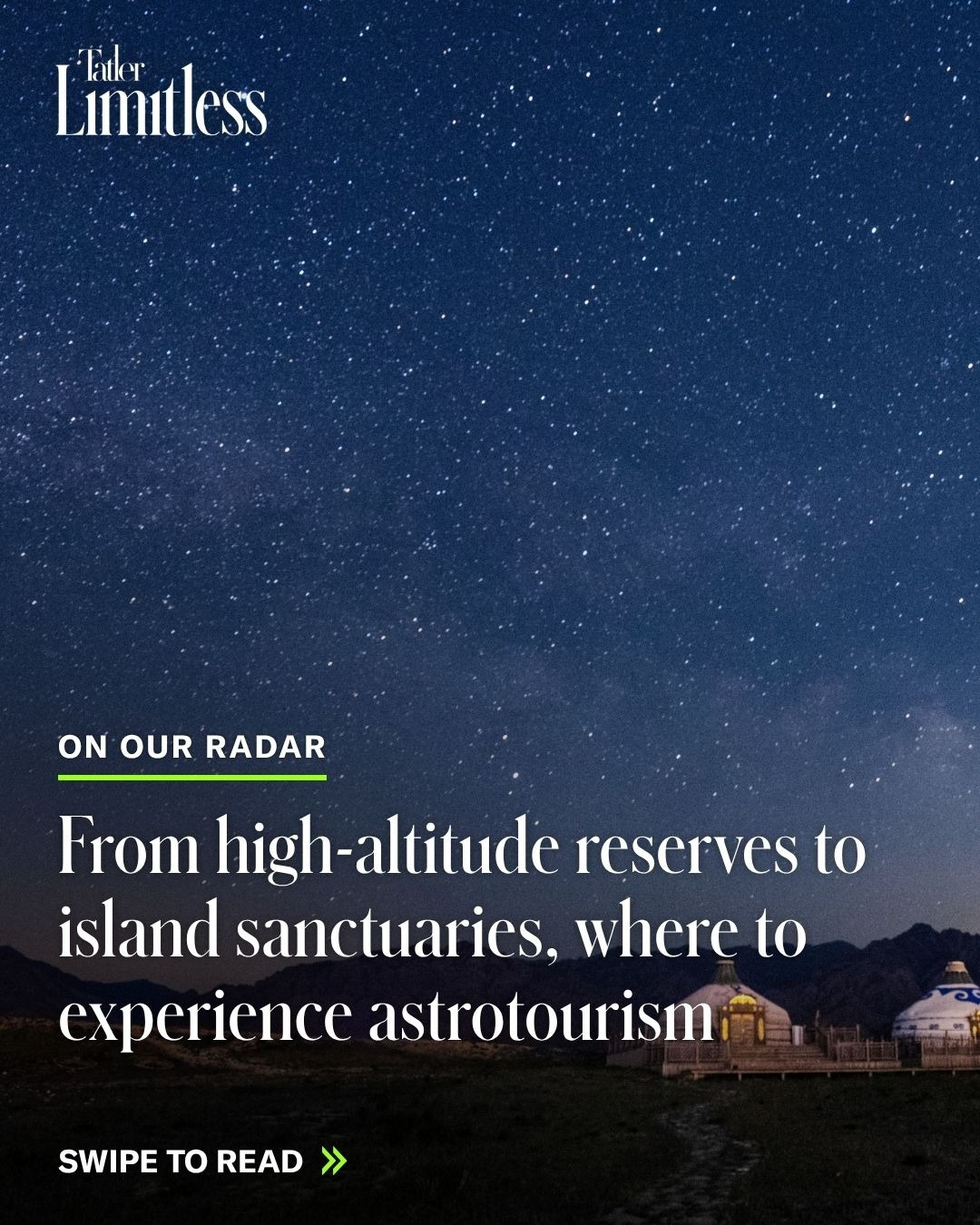
Cover ‘Galaxy wellness’ is now a thing: pitched as a break for burnt-out travellers, it covers stargazing, moonlight meditation, astronomy experiences and stays that deliberately embrace the darkness (Photo: Unsplash)
‘Galaxy wellness’ is now a thing: pitched as a break for burnt-out travellers, it covers stargazing, moonlight meditation, astronomy experiences and stays that deliberately embrace the darkness (Photo: Unsplash)
1 / 1
In Asia’s always-on cities, night is getting harder to find. Now travellers are seeking out dark skies, stargazing and even “galaxy wellness”. But the case for darkness starts with something more fundamental than the stars
Think about the last time you were somewhere truly dark. Not a hotel room with blackout blinds. Not a dimly lit restaurant. Somewhere you could step outside at night, wait for your eyes to adjust and realise how much of the sky you normally cannot see.
For many people living in Asia’s major cities, night no longer really arrives. Buildings glow, signs flash, streets stay bright and screens follow us into bed. We spend money perfecting mattresses, tracking sleep and optimising bedrooms, while paying much less attention to what has happened to darkness itself.
There is a health reason to care. Light is one of the body’s main cues for setting its circadian clock, helping regulate when we feel alert and when we prepare for sleep. A 2026 systematic review of 15 studies involving more than 765,000 people found that those with the highest exposure to artificial light at night had a 27 per cent higher risk of sleep disturbance than those with low or no exposure. That is an association, not proof that bright cities cause insomnia, but it adds to the case for taking nighttime light seriously.
The problem, then, is not simply that light pollution stops us from seeing stars. For health, the more immediate issue is how much artificial light reaches us after sunset—from our homes, streets and devices—and whether it erodes the contrast between day and night.
Read more: The science behind less conventional stress therapies


Above Light is one of the body’s main cues for setting its internal clock. It impacts alertness, sleep timing and when we start to wind down for the day (Photo: Unsplash)
Light is one of the body’s main cues for setting its internal clock. It impacts alertness, sleep timing and when we start to wind down for the day (Photo: Unsplash)
1 / 1
Asia is starting to turn the lights down
Some places are actively protecting what remains. Bisei in Okayama, Japan, introduced a light-pollution ordinance in 1989 and later became Asia’s first certified International Dark Sky Community. Its public outdoor lighting has since been replaced with DarkSky-compliant fixtures. On Taiwan’s Hehuan Mountain, efforts to reduce light from nearby communities and roads helped create the country’s first International Dark Sky Park. Thailand has gone further at a national level: its dark-sky tourism programme has expanded from 12 registered locations in 2022 to 64 parks, communities and private properties today.
But looking upwards is hardly a new wellness discovery in Asia.
On Taketomi Island in Okinawa, stars once served as a calendar. Islanders used their movement to determine when to sow and harvest crops, with the Pleiades holding particular importance. In Laos, lunar cycles remain woven into Buddhist festivals. In Bhutan, astrology, new-moon observances and celestial traditions remain part of cultural and religious life. The night sky was practical, spiritual and social long before anyone invented the term “astrotourism”.
Read more: 7 Asian airports with spaces to rest, recharge and recover
From dark skies to ‘galaxy wellness’
What is new is the way hospitality is packaging the experience for an exhausted, hyperconnected traveller.
Travel media has begun calling it “galaxy wellness”: stargazing recast as an antidote to the overstimulation of modern life. The more extravagant claims—that looking at stars can “reset” the nervous system or cure burnout—run ahead of the evidence. But there is an intriguing idea underneath them. Research into awe suggests encounters with something vast can temporarily shift attention away from ourselves and our immediate concerns; separate research has found that a stronger connection to the night sky is associated with greater mental wellbeing and happiness. Neither proves that stargazing treats burnout. They help explain why lying beneath a huge dark sky can feel different from another hour in a spa.
Hotels have noticed. Hoshinoya Taketomi Island avoids overhead lighting and builds experiences around the island’s star-filled nights. Soneva Fushi in the Maldives has an observatory and resident astronomer, while Anantara Kihavah operates an overwater observatory in Baa Atoll. The most interesting amenity may be what these resorts take away: artificial light, visual noise and another reason to look at a screen.

Above The observatory at Soneva Fushi in the Maldives (Photo: Soneva Fushi)
The observatory at Soneva Fushi in the Maldives (Photo: Soneva Fushi)
1 / 1
Where to find a properly dark night in Asia
For protected subtropical skies, head to Japan’s Yaeyama Islands, where 84 of the 88 recognised constellations can be observed, and Taketomi and Iriomote offer stays built around the night sky. For something wilder, Hanle in Ladakh, at around 4,500 metres, has India’s first Dark Sky Reserve and locally trained astronomy ambassadors leading telescope sessions.
In the Maldives, remote islands make darkness part of a far more polished luxury experience. Or explore Thailand’s growing dark-sky network, where protected locations range from national parks to private properties.
You can go less polished still: drive up Taiwan’s Hehuan Mountain, sleep in a yurt beside Song-Kul Lake in Kyrgyzstan, see fireflies beneath the Milky Way in Yeongyang, South Korea, or spend the night on a remote island off Palawan with little more than hammocks and solar lights.
For most of human history, darkness was simply night. Now it is something we increasingly have to seek out and protect—and occasionally travel for.
Maybe the antidote to an always-on life isn’t another wellness treatment. It’s turning things off. The lights included.
Topics

Tamara Lamunière is the president of Tatler Asia Group.
Curated for you
The stories, profiles, and cultural moments featured on our Instagram feed