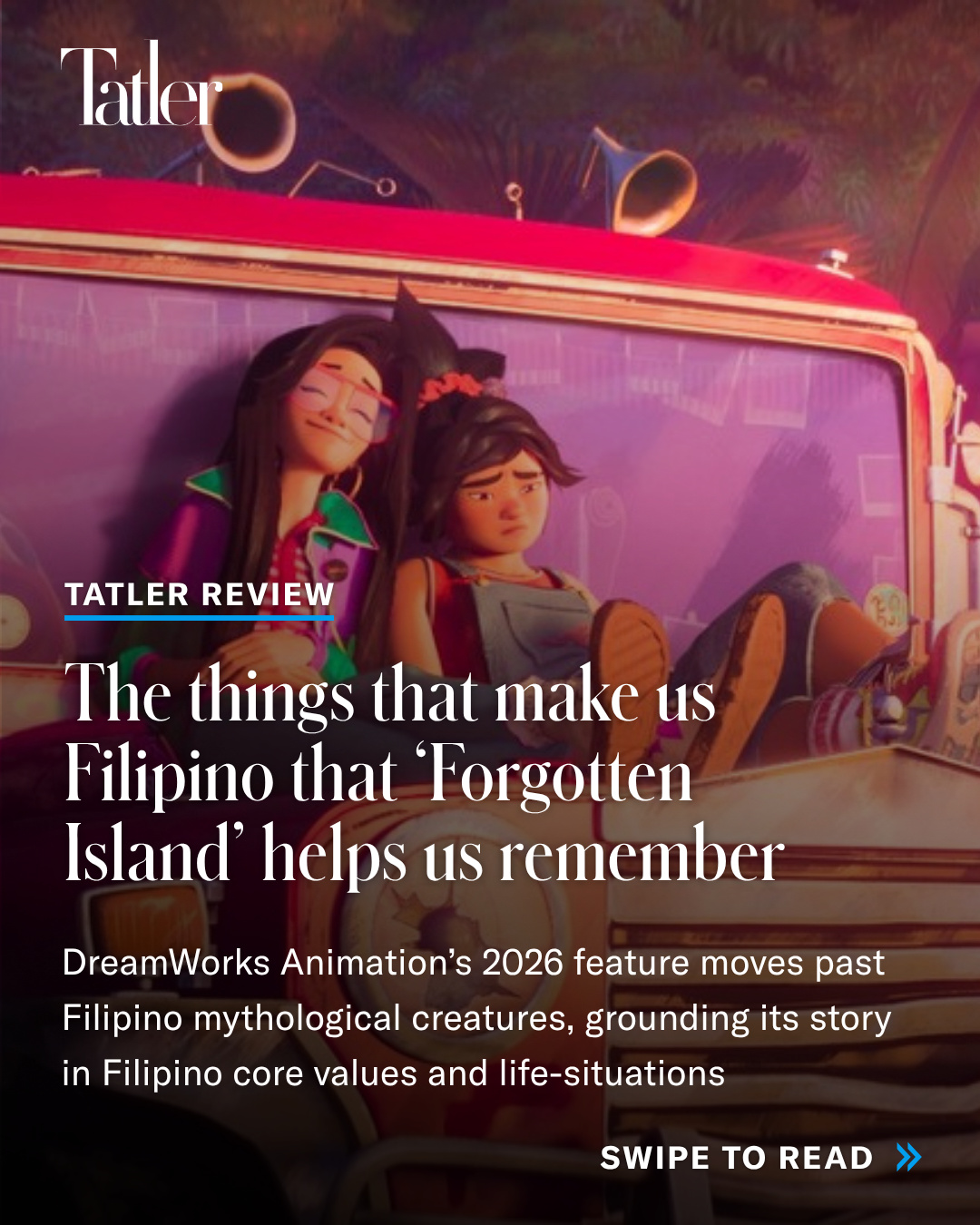
Cover Raissa and Jo in a heartfelt scene in ‘Forgotten Island’, voiced by Liza Soberano and H.E.R., respectively (Photo: DreamWorks Animation)
Raissa and Jo in a heartfelt scene in ‘Forgotten Island’, voiced by Liza Soberano and H.E.R., respectively (Photo: DreamWorks Animation)
1 / 1
DreamWorks Animation’s feature ‘Forgotten Island’ explores the core values that shape the Filipino identity
It is not the first time that Hollywood has drawn upon folklore and mythology from different parts of the world to build contemporary narratives for its films. And yet, when Forgotten Island premiered on September 25 and remains in cinemas today, something more than the Philippines’ aswang and manananggal has received global attention since Netflix’s Trese. The 2026 DreamWorks Animation feature, co-directed and co-written by Joel Crawford and Januel P Mercado, centres on values and philosophies in life grounded in the realities that make us Filipino.
Set initially in the Philippines during the 1990s, the story follows childhood friends Jo (voiced by H.E.R.) and Raissa (Liza Soberano). Their daily routines are disrupted when they inadvertently cross over into Nakali, a mythical world populated by figures from local folklore. The primary conflict arises from the island’s inherent nature: it gradually consumes the memories of its human visitors. To survive and return home, Jo and Raissa must find an escape route before they forget their pasts, their families and each other.


Above ‘Forgotten Island’ poster (Image: courtesy of DreamWorks Animation)
‘Forgotten Island’ poster (Image: courtesy of DreamWorks Animation)
1 / 1
Beyond its visual execution and animated set pieces, Forgotten Island highlights several distinct cultural traits. The film moves past surface-level representation to incorporate local social constructs into its narrative structure.
Kapwa and pakikisama
The central narrative is driven by the concept of kapwa, which can be loosely translated into shared identity or fellow-man. In Filipino psychology, kapwa is the recognition of a shared inner self with others, erasing the strict boundary between the self and the community. Jo and Raissa’s survival in Nakali relies entirely on pakikisama—maintaining their companionship and supporting one another under severe pressure. Their friendship operates as the primary mechanism that resists Batiba’s memory-erasing charm. According to Crawford and Mercado, who presented the film’s conceptual framework at the Annecy International Animation Film Festival earlier this year, this relational dynamic forms the emotional core of the story.

Above The protagonists navigate the dangers of the realm not through brute force, but by fostering mutual respect (Image: courtesy of DreamWorks Animation)
The protagonists navigate the dangers of the realm not through brute force, but by fostering mutual respect (Image: courtesy of DreamWorks Animation)
1 / 1
This shared identity extends beyond the two protagonists to underscore their family dynamics. The stakes in Forgotten Island are heightened by the characters’ deep-seated ties to their households back in the human world—which, at the film’s setting, is in the Nineties when communication was still analogue and intimate. The island’s memory-draining nature also threatens to sever the intergenerational bonds that define their upbringing and shape their identity. The growing fear of forgetting others—which in their case, each other—drives their urgency to escape, illustrating how the Filipino identity is intrinsically linked to this fundamental unit of interrelatedness.
Furthermore, this application of kapwa dictates how Jo and Raissa interact with the mythological inhabitants of Nakali. Rather than approaching the island’s figures solely as monsters or obstacles to be defeated, the girls actively build a makeshift community. Their evolving alliances with the island’s denizens—most notably with the centuries-old “were-aspin” Raww (Dave Franco)—highlight an inclusive form of pakikisama. Even when encountering traditionally fearsome entities voiced by Manny Jacinto and Lea Salonga, the protagonists navigate the dangers of the realm not through brute force, but by fostering mutual respect. By finding common ground with the peers they meet in Nakali, Jo and Raissa demonstrate that building alliances is just as crucial to their survival as finding a way home.
Read more: A journey into Filipino folklore: DreamWorks unveils ‘Forgotten Island’

Above Batiba, a tree-dwelling batibat, voiced by Jenny Slate (Image: courtesy of DreamWorks Animation)
Batiba, a tree-dwelling batibat, voiced by Jenny Slate (Image: courtesy of DreamWorks Animation)
1 / 1
The weight of memory and heritage
The threat of memories being erased literalises a common cultural fear of losing touch with one’s roots. This narrative device calls to mind the national proverb: “Ang hindi marunong lumingon sa pinanggalingan, hindi makakarating sa paroroonan” (One who does not look back at where they came from will never reach their destination). The characters’ struggle to hold onto their pasts reflects the broader experience of the Filipino diaspora. It examines what happens when geographical distance, time or assimilation threatens cultural ties. The memory loss in Forgotten Island acts as a metaphor for cultural disconnect, positioning the act of remembering as a necessary tool for survival.

Above Manang, a grief-stricken manananggal, voiced by Lea Salonga (Image: courtesy of DreamWorks Animation)
Manang, a grief-stricken manananggal, voiced by Lea Salonga (Image: courtesy of DreamWorks Animation)
1 / 1
The film explores the consequences of this cultural amnesia most effectively through the storyline of Manang, the dreaded manananggal (voiced by Salonga). Rather than presenting her merely as a traditional creature of horror, the narrative reveals that her fractured state and savage behaviour are the direct results of having her memories stolen by Batiba, the memory-hoarding batibat (voiced by Jenny Slate).
By losing her memories, Manang is severed from her humanity. The void left by her forgotten history corrupts her, transforming her isolation into hostility. In this context, her physical separation as a manananggal operates as a direct visual metaphor for the diaspora: a being detached from its grounding roots, existing in a state of perpetual incompleteness. It is only when her stolen memory is returned to her that this internal void is filled. Her composure is restored, and her severed wings reunite with her body. Manang’s storyline serves as a direct cautionary tale for Jo and Raissa, illustrating the severe cost of allowing one’s origins to fade and reinforcing the girls’ urgent need to hold onto their shared history.
Above An extended graduation scene from ‘Forgotten Island’
The batang Nineties childhood
The decision to ground the human world in the 1990s Philippines allows the film to utilise specific cultural markers that function as a synecdoche for the Filipino childhood many generations experienced in the 20th century. The production design captures an analogue era defined by neighbourhood sari-sari stores, traditional street and party games, and massive family gatherings where the entire barangay is invited to celebrate and everybody lines up for the lechon.
Musically, the film accurately reflects the period’s soundscape. Rather than relying solely on Original Pilipino Music (OPM), the film leans into the country’s deep-rooted karaoke culture. The memorable scene of Raissa’s father singing the foreign hits Nothing’s Gonna Stop Us Now and On the Wings of Love—which have been covered locally by OPM artists—depicts the vibrancy of communal joy.
These grounded, analogue details provide an authentic starting point before the narrative shifts to the fantastical realm of Nakali. For older viewers, the setting offers sharp nostalgia for a highly connected, pre-digital past. For international audiences, it establishes a specific sense of time and place that contrasts effectively with the timelessness of the mythological island, highlighting what the protagonists stand to lose if they fail to return home.
Diasporic stories
Every year, a significant number of Filipinos leave their homes to pursue educational or employment opportunities abroad. Forgotten Island grounds its fantastical narrative in this very real demographic shift. The emotional catalyst of the story occurs just before the protagonists are transported to Nakali: Raissa has been granted a scholarship in the United States and is preparing to leave the Philippines. This impending departure introduces the anxiety of cultural detachment and shifting interpersonal dynamics long before the mythological stakes are even established.
There is immense potency in sharing these diasporic stories on an international platform. By giving these themes a major studio release, the film elevates a highly specific, regional experience into a universal cinematic event, validating the complex feelings of homesickness and assimilation that many migrant families endure. This narrative thread is given a fitting resolution in the film’s concluding time jump. Set years later, the ending depicts Jo conducting a comic book reading in the US with Raissa in the audience. It is a quiet but powerful statement illustrating that while geography and time may alter circumstances, the ties of shared memory can survive the distance.
The casting choices reinforce this connection to the global Filipino community. By casting performers of Filipino descent in the lead roles, the production ensures the vocal performances carry an inherent understanding of the required cadence and cultural shorthand. H.E.R. and Soberano deliver performances that feel grounded in genuine familiarity, making the dialogue flow naturally. The inclusion of veterans like Salonga and Dolly de Leon creates a cast that spans different generations of Filipino talent making their mark in the international entertainment industry.
Technically, Forgotten Island delivers the high-quality animation expected from a major studio. The environments of Nakali are rendered with close attention to lighting and texture, contrasting the warm, familiar tones of the Nineties human world with the vibrant, unpredictable colour palettes of the mythological realm.

Above There is immense potency in sharing these diasporic stories on an international platform. By giving these themes a major studio release, the film elevates a highly specific, regional experience into a universal cinematic event, validating the complex feelings of homesickness and assimilation that many migrant families endure. (Image: courtesy of DreamWorks Animation)
There is immense potency in sharing these diasporic stories on an international platform. By giving these themes a major studio release, the film elevates a highly specific, regional experience into a universal cinematic event, validating the complex feelings of homesickness and assimilation that many migrant families endure. (Image: courtesy of DreamWorks Animation)
1 / 1
However, the film occasionally struggles with its own pacing. The rapid comedic timing, typical of contemporary studio animation, sometimes interrupts the narrative’s emotional weight. When the story pauses to address the loss of identity or the fading of memories, a quick joke often follows. This structural choice frequently prevents the heavier themes from fully registering with the audience, favouring momentum over reflection.
Despite these issues with pacing, Forgotten Island remains a notable entry in modern animation. It brings Philippine folklore and the realities of the diasporic experience to a wide audience, demonstrating that local stories can sustain a major studio feature while clearly defining the cultural ties that bind its characters.
NOW READ
Confronting the shadows of the past: Lea Salonga on preparing for ‘Ang Tahanan ni Bernarda Alba’
Trese: a quick guide on the monsters of Philippine folklore—who is friendly and who is not?
‘First Light’: a masterful intersection of faith and environmental advocacy

Franz writes about the local cultural scene and rediscovering the country’s storied past and rich heritage. He earned his bachelor’s degree in Journalism from the University of Santo Tomas and is currently pursuing a master's degree in Art Studies at the University of the Philippines Diliman. Besides working on this luxury lifestyle magazine, Franz is an avid book reader, local traveller, museum-goer, chorister, and community theatre playwright. But above all this, this Aether main spends more time in Teyvat than anywhere else.
Curated for you
Discover the stories and updates featured on our Instagram page