

Cover Rebecca Pan at Chat (Photo: courtesy of Chat)
Rebecca Pan at Chat (Photo: courtesy of Chat)
1 / 1
Cultural pioneer Rebecca Pan, who appears on Tatler’s Asia’s Most Stylish list this year, looks back at how she thrust Chinese fashion and Hong Kong arts into the international limelight
Rebecca Pan turns 93 this December. When Tatler arrives at her apartment in Ho Man Tin for the interview in mid-July, the actress pushes herself up shakily from her chair. She says with an apologetic smile, “My body isn’t too well these days. I can’t stand up to greet you.” Despite her outward frailty, her hearty laugh, effervescent personality and candy pink locks interlacing her silver hair reveal traces of the daring, stylish, modern starlet that she was decades ago.
The name may not ring a bell today, but Pan was a celebrated multilingual singer in Hong Kong in the 1950s and 1960s who was fundamental in putting the city’s art scene on the international map, especially when mainland China opened its borders to the western world in the late 1970s. She is also a fashion icon known for wearing qipao during her performances.
In case you missed it: Louise Wong on her transition from model to actress, speaking the language of fashion and Asian representation in modelling


Above Rebecca Pan performing in Manchester in 1962 (Photo: courtesy of Rebecca Pan)
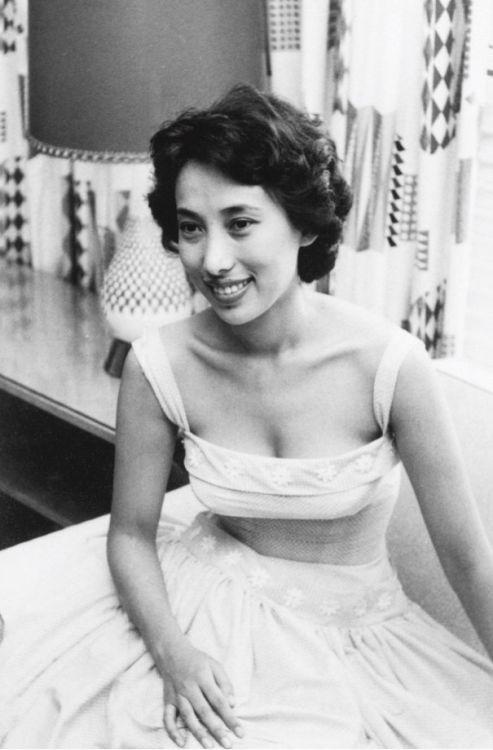
Above Rebecca Pan at her former residence on Hawthorn Road, Happy Valley, circa 1953-1956 (Photo: courtesy of Rebecca Pan)
Rebecca Pan performing in Manchester in 1962 (Photo: courtesy of Rebecca Pan)
1 / 2
Her six decades of legacy and achievements are now celebrated at With the Sun, She Quells the Night—A Tribute to Rebecca Pan, an exhibition by Centre for Heritage, Arts and Textile (Chat) in Tsuen Wan. Featuring Pan’s photos, costumes, jewellery and news clippings, the show spotlights the key moments and impact of her life. “Rebecca is an icon and figure of nostalgia,” says Bruce Li, one of the curators of the show. “But of course, she doesn’t want that. She doesn’t like staying in the past. She is always one step ahead.”
Pan’s avant-garde approach to life from an early age can be explained by the environment she grew up in. She was born Pan Wan Ching to a middle-class family in 1930 in Shanghai. The city had recently had an influx of British bankers and French artists—and along with them, jazz, films, cabaret, nightclubs, dance and literature that turned it into China’s most modern city.
“My father wanted me to be a lawyer because a cabaret singer wasn’t considered a proper profession, but I was obsessed with films and songs. Mostly I was a rebel,” Pan recalls. “I secretly saved up to watch western films, which were expensive, so I only watched them occasionally. When my father went out for work, I listened to [Chinese] songs on the radio. [Chinese singer] Zhou Xuan is my idol.” Her education at a Shanghai girls’ school which was known for an excellent music programme cemented her skills and interest in the arts.
Don’t miss: Asia’s Most Stylish 2023: The best-dressed individuals defining fashion’s standard

Above A photoshoot in
Aberdeen for the cover of Rebecca Pan’s first album in 1959 (Photo: courtesy of Rebecca Pan)

Above Rebecca Pan performing in November 1961 (Photo: courtesy of Rebecca Pan)
A photoshoot in Aberdeen for the cover of Rebecca Pan’s first album in 1959 (Photo: courtesy of Rebecca Pan)
1 / 2
In the 1940s, Pan auditioned for film companies in Shanghai, but it was her debut performance as a professional singer at the nightclub in Empire Theatre (later renamed State Theatre) in 1957, eight years after the Pans immigrated to Hong Kong, that established her name. “She is the one of few Chinese people who could speak and sing in English,” says Wang Weiwei, the curator of exhibitions and collections at Chat, which is part of The Mills’ heritage conservation project. “This became an advantage for her, [allowing her] to entertain both expats and local businessmen, politicians and socialites.” With her charming voice and ability to create an atmosphere, she was quickly promoted to floorshow artist, and expanded her stage presence at other venues on Hong Kong Island and in Kowloon, including Tai Pak Floating Restaurant and nightclubs in glamourous hotels such as Paramount. In 1970, Pan was the first Chinese singer to perform at the Hilton Hotel’s nightclub, Eagle’s Nest.
Despite having one foot in the western cultural space, Pan remained proud of her identity as a Chinese Hongkonger, something she constantly demonstrated by her decision to don qipao during performances and public events, including the Hong Kong Jazz Festival in 1960, which was the first time Chinese performers were invited. “Western dresses may be regal and elaborate, but when I pair a string of pearls with a simple qipao, I look just as beautiful,” she says.
The singer says she grew up in an era when people who had undergone the Battle of Shanghai in 1937 and the Japanese occupation of Hong Kong from 1941 to 1945 had a great sense of national pride. She has strong negative feelings about the class divide in which Chinese were looked down on. Wearing national dress was a way to celebrate her Chinese roots and to show that Chinese people like herself belonged on the international stage.

Above Rebecca Pan in Germany in 1969 (Photo: courtesy of Rebecca Pan)

Above Rebecca Pan at The
Peak circa 1954-1956 (Photo: courtesy of Rebecca Pan)
Rebecca Pan in Germany in 1969 (Photo: courtesy of Rebecca Pan)
1 / 2
Her ambition to promote Chinese culture to the western world began to take shape through her pioneering musical work. Most memorably, in 1972, after her visit to Broadway, where she was impressed by the musical productions, she decided to finance, produce and perform her own musical with a Chinese story, Pai Niang Niang, which was the first Broadway-style musical in Hong Kong; it had an eclectic mix of influences from genres like Chinese music and rock’n’roll.
The production was inspired by the tale from Chinese folklore about a white snake spirit which takes human form and falls in love with a scholar. Pan brought onto the team Joseph Koo, the late local composer who wrote Pai’s songs in the western musical style, and Lo King-man, who contributed to the adaptation of the story. The costumes were designed with Chinese opera elements and ancient Chinese outfit styles by David Sheekwan. It was an ambitious, elaborate show that cost HK$1 million. Performed in Mandarin, Pai was meant to be staged overseas after the Hong Kong premiere. “I didn’t only want to show it in Hong Kong; I had plans to bring it to the world,” Pan says.
Her efforts were in vain, though, as the city wasn’t ready for it. As well as the lack of technical equipment to realise Pan’s artistic vision, Pai’s Broadway presentation style was far from the Cantonese opera that local audiences were familiar with, while the Chinese story wasn’t something the western audience could relate to or showed interest in. But the setback and financial loss didn’t deter Pan from her ambition to promote Chinese culture to the world. She felt frustrated that while western tunes dominated the Hong Kong music industry, the Chinese melodies which she grew up with didn’t get the same reception in western countries. In 1964, she got a deal as the first Hong Kong singer to sign with EMI London, with whom she released several singles, with Chinese melodies sung in English, including Will the Orange Blossom Smile? and My Hong Kong. Often at her live performances where she sang songs in non-English languages, she would explain to her western audience the content of the songs in English.
In case you missed: Is Hong Kong becoming the ‘Broadway of the East’?

Above Rebecca Pan and Enoch Cheng, an artist who responds to Pan’s work in the retrospective exhibition (Photo: courtesy of Chat)
Rebecca Pan and Enoch Cheng, an artist who responds to Pan’s work in the retrospective exhibition (Photo: courtesy of Chat)
1 / 1
Throughout her life, as well as building a remarkable career in the entertainment scene for herself, such as starring in films by Wong Kar Wai, Ann Hui and Hou Hsiao-hsien, Pan has also worked hard to establish Hong Kong as an international arts city. In 1963, while she was on tour in London, her label Diamond Records invited her to be a guest performer at American jazz trumpeter and singer Louis Armstrong’s concert at the opening of Hong Kong City Hall.
Starting from 1967, when TVB started broadcasting, she was one of the inaugural hosts of the three-decade variety show Enjoy Yourself Tonight. As a touring artist, Pan often travelled alone to the Middle East, Southeast Asia and the west to perform, which was rare for an Asian woman at the time. During the trips, she would always wear a qipao—for her cabaret performance at Melbourne’s Oriental Hotel in 1959, she even brought a Chinese sword to impress the western crowd.
Pan gave a farewell concert in 2011, but she has remained active in her retirement years. As well as working with the next generation of artists on art shows, such as an adapted version of Pai with the Hong Kong Children’s Choir in 2014, a tribute concert in 2019 performed by the likes of Joyce Cheng, and artist Enoch Cheng’s contemporary interpretation of her work as part of Chat’s exhibition this year, she is writing a second memoir.
Back in her apartment, the pink-and-silver-haired star looks fondly at a portrait of herself painted in her youth. “I’ll use this as my book cover. I’m deciding whether to print it in monocolour or full colour.” Much like the spectrum of achievements in her life, she says, “I’m leaning towards the latter.”

Zabrina is the Senior Editor, Arts and Culture of Tatler Hong Kong. She specialises in performing arts, visual art and film. Her wanderlust was first fuelled by the Mighty Rovers Antarctica Expedition 2010. Over the years, she has interviewed A-list artists and filmmakers, including Oscar winners Chlóe Zhao and Tim Yip, Golden Horse winner Sylvia Chang, In the Mood for Love cinematographer Christopher Doyle, Pachinko author Min Jin Lee, and Coachella’s first Chinese solo singer Jackson Wang. She won gold at the WAN-IFRA Asian Media Awards for her 2021 feature on the waves of hate crimes targeting Asian Americans.





