

Cover Aaron Chan (middle) with Emmanuel Dron of The Auld Alliance (left) and Daiki Kanetaka of D.Bespoke (right). Image courtesy of @dbworklifestyle/Instagram
Aaron Chan (middle) with Emmanuel Dron of The Auld Alliance (left) and Daiki Kanetaka of D.Bespoke (right). Image courtesy of @dbworklifestyle/Instagram
1 / 1
"I am actually a very, very lucky and fortunate person. I believe I've tried basically 99 percent of the best bottles ever produced."
Our By The Glass series invites sommeliers and experts in the world of wine and whisky to share some inspiration for your next pour.
Aaron Chan is a bit of a whale in the world of whisky. As the owner of Club Qing in Lan Kwai Fong, he showcased for five years a complete set of the legendary Full Card Series by now-closed Japanese distillery Hanyu Ichiro—comprised of 54 bottles modelled on the standard deck of playing cards—which he finally auctioned in 2020 at Bonhams for a record-breaking sum of US$1.52 million. Having wrapped up another auction this month, this time of his prized collection of rare Scotch, Chan spoke to Tatler Dining on his picks for everything from his favourite mid-week dram to a pour that changed his life.
See also: Rare Whisky and Accompanying NFT To Go Under the Hammer in Hong Kong
An early (in your career) whisky that made you go 'Wow! (I want to be a whisky collector)'?
I started drinking and collecting Japanese whiskies in 2012 or 2013. A friend of mine was working in Singapore at that time and he told me that there's this amazing whisky bar there called The Auld Alliance. So a few friends and I planned a trip and once we landed, we went directly to the bar with our luggage.
So we drank, drank, and drank. And then a few hours later, the owner of the bar, Emmanuel Dron, walks in. We talked a bit, and we told him we're very into Japanese whisky, and then he asked whether or not we'd like to try some Scotch whisky.
[At that time] I didn't know much about Scotch, so he recommended two bottles for us. The first one's crazy—it was a Black Bowmore First Edition. It was only until far later that I realised that Black Bowmore is like one of the legendary bottles. It's probably one of the top 20 Bowmores ever made. The other bottle was also a Bowmore: the 1967 official release at 50% ABV, so it's like a cask strength version.
Both bottles were amazing, even for someone like me who has no experience whatsoever with Scotch whisky, and my palette being heavily skewed towards Japanese whisky at that time as well. I was so impressed that after the trip, I decided to begin collecting Scotch.
Most memorable pour?
If I can only pick like one, it would be the Largiemeanoch 1967. It's actually a Bowmore 12 Year Old, but they didn't use the name Bowmore at that time. This is a super rare bottle; one that I have but I'm not putting up for auction.
Tipple for a Tuesday?
I love Laphroaig 10 Years Old, but preferably the ones that were released back in the '80s or '90s. I like the delicate flavours of older Laphroaigs; newer Laphroaigs are also good, but they are very strong in terms of flavours—very peated and smoky. But if you try Laphroaig 10 from the 1980s or even 1990s, they are much more delicate, with very elegant fruits and peat and smoke but nothing overwhelming.
Whenever I see one that pops up at a reasonable price I'll buy it, so I still have cases and cases of those. It's my movie drink, my casual drink. When a bottle is finished, I always pop another one open almost immediately.
What goes into your highball?
I am not really a highball drinker, but I don't oppose drinking whiskies in a highball. There are actually a lot of bottles that go well with highballs, even expensive ones. I've tried a Hibiki 30 Years Old highball, which was excellent. It was in Japan many years ago when Hibiki 30 was still at a reasonable price. I believe a lot of Hibiki—not necessarily 30 years old—are probably designed to be drunk either on the rocks or as a highball.
There are a few other highballs that I can recommend, like Talisker 10—not the newest bottles but slightly older versions—and also the Japanese brand Hakushu 12 or 18. If you are a hardcore Islay or peat smoke fan, you can also try a Laphroaig 10 highball. That's also very memorable. If you like it, then you like it; if you don't like it, you'll hate it so much [chuckles].
Whisky of the moment?
My favourite whisky at the moment that I have an open bottle of at home is a Brora 1977, 21 Years Old rare malts. Brora closed together with Port Ellen in 1983. It didn't become popular until recently because nowadays, people talk about closed distilleries and their premium on rarity.
I discovered Brora back in 2013-14. At that time, Brora was already a little expensive, but not as expensive as today, so I was still able to acquire some bottles. It's actually my favourite distillery.
I believe I have a very wide spectrum of taste in whisky, but when it comes down to daily drams, I always go back to those few bottles. I am quite boring in that respect [chuckles].
What's one bottle you're saving for a really big moment?
The Brora 1972, 20 Year Old rare malts. It's the highest rated Brora by a lot of whisky critics. I have more than one of those bottles, and that's a bottle that I intend to open during my, I don't know, 50th birthday or something.
Don't miss: The Past, Present and Future of Cantonese Liquor

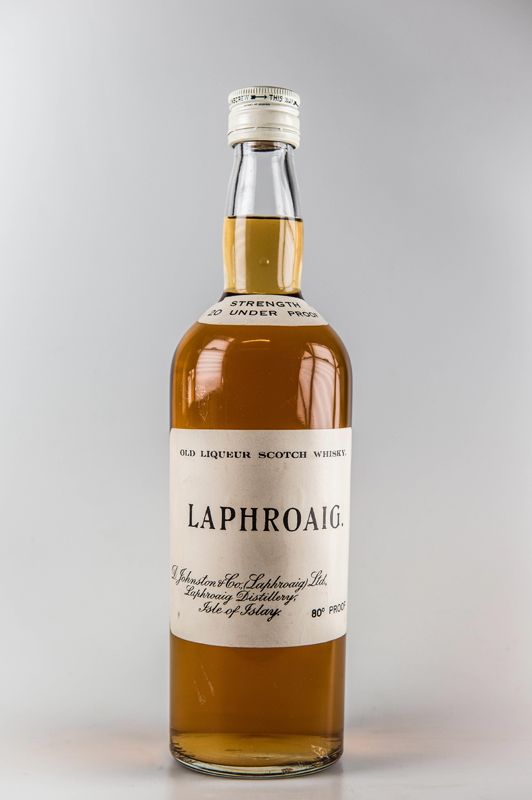
Above Laphroaig O.B. 20 Under Proof from the 1940s. (Image retrieved from laphroaigcollector.com)
Laphroaig O.B. 20 Under Proof from the 1940s. (Image retrieved from laphroaigcollector.com)
1 / 1
What do you bring to a dinner party?
I think it really depends on who the guests are, and how much experience they have with whisky. Sharing whisky with people is a skill; it requires a lot of knowledge, especially when I want to impress someone. In order for that to happen, I need to know what kind of style they really enjoy, so there isn't a one-size-fits-all answer.
For casual drinkers, I would bring something from a sherry cask with low alcohol strength, possibly bottled in the '80s or '90s, like an old Glendronach 15 Years Old.
If you want to drink with knowledgeable people, you really need to think very hard but usually a bottle of Port Ellen would be good, because I believe there is no bad Port Ellen out there. It's just a matter of how good they are, right? Even a simple Port Ellen 18 or 19 Years Old can be very impressive already, and the majority of the people will probably love it.
A bottle you haven't tried but really want to?
[Prolonged silence] The reason that I'm thinking so hard is that I am actually a very, very lucky and fortunate person. I believe I've tried basically 99 percent of the best bottles ever produced... but there could be like one or two that I have never tried.
I'll say very old Laphroaigs from the 1940s, like the Laphroaig O.B. 20 Under Proof. The label is so clean. It doesn't say anything, not even an age statement; just Laphroaig. This is a very iconic bottle—the holy grail of basically all Laphroaig collectors—because it is one of the earliest Laphroaigs in existence. I don't know how many bottles are still on the market, probably less than 12. [The meaning of] 20 Under Proof is the same as 80% proof, which is around 45.7 percent ABV.
When we study the history of whisky, we can see that at different times, people focused on different aspects of a whisky. So obviously in the '40s and '50s, people didn't really care about age because you don't see a lot of age statements on those whiskies.
If not whisky, then what?
I like old champagne from the '80s with around 30 years of ageing. They usually develop into more intense apple and pear flavours. On the nose, they usually are more crisp, but also with a nose of fine fermented cheese. I don't demand that it has a lot of bubbles because usually the bubbles will have reduced, but they should still have a little bit of bubble. I also like a long finish with excellent acidity; but I don't have a brand or a particular vintage.
I intentionally prohibit myself from learning anything about champagnes and wine because I am scared that if I start to dig into that world, I'll be dead! I just know what I like, and how I'll be if I get too involved.
Club Qing, 10/F, Cosmos Building, 8-11 Lan Kwai Fong, Central, Hong Kong; +852 9379 7628
NOW READ
The Tatler Dining Guide To Champagne
Whisky Business: Are Investors Setting Their Sights On Rare Whiskies?
Prince Robert of Luxembourg to Empty His Personal Wine Cellars for Charity
Topics

Gavin Yeung is a Hong Kong-based writer and was the editor at Tatler Dining. He has written across the realms of F&B, design, fashion and travel, with a focus on in-depth profiles and experiential features. Previously, he held editorial positions at Hypebeast, Soho House and Vogue Hong Kong. He’s also a keen photographer and aspiring home bartender, and is constantly thinking of original, Cantonese-inflected (and occasionally questionable) cocktails to shake up. Follow him on Instagram at @gaviny.





