Cover Michel Navas, co-founder of La Fabrique du Temps (Photo: courtesy of Louis Vuitton)
Michel Navas, co-founder of La Fabrique du Temps (Photo: courtesy of Louis Vuitton)
1 / 1
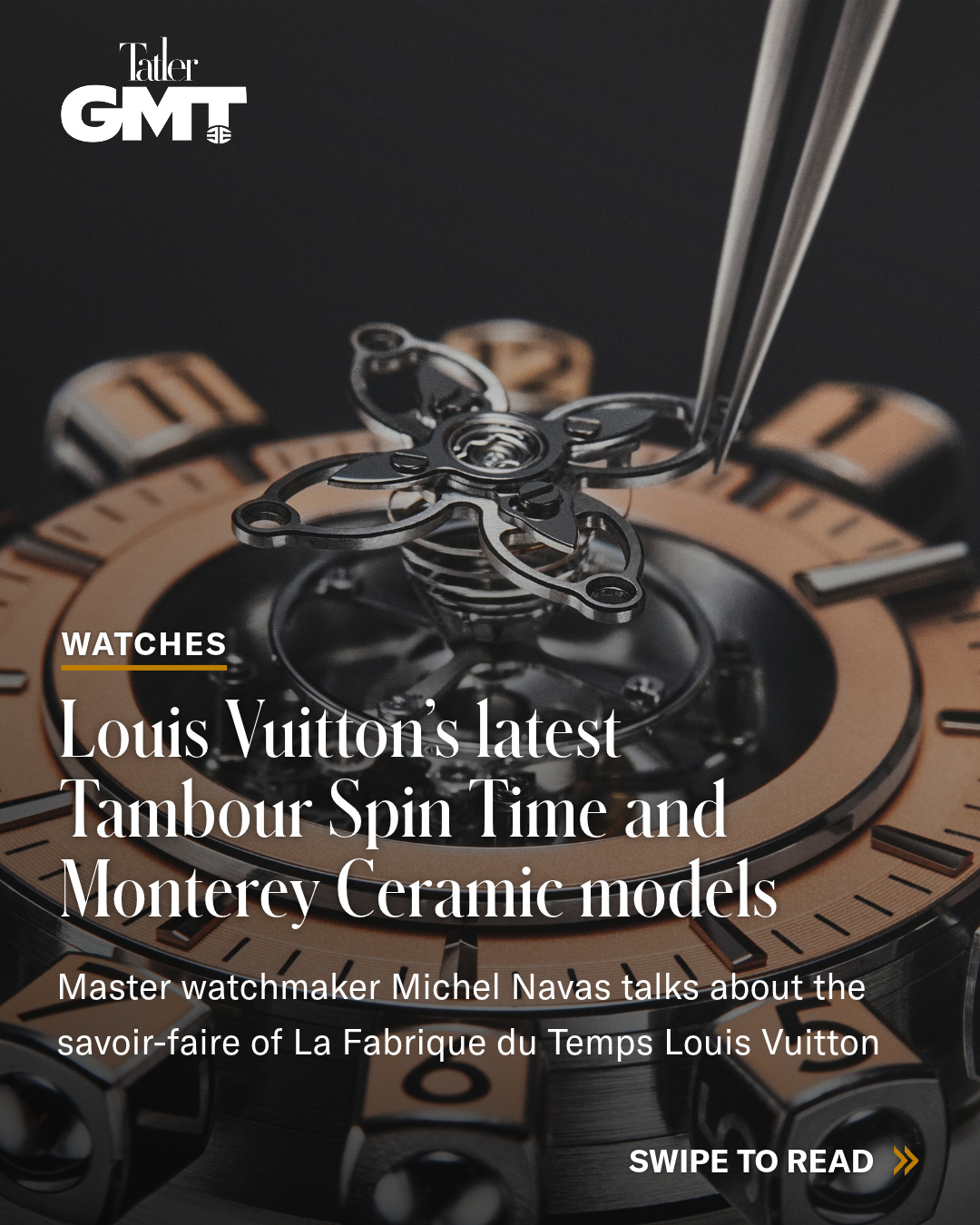
Master watchmaker Michel Navas, co-founder of La Fabrique du Temps, talks to Tatler GMT about Louis Vuitton’s latest Tambour Spin Time and Monterey Ceramic models
Swiss watchmaking is fiercely competitive, dominated by legacy maisons with rich heritage and storied histories. Yet there is still ample room for younger manufactures to leave their mark. For Michel Navas, co-founder of La Fabrique du Temps Louis Vuitton, that means leaning on creative and impressively complex timepieces. The master watchmaker spoke to Tatler GMT about two of the manufacture’s latest releases, which exemplify this philosophy: five new Tambour Spin Time models and two faithful editions of the Monterey Ceramic.
See more: Beyond the past with the Santos de Cartier Chronograph


Above The LFT ST13.01 movement that makes the floating cubes of the Tambour Spin Time possible (Photo: courtesy of Louis Vuitton)

Above The inner workings of the Spin Time collection (Photo: courtesy of Louis Vuitton)
The LFT ST13.01 movement that makes the floating cubes of the Tambour Spin Time possible (Photo: courtesy of Louis Vuitton)
1 / 2
Even through a video feed from halfway across the world, Navas’s love of watchmaking is easy to discern. Four decades in the industry have not dulled his passion. “To work at La Fabrique du Temps is a real pleasure,” he says. “All the métier, all the savoir-faire are under one roof. It’s like a big family, totally different from the other companies I’ve come from.” That concentration of skills, he stresses, is what makes it relatively easy for the atelier to produce new ideas: exploring materials, adopting new technologies and standing out in design and ingenuity.


Louis Vuitton Spin Time Air
1 / 5
The limited edition nature of certain watches often contributes to how coveted they are by collectors and enthusiasts. The five latest editions of Tambour Spin Time, however, are no longer scarce, but are joining the permanent catalogue. Consisting of Green, Opal, Blue, Antipode and Flying Tourbillon models, this latest generation all share the iconic, drum-shaped Tambour case, with subtle differences in terms of movements and colourways. “It’s totally different,” Navas says, comparing the collection to earlier editions. “The lugs are different, the aesthetic is different, the case is different.”

Above The flower-shaped cage of the flying tourbilllon (Photo: courtesy of Louis Vuitton)
The flower-shaped cage of the flying tourbilllon (Photo: courtesy of Louis Vuitton)
1 / 1
One of the standouts is the Tambour Spin Time Air Flying Tourbillon Salmon in Platinum, which runs on the LFT ST05.01 in-house calibre, which takes more than 50 hours to assemble. The reason lies in its complexity: fitting a tourbillon is already a difficult task (all the more placing it at the centre), but pairing it with 12 rotating cubes—each carrying a numeral—greatly compounds the difficulty. These additional components and complications compete within the case’s limited space—which makes its existence all the more impressive. “It is one of my favourites,” Navas enthuses. “It was a huge challenge, and we succeeded.”

Above Louis Vuitton Monterey Ceramic Verte (Photo: courtesy of Louis Vuitton)

Above Louis Vuitton Monterey Ceramic Noir (Photo: courtesy of Louis Vuitton)
Louis Vuitton Monterey Ceramic Verte (Photo: courtesy of Louis Vuitton)
1 / 2
“We display the hours with cubes, so it goes perfectly with the idea to put the flying tourbillon in the centre,” he adds. “These are two challenges, and they are perfect representations of the DNA of Louis Vuitton.” The combination appears nowhere else, a rarity that speaks to the maison’s skill and creativity. If the Spin Time is difficult to because of its complications, the two new Monterey Ceramic watches are difficult because of its material. Ceramic is notoriously challenging to work with, but the result is well worth it, not just for its beauty, but for its remarkable resistance, anti-corrosive and non-magnetic properties.
The Monterey traces its origins to 1988 and the LV I and LV II, designed by Gae Aulenti. The new editions revisit that heritage with updated aesthetic codes and a major change inside. The Ceramic Noir is the more familiar of the two, with a white lacquered dial, railroad track subdials, red hour and minute hands and a blue seconds hand. The Ceramic Verte takes a tone-on-tone approach, with white markings and yellow hands for contrast. The green hue required several attempts to acquire that exact shade. Both cases were accurately machine-cut for comfort and lightness, then fired at extremely high temperatures to achieve the desired colour. Indeed, the Maison took no shortcuts—paintstaking work that paid dividends.
In case you missed it: 5 luxury brands that put human craftsmanship at the heart of their holiday campaigns

Above The iconic pebble-shaped case has largely been retained (Photo: courtesy of Louis Vuitton)

Above White markings and yellow hands add contrast to the Verte model (Photo: courtesy of Louis Vuitton)
The iconic pebble-shaped case has largely been retained (Photo: courtesy of Louis Vuitton)
1 / 2
In a departure from the quartz movement of the original models, both use the LFT MA01.02, an in-house automatic movement meticulously finished with circular graining, sandblasted bridges and colourless sapphires for a more modern feel. The case has slimmed to 37mm, two millimetres smaller than last year’s 39mm gold model. “It’s a little smaller now, and ceramic is very, very hard to work with,” Navas explains. “But the back is not ceramic. You can slide the strap out and change it very easily.”
In terms of design, Navas was careful to retain the identifiable codes that made the original LV I and LVII favourites of enthusiasts. “We wanted to respect this pebble,” Navas explains. “If you look at the front and the back, it’s totally pure without any screws— like a bubble on the wrist.” The overall proportions have been kept as closely as possible to the original.
When asked which watch from the two latest collections he favoured, Navas replied, “Both of these watches are our babies—but if I had a preference, and because I am a big traveller, it would be the 24 different time zones of the [Antipode] Spin Time. It’s just so useful,” he laughs.

Above For Louis Vuitton, complexities and complications are simple stepping stones to the final, exquisite result (Photo: courtesy of Louis Vuitton)
For Louis Vuitton, complexities and complications are simple stepping stones to the final, exquisite result (Photo: courtesy of Louis Vuitton)
1 / 1
Words such as challenging, difficult and complex aptly describe the way La Fabrique du Temps Louis Vuitton approaches watchmaking. It does not treat them solely as hurdles to overcome, but as part of the joy of making an exquisite timepiece, especially one that you are likely to have never seen before. That creative appetite is what makes each of the manufacture’s releases a pleasure to behold.
NOW READ
Liza Soberano on taking control of her own narrative
Tatler Most Influential Philippines 2026: the Filipinos making an impact across industries
Lasting impact: how the Tatler Ball became a celebration of giving
Topics

About
Tobias wants to write things that make people think, laugh, and reflect. He’s especially proud when he can sneak in a cheeky pop-culture reference or a pun in his titles and articles.
He possesses a deep love of history, resulting from years of books, games, and museum visits. It was this fascination with the human endeavour that fostered his love of writing, spanning genres, tones, and moods. He one day hopes to write a novel—he just hasn't decided on a genre yet. A certified homebody, you'll often find him on the computer he built himself, binge-watching Seinfeld or House, playing his favourite gacha game, or reading a book.
Work
Tobias is a features writer that specialises in branded content. Reach out to him at tobias.tomas@tatlerasia.com.
Curated for you
The stories, profiles, and cultural moments featured on our Instagram feed