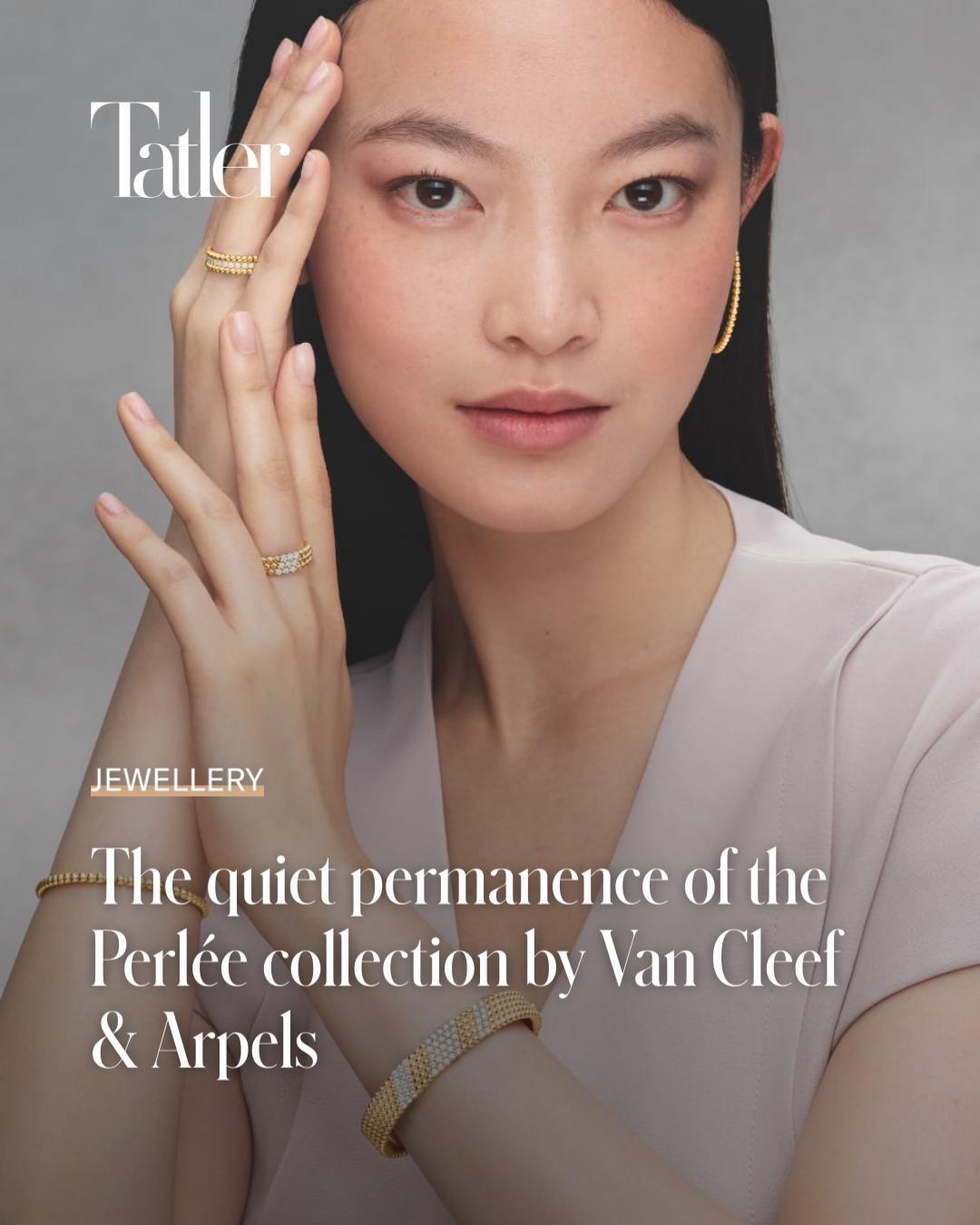
Cover Van Cleef & Arpels’ Perlée collection is one that stands the test of time
Van Cleef & Arpels’ Perlée collection is one that stands the test of time
1 / 1
The golden bead has been a Van Cleef & Arpels signature since the late 1940s—and the Perlée collection, now entering its third decade, suggests that some ideas only deepen with time
Constant reinvention is par for the course these days, from fashion maisons to delivery apps. The Perlée collection from Van Cleef & Arpels has spent nearly two decades doing something considerably harder: remaining entirely, unmistakably itself.
Born in 2008, the collection takes its soul from a deceptively straightforward motif: the golden bead. Yet to call it simple would be to misread what simplicity, executed with this degree of intention, actually demands. The bead does not compete for attention. It earns it gradually, through proportion and light and the particular satisfaction of a form that feels resolved. This is rarer in jewelry design than it might seem.
Read also: Van Cleef & Arpels’ universe of ballerinas welcomes 12 new members


Above Van Cleef & Arpels Perlée diamonds ring in yellow gold and diamond

Above Van Cleef & Arpels Perlée couleurs ring in rose gold
Van Cleef & Arpels Perlée diamonds ring in yellow gold and diamond
1 / 2
The new additions to the Perlée line—rings in yellow, rose, and white gold set with diamonds and coloured gemstones—extend this philosophy rather than depart from it. Golden beads of varying sizes encircle the finger in three measured rows, arranged in careful graduation: the largest crowning the top, the most delicate adorning the underside. A diagonal line of nine diamonds moves across the surface, catching light as the hand moves.
The diamonds used in these pieces must meet rigorous internal standards—graded D to F for colour, IF to VVS for clarity—then subjected to a further quality-control process by the Maison's own experts. The coloured stone variations observe the same discipline: sapphires chosen for a dense, velvety blue, rubies for saturated red, emeralds for vibrant green, each stone examined individually to ensure the ensemble reads as coherent rather than assembled.

Above Van Cleef & Arpels Perlée diamonds ring in white gold and diamond

Above Van Cleef & Arpels Perlée couleurs ring in yellow gold and emerald
Van Cleef & Arpels Perlée diamonds ring in white gold and diamond
1 / 2
The craftsmanship embedded in each piece reflects a broader commitment to the unhurried. The golden beads begin as lost-wax castings in precious metal, then are reworked entirely by hand, each movement calibrated toward perfect roundness, with several polishing stages needed to draw out their characteristic luster. On the reverse of each ring, honeycomb openwork allows light to pass through the gemstones from beneath, amplifying their fire.
The story of the golden bead stretches back further than 2008. From the late 1940s, Van Cleef & Arpels was already treating the bead as a central aesthetic statement, first in the abstract pieces of the Couscous collection, mounted on supple Tubogas-style chains, then in animal clips of the 1950s that celebrated the bead’s intrinsic warmth, and later in the Twist creations of 1963, where beads entwined with coral, lapis lazuli, and cultured pearls in combinations that felt both playful and precise.
From 1968 onward, the golden bead traced the contours of the Alhambra, becoming one of the house’s most recognizable signatures. The Perlée collection, when it arrived decades later, was less a new departure than an act of consolidation, a recognition that certain ideas accumulate meaning over time.
This, perhaps, is what the Perlée collection offers beyond its obvious beauty: a sense of continuity that feels earned rather than manufactured. The golden bead does not position itself against what came before or signal urgency about what comes next. It simply persists—and in persisting, makes a quiet case that the most considered things rarely need to raise their voice to be heard.
Topics
Curated for you
The stories, profiles, and cultural moments featured on our Instagram feed