Cover Couture designer Michael Leyva and contemporary artist Ronald Ventura merge haute couture and fine art in a landmark 10-piece capsule collection staged at Venice’s historic Docks Cantieri Cucchini during the 61st Venice Biennale (Photos courtesy of Michael Leyva)
Couture designer Michael Leyva and contemporary artist Ronald Ventura merge haute couture and fine art in a landmark 10-piece capsule collection staged at Venice’s historic Docks Cantieri Cucchini during the 61st Venice Biennale (Photos courtesy of Michael Leyva)
1 / 1
At the Venice Biennale, a landmark 10-piece capsule collection merges haute couture and contemporary art to elevate Philippine craftsmanship on the global stage
Amidst the scenic Docks Cantieri Cucchini of Venice, Italy, lies a distinctive collaboration between a fashion designer and a visual artist at this year’s International Art Exhibition of La Biennale di Venezia or Biennale Arte. Staged within a city world-renowned for its architectural majesty and artistic legacy, this joint project bridges geographic boundaries while creating an intriguing nexus where haute couture and contemporary art converge.
Set in the historic San Pietro di Castello—a former industrial shipyard transformed into a contemporary art venue—fashion designer Michael Leyva and contemporary artist Ronald Ventura joined forces to present a ten-piece capsule collection, a literal manifestation of wearable art. Together, they demonstrated how fine art can seamlessly transition into the world of fashion.
More from Tatler: Liza Soberano on taking control of her own narrative


Above Michael Leyva and Ronald Ventura

Above A model at the Venice Biennale in an ethereal ensemble
Michael Leyva and Ronald Ventura
1 / 2
Michael Leyva, widely acclaimed for his grand bridal and red-carpet couture, stepped outside his conventional aesthetic to spend five months developing this highly experimental 10-piece collection. Renowned for constructing elegant silhouettes and intricate embellishments, Leyva embraced a transformative creative process to accommodate another artist's vision. Ventura, one of Asia's most prominent contemporary artists renowned for his hyper-realist and pop-surrealist compositions, brought his complex visual iconography into the realm of tactile fashion. His signature motifs—blending street culture, classical mastery and surreal narrative layers—found new life upon fluid textiles.

Above A beaded cocktail dress with butterfly sleeves

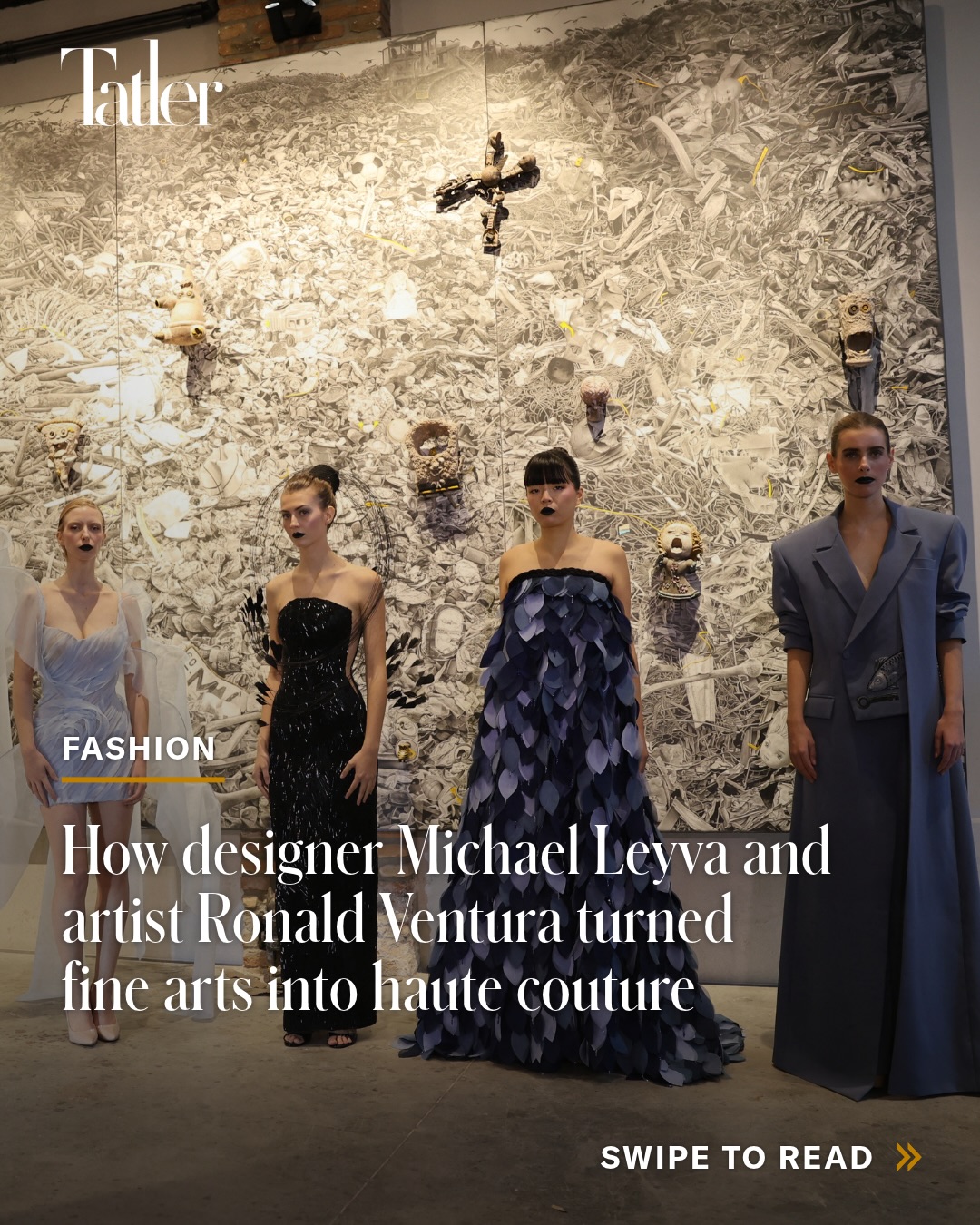
Above A model in a sculptural feather-embellished blue outfit against a large-scale artwork from Ventura's LUNA
A beaded cocktail dress with butterfly sleeves
1 / 2
In the 61st edition of Biennale Arte, Ventura presented an exhibit titled LUNA that compares the maritime histories of Venice and the artist’s native Malabon, both of which are connected by their environmental and climate vulnerabilities. Symbolic of the way the moon influences the rhythm of the tides, the artist explores how reclamation, rising sea levels, and changing climate cycles affect coastal human settlements through paintings, sculptures and installations. The LUNA exhibit serves as an immersive sanctuary, prompting viewers to consider environmental shifts while highlighting the shared resilience of coastal communities separated by oceans yet united by shared ecological threats.
More often, visual arts and fashion are seen as separate forms; rarely do we see works in which both distinct languages merge to create an aesthetic that transcends structure and the canvas. So, against the backdrop of Ventura’s LUNA, the duo created a dynamic dialogue between the two mediums. The collection featured sculptural black gowns, ethereal translucent drapery, flowing ocean-hued gowns and tailored outerwear featuring prints of Ventura’s motif work, emerging as living extensions of the exhibited art collection. By blurring the lines between structural garment construction and expressive visual storytelling, each ensemble redefined wearable art.
See also: Both sides of Nadine Lustre: the new face of Density Noir on softness and strength

Above An avant-garde gown featuring an illustrated bodice and a sculpted skirt of white and teal petal-like layers, presented during the 2026 Venice Biennale

Above Michael Leyva and Ronald Ventura team up to create a ten-piece collection that merges fine arts and fashion
An avant-garde gown featuring an illustrated bodice and a sculpted skirt of white and teal petal-like layers, presented during the 2026 Venice Biennale
1 / 2
Key garments within the showcase translate Ventura’s canvases and textures directly onto fabric—including an oversized, floor-length coat featuring hand-painted designs executed by Ventura himself, as well as a fully textured, hand-beaded pearl mini-Filipiniana dress that pays homage to Philippine craft and marine life. Other ensemble highlights include multi-layered petal skirts with pearl detailing, hand-painted bodices, and structured strip bodices with wide-leg trousers. Each garment stands as a testament to the versatility of Philippine haute couture, showcasing meticulous handwork, structural audacity and a deep reverence for regional traditions.
For both Leyva and Ventura, the project was rooted in mutual creative respect and a shared desire to push their respective mediums beyond traditional boundaries. Staging this artistic cross-section in Venice during one of the international art world’s most significant gatherings allowed the duo to spotlight the depth and sophistication of contemporary Philippine craftsmanship. By putting Filipino fashion designers and visual artists side by side on such an influential platform, the showcase affirmed that creative boundaries exist only to be challenged and redrawn.

Above A structured long jacket featuring illustrations, hand-painted by Ventura

Above The front of a long jacket piece
A structured long jacket featuring illustrations, hand-painted by Ventura
1 / 2
At Docks Cantieri Cucchini, the powerful fusion of Leyva’s sartorial mastery and Ventura’s vision ensured that the Philippine artistic narrative resonated deeply across the global stage.
NOW READ
Rizzoli and Bench chronicle the century-long evolution of the Philippine terno
Liza Soberano on taking control of her own narrative
Jaggy Glarino on reimagining modern Philippine fashion through storytelling and avant-garde design

Karis Tsang serves as a Junior Associate Editor at Tatler Philippines. She tells stories at the intersection of high society, local arts and pop culture. A UST journalism alum, she has a knack for finding the extraordinary in the ordinary. When she’s not typing furiously against a deadline, she’s likely getting lost in a theatre, overanalysing style or planning her next creative rabbit hole.
Curated for you
Discover the stories and updates featured on our Instagram page