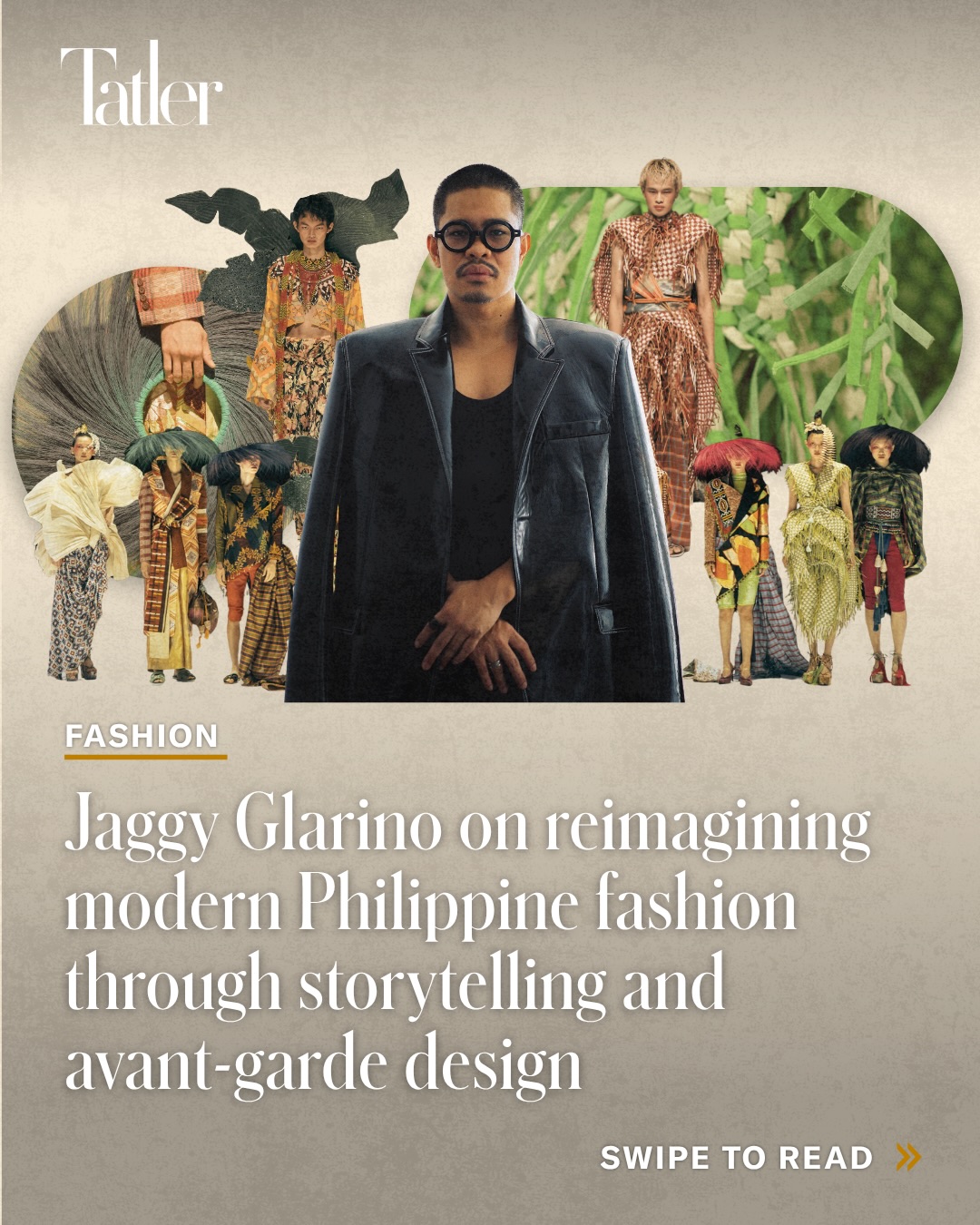

Cover Step inside the world of Jaggy Glarino—where personal memory, woven heritage and fearless silhouette design converge to redefine the future of avant-garde Philippine fashion
Step inside the world of Jaggy Glarino—where personal memory, woven heritage and fearless silhouette design converge to redefine the future of avant-garde Philippine fashion
1 / 1
Jaggy Glarino, a leading avant-garde figure in Philippine fashion, reimagines local nostalgia and personal history through sculptural, thought-provoking couture
Good design always comes from the authentic self. For Jaggy Glarino, fashion is not just an expression but an introspection into his personal story and identity. Every garment represents a piece of what makes up Glarino’s journey in fashion design.
The Mindanao-born, Manila-based designer has emerged as one of the most compelling voices in modern Philippine fashion—not merely for his dramatic, sculptural silhouettes but also for his refusal to treat clothing as simple commodities.
Glarino’s journey to the upper echelons of Philippine fashion is as unconventional as his aesthetic. Before claiming top honours at the Bench Design Awards in 2017 and becoming a fixture at Ternocon and Bench Fashion Week, Glarino earned a nursing degree and passed the US nursing board exam. Yet, he has always kept the arts a constant presence in his life. Before fashion, he had dabbled in dance, theatre, music and painting. With fashion, Glarino felt it was the art form that fully resonated with him, a culmination of all his artistic explorations.
Without formal fashion school training, he approached the craft with the discipline of a scholar and the heart of a multi-hyphenate artist. “Other art forms can tell stories beautifully... but there is something particularly special about fashion. It is one thing to create something and hang it on a wall, but it is another to have a story worn, lived in and eventually become part of someone else’s life,” he said.
To Glarino, a garment is an encounter, a conversation between his life and the wearer’s. His design inspiration comes from past experiences. His work reflects the semiotics he often observed and practised from childhood. These sentiments are evident in his September 2025 collection, IGNO, a name derived from the word “ignorante”. In the IGNO collection, Glarino portrays the rough transition from provincial life to the competitive Metro. The collection features textured tops and dresses inspired by yero, or galvanised iron sheets; oversized dresses shaped like the iconic striped sando bag seen in community wet markets; a wearable kulambo, or mosquito-net head accessory and even a banig, or woven palm mat garment.
By incorporating these elements into his work, he feels as though he is relating his experiences directly to his audience or to the wearer. This creates a feeling of familiarity, as though he is communicating a shared narrative that often does not get any spotlight on the runway.
“My stories may not necessarily mirror theirs, but they contain emotions, situations and experiences that people can recognise, relate to or simply become curious about,” Glarino said. “In that sense, the clothes become a kind of encounter between my story and someone else’s. Through that encounter, there can be synergy, contrast, different interpretations and conversations among the audience. I like that the work does not have to mean the same thing to everyone.”
See more: Holiday dressing, reimagined: the standout trends to adopt from Bench Fashion Week Holiday 2026


Above The IMIN collection from the Bench ‘Thread of Dreams’ show (Photo: Kim Kyle Montes, courtesy of Bench)
The IMIN collection from the Bench ‘Thread of Dreams’ show (Photo: Kim Kyle Montes, courtesy of Bench)
1 / 1
For Glarino, breaking established fashion rules requires an intimate understanding of why they exist in the first place. He spent years dissecting tailoring and garment architecture, viewing technical mastery not as a restriction but as a designer’s primary vocabulary.
“I see craft, skill and discipline as the basic vocabulary of a fashion designer,” Glarino explains. “The interesting part begins when you learn to speak that language in your own way, interrupt it, distort it or push it somewhere unexpected.”
This philosophy allows him to walk the wireline between raw avant-garde concepts and functional tailoring. When working with inherently rigid traditional crafts—such as banig or solihiya (rattan weave)—he avoids a literal, rigid application. Instead, he extracts the weave’s rhythm, texture and spirit, translating them into fluid, body-conforming textiles that allow the garment to breathe and move.
See more: In Conversation: Gloria Diaz and Margie Moran on what it means to be a Filipina beauty queen

Above A Jaggy Glarino design (Photo: Kim Kyle Montes, courtesy of Bench)
A Jaggy Glarino design (Photo: Kim Kyle Montes, courtesy of Bench)
1 / 1
Glarino cites the theatricality and fearlessness of Alexander McQueen and John Galliano as pivotal influences in his early creative awakening. Like his idols, Glarino isn’t afraid to make his audience uncomfortable if it helps tell an authentic story. In an era when fashion often feels pressured to stay agreeable, Glarino champions the power of clothing to seduce, disturb and provoke.
“Fashion and art can do more than simply please. They can put you in beautiful situations, but they can also confront you with things you may not necessarily want to talk about, or even think about,” said Glarino.
This fearlessness translates directly into his nonconformist approach to proportions. He treats them as an independent proposition—exaggerating shoulders, obscuring waists and shifting volume in ways that allow women to define their own version of beauty and confidence.
Glarino describes his approach to fashion as non-linear. His inspiration can come from a song, a piece of deadstock fabric, a personal memory or an image of a completed gown that appears all at once in his mind.
He maintains a dynamic relationship with textiles, especially handwoven and organic materials that bear the physical history of human touch. Rather than imposing a rigid sketch on a textile, Glarino lets the fabric’s weight, drape and resistance dictate the final silhouette. He frequently pairs traditional, handwoven fabrics with modern technical or industrial materials—using contrast to heighten the heritage weave’s delicacy and history.
For him, sustainability extends far beyond choosing eco-friendly fabrics. It is a multidimensional practice encompassing community support, cultural preservation and studio resourcefulness—transforming atelier scraps, vintage tablecloths and salvaged materials into runway-ready couture.
Perhaps Glarino’s most vital contribution to contemporary fashion is his refusal to treat Philippine culture as a static museum artefact or a costume. This commitment is evident in collections like IMIN, showcased at BENCH Fashion Week spring-summer 2026. IMIN, derived from the word “immigration”, is inspired by the pre-war Japanese settlements in his native Mindanao. The collection celebrates Japanese-Filipino historical ties through a local lens, one grounded in his home province. Glarino proposes a fresh visual language that fuses T’boli beadwork, samurai-inspired shoulder pads and cross-border weaves.

Above Jaggy Glarino for Tatler Philippines
Jaggy Glarino for Tatler Philippines
1 / 1
For Glarino, indigenous Filipino artistry should never be reduced to predictable Filipiniana tropes. “Filipinos are more ready to be challenged now... Tradition can be respected while still being questioned, reinterpreted and allowed to evolve.”
By viewing cultural references through the lens of their intelligence, craft and emotional weight, Glarino continues to prove that Philippine fashion can compete on the global avant-garde stage—not by conforming to global standards, but by fearlessly reimagining its own roots.
NOW READ
Ariana Grande reclaims her voice in ‘Petal’, a dark ‘80s synth-pop and horror record
How Tatler Most Stylish 2026 honourees wear style their own way
Everything the front row witnessed at Manila Fashion Week 2026
Topics

Karis Tsang serves as a Junior Associate Editor at Tatler Philippines. She tells stories at the intersection of high society, local arts and pop culture. A UST journalism alum, she has a knack for finding the extraordinary in the ordinary. When she’s not typing furiously against a deadline, she’s likely getting lost in a theatre, overanalysing style or planning her next creative rabbit hole.
Curated for you
Discover the stories and updates featured on our Instagram page