

Cover A 1964 photo of Ayala Avenue as seen in the book, 'Fifty Years and Forward'
A 1964 photo of Ayala Avenue as seen in the book, 'Fifty Years and Forward'
1 / 1
An excerpt from the book 'Fifty Years and Forward', on the rich history of Makati and how it became the financial capital of the Philippines
Before the first patch of ground was broken, the first pipe laid, and the first street paved, there were almost two years of careful research, study and preparation that went toward the making of the Makati of the Ayalas.
Between 1946 to 1947, when the smoke and rubble of the Second Word War had barely cleared, Col Joseph R McMicking would bring to bear the principles of American town planning on this project, consulting with experts on topics as diverse as engineering and architecture, sociology and financing, as well as marketing and sales.
This was the foundation on which the Master Plan, and with it, Makati, was formed.

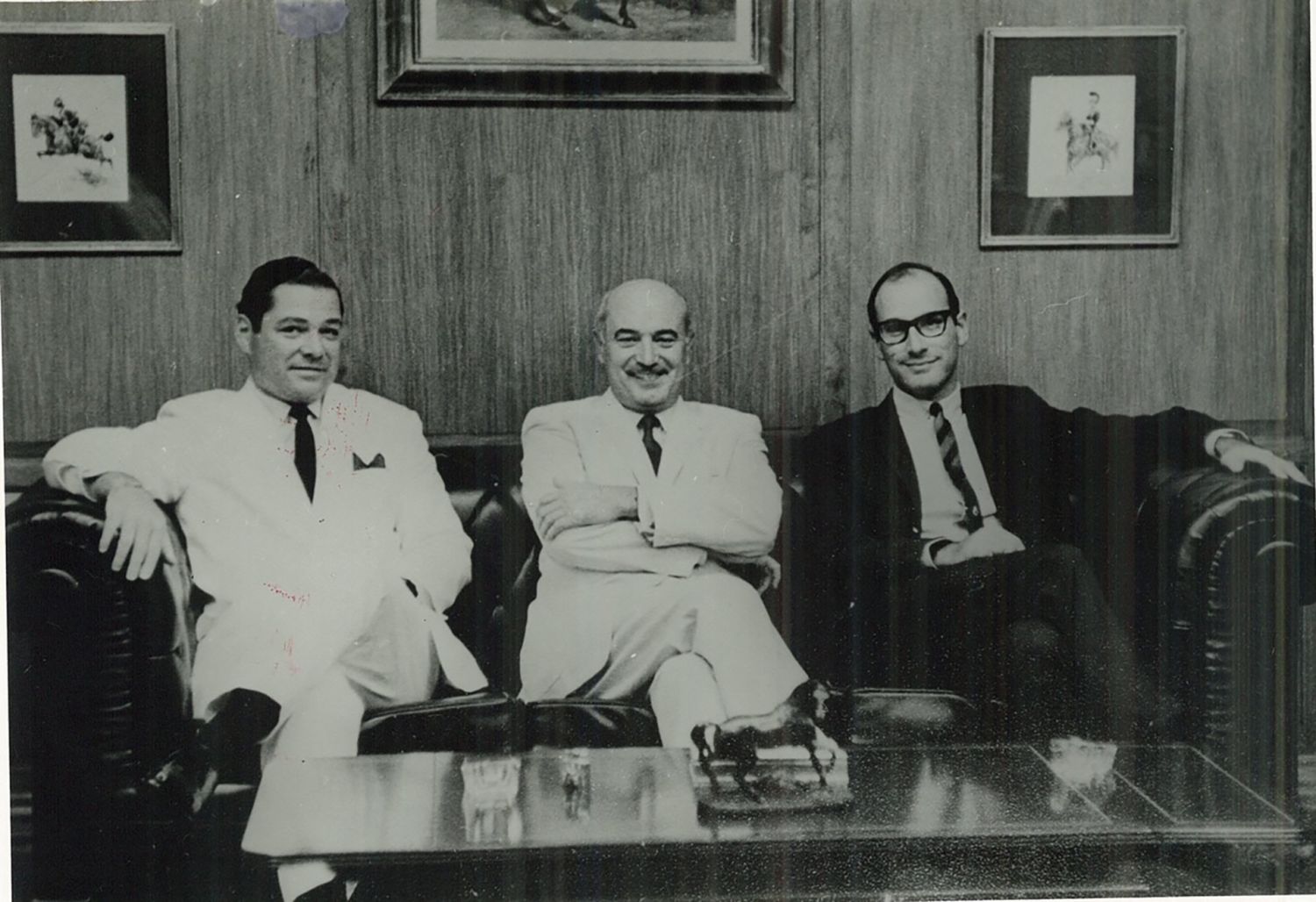
Above Enrique J Zobel, Col Joseph R McMicking, and Jaime Zobel de Ayala
Enrique J Zobel, Col Joseph R McMicking, and Jaime Zobel de Ayala
1 / 1
It had a certain symmetry to how Manila’s first stone structures were raised—from the enterprise and effort of two Spanish priests who had arrived together in 1581. They were the first bishop of the Philippines, Fray Domingo de Salazar, and Fr Antonio Sedeño (whose name is now on a street in Salcedo Village), superior of the first Jesuit missionaries to arrive in this country. Fr Sedeño was an engineer given the task of putting up the churches and battlements of Intramuros. It was Bishop Salazar, on the other hand, who made it his mission to find the necessary stone. He explored the Pasig River in a barge, intrepidly sailing into unknown territory until he finally found adobe in a place that would be called Makati. To this day, more than 440 years later, some of the walls and churches of old Manila still stand made from this strong Makati material—in the same way, that Makati, too, still stands strong on a foundation forged from vision and courage.
McMicking was, in the truest sense, a shaper of things, a maker of the future. Born at the dawn of the 20th century in Manila, he was a unique hybrid of experiences crossing several cultures. Educated in both the Philippines and the United States, he was the youngest member and only Filipino on General Douglas MacArthur’s staff. He must have become adept at information gathering, as well as its analysis and communication, as an intelligence officer serving in the Pacific Command. Later, he would consult with President Manuel L Quezon as the army’s emissary in Washington, DC, to discuss the reconstruction and rehabilitation of the occupied country. In 1945, McMicking would wade ashore alongside MacArthur on the historic Leyte beach. Like his entire generation, he must have been devastated to find Manila in ruins upon his return.
Read also: The Historically Iconic Spots Around Makati Central Business District
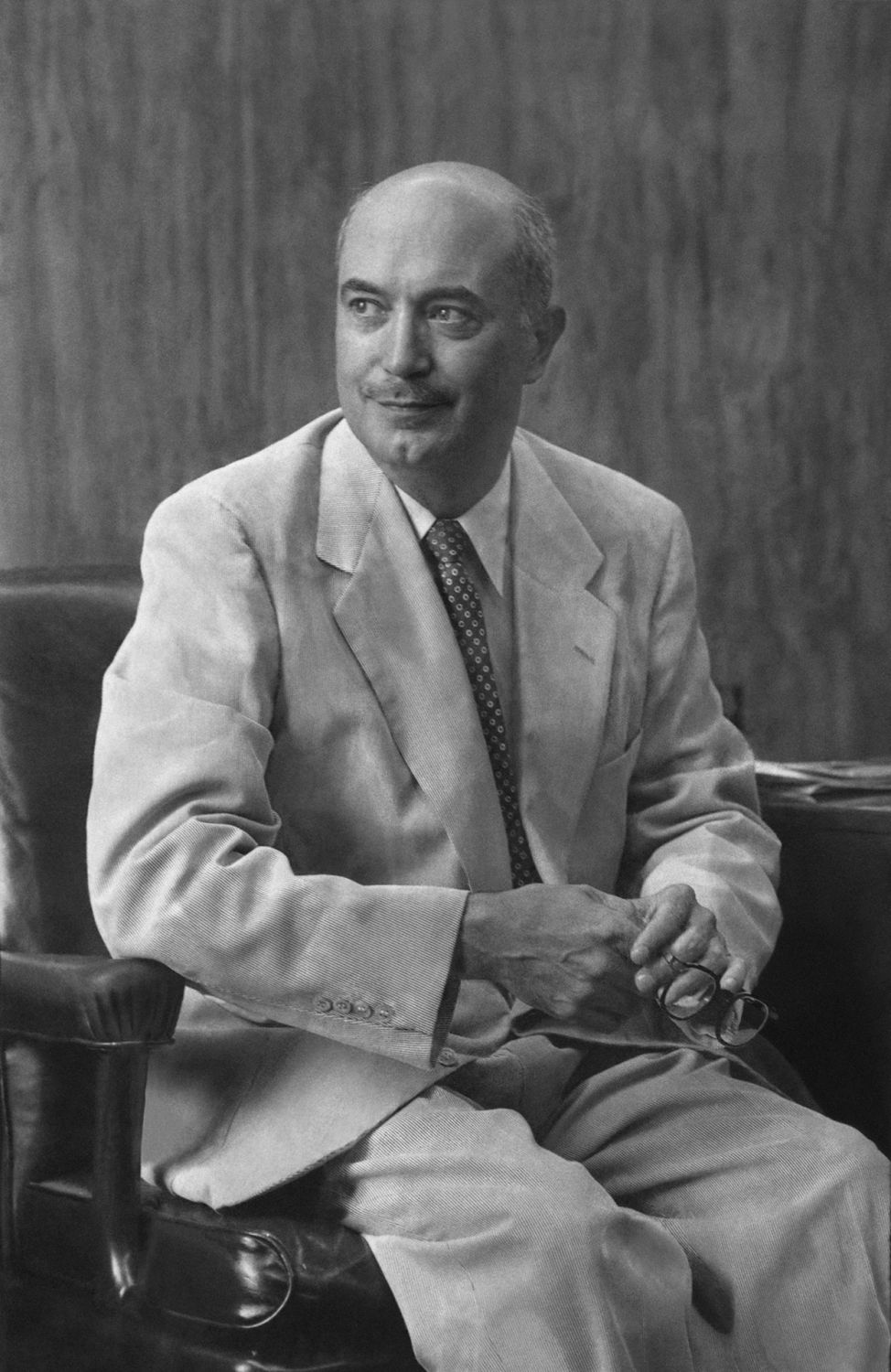
Above Col Joseph R McMicking at Ayala y Cia, taken in 1956
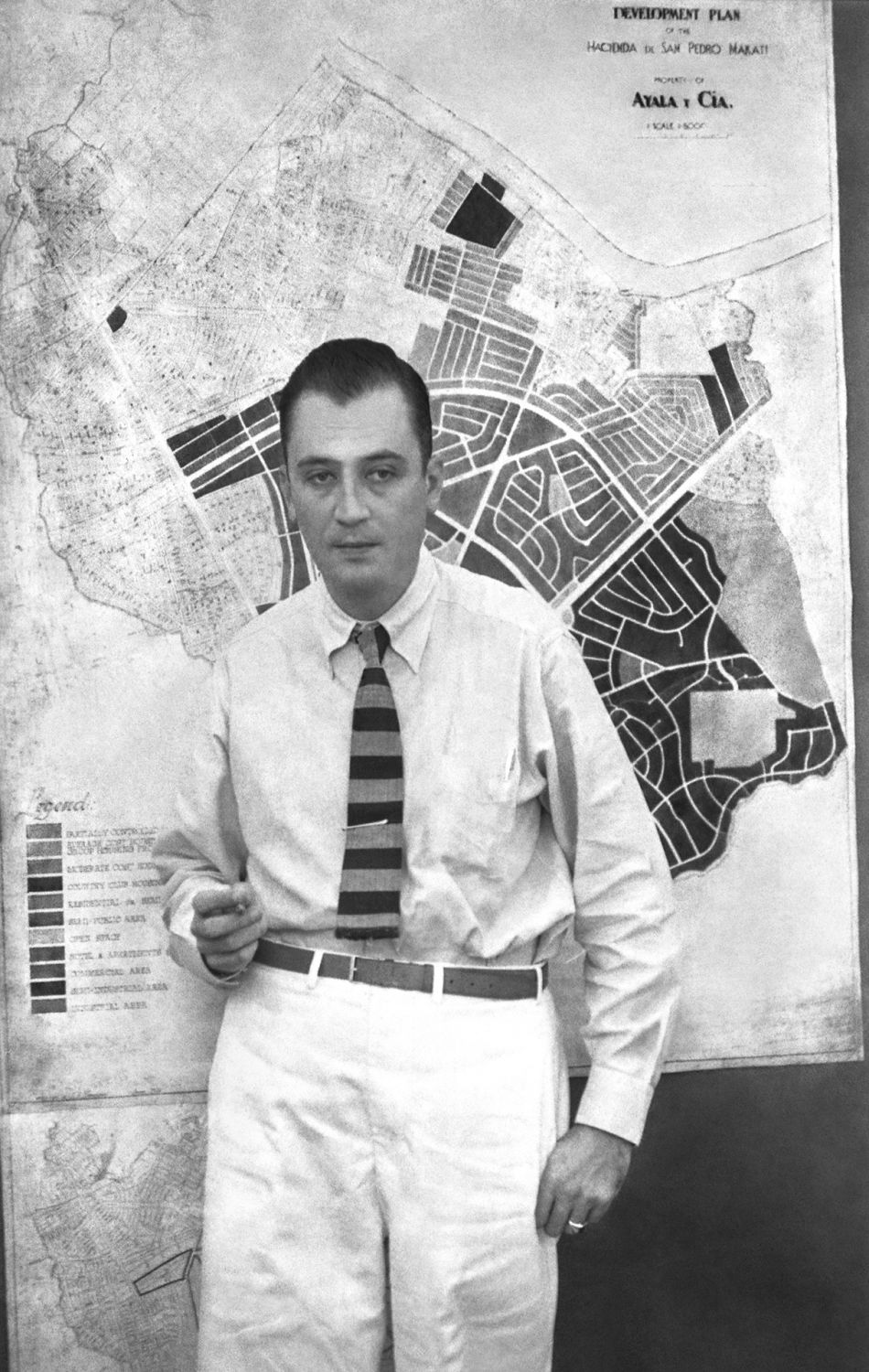
Above Fernando Zóbel with a map of the Makati Master Plan
Col Joseph R McMicking at Ayala y Cia, taken in 1956
1 / 2
It must have only strengthened his resolve “to deliberately build the finest real estate development in the Philippines”, as he put it. “Anything less could not have accomplished our purpose,” he wrote in an essay titled, The Makati Adventure. There was no other term for it than a plan—the Master Plan—to create a model city, entirely from scratch, whose various sections (residential and leisure, to the arts and sciences, to business, light industry, apartments and hotels, and education) would be rolled out in phases according to a finely tuned rationale.
To begin the process, McMicking needed to create what he would famously term as “the first magnet”: a value proposition so enticing that nobody could reasonably turn it down.
Its basal phase called for the establishment of a first-rate residential neighbourhood featuring “fully paved, full-width roads, underground drainage and elaborate landscaping”. Furthermore, the initial lots would be sold at an introductory price below development cost and with substantial rebates to those who would build in a short period of time. A holding period before resale was established to discourage speculative investment.
The Plan also introduced the country’s earliest zoning and building regulations. The residential sector was to be used exclusively for homes (no mixed-use properties such as home businesses or agricultural enterprises like poultry raising). Only 30 per cent of each property, which averaged a lavish 2,500 square metres, could be built up. The lion’s share, or 70 per cent, was meant to go to gardens, tennis courts and swimming pools.
Read also: The Brilliant Life and Turbulent Times of Don Jacobo Zóbel y Zangroniz

Above An aerial view of Ayala Avenue from the intersection of Ayala and Buendia Avenues in 1964
An aerial view of Ayala Avenue from the intersection of Ayala and Buendia Avenues in 1964
1 / 1
To add an indispensable cachet, both the Manila Golf Club and the Manila Polo Club were wooed away from their original addresses with attractively priced parcels of land.
Finally, William Cameron Forbes, the fifth American governor-general of the Philippines—and the man who brought polo to the country—was prevailed upon by a fellow Harvard alumnus, Fernando Zóbel, to lend his name to this promising new enclave.
Thus, on January 1, 1948, the infrastructure works for Forbes Park began.
Once that had been accomplished, McMicking began what would become a long-time Ayala tradition of leading by example. He did two things. First, he moved his own home and the rest of the Ayala families to Forbes Park. Second, he built 20 “handsome houses” for rent not just to immediately populate the neighbourhoods but also to quickly establish what would be another hallmark of Ayala developments: high-quality construction. It would not be long before a minimum spend per home would be included in the contracts of sale as well.
Sale number one was made almost a year later, on January 14, 1949, to Jack Manning, the president of the Ford Motor Company in the Philippines. Manning was a popular, accomplished member of Manila society and its business community, both expat and local. He was exactly the kind of well-connected resident that the development would count on to influence his many friends and associates to relocate with him.
Read also: Welcomed with Luxury: 8 Top of the Line Hotel and Resort Lobbies

Above The men behind the Makati Master Plan included (seated, from left) Fernando Zobel de Ayala, Alfonso Zobel de Ayala, Col Joseph R McMicking and Enrique J. Zobel. (Standing, from left) Jaime Zobel de Ayala, Alfredo Melian, Col Jaime C Velasquez and Salvador Lorayes
The men behind the Makati Master Plan included (seated, from left) Fernando Zobel de Ayala, Alfonso Zobel de Ayala, Col Joseph R McMicking and Enrique J. Zobel. (Standing, from left) Jaime Zobel de Ayala, Alfredo Melian, Col Jaime C Velasquez and Salvador Lorayes
1 / 1
The process McMicking used to build Forbes Park was next applied to the development of the business centre. To set the stage, the paving of Ayala Avenue was undertaken, using the runway of the now-defunct airport called the Nielson Tower. Established in 1936, it had a short-lived run as the country’s first international aerodrome. The Plan transformed it into a two-kilometre, six-lane boulevard that ran from what was then called Highway 54 (the present-day EDSA) to Buendia Avenue (now Senator Gil Puyat Avenue). Trees were planted along both sides, and parkland would be set aside for open spaces.
To accelerate the development of this financial capital of the future, the Ayalas once again put up their own buildings, setting the bar for the kind of sleek design and state-of-the-art construction the new city demanded. The Monterey, in 1956, a luxurious eight-story residential building, was the first of its kind on the avenue—and a few years later, in 1958, the Makati Building, which had six floors housing Ayala y Cia and Filipinas Life. Both were designed by an enthusiastic young architect named Leandro Locsin.
The rules for land use in the residential zones were also applied here: owners were required to build within three years. Only first-class materials could be used (such as reinforced concrete), and buildings had to be fully air-conditioned, serviced by elevators, lit at night and have a minimum of five stories (later six, but no higher than 12). No retail establishments, restaurants and gas stations were allowed on the ground floor of any building so as not to impede the flow of traffic. In fact, buildings on corners had to be curved to allow for greater visibility of oncoming cars.\
Read also: San Nicolas District: The Forgotten Treasure of Manila
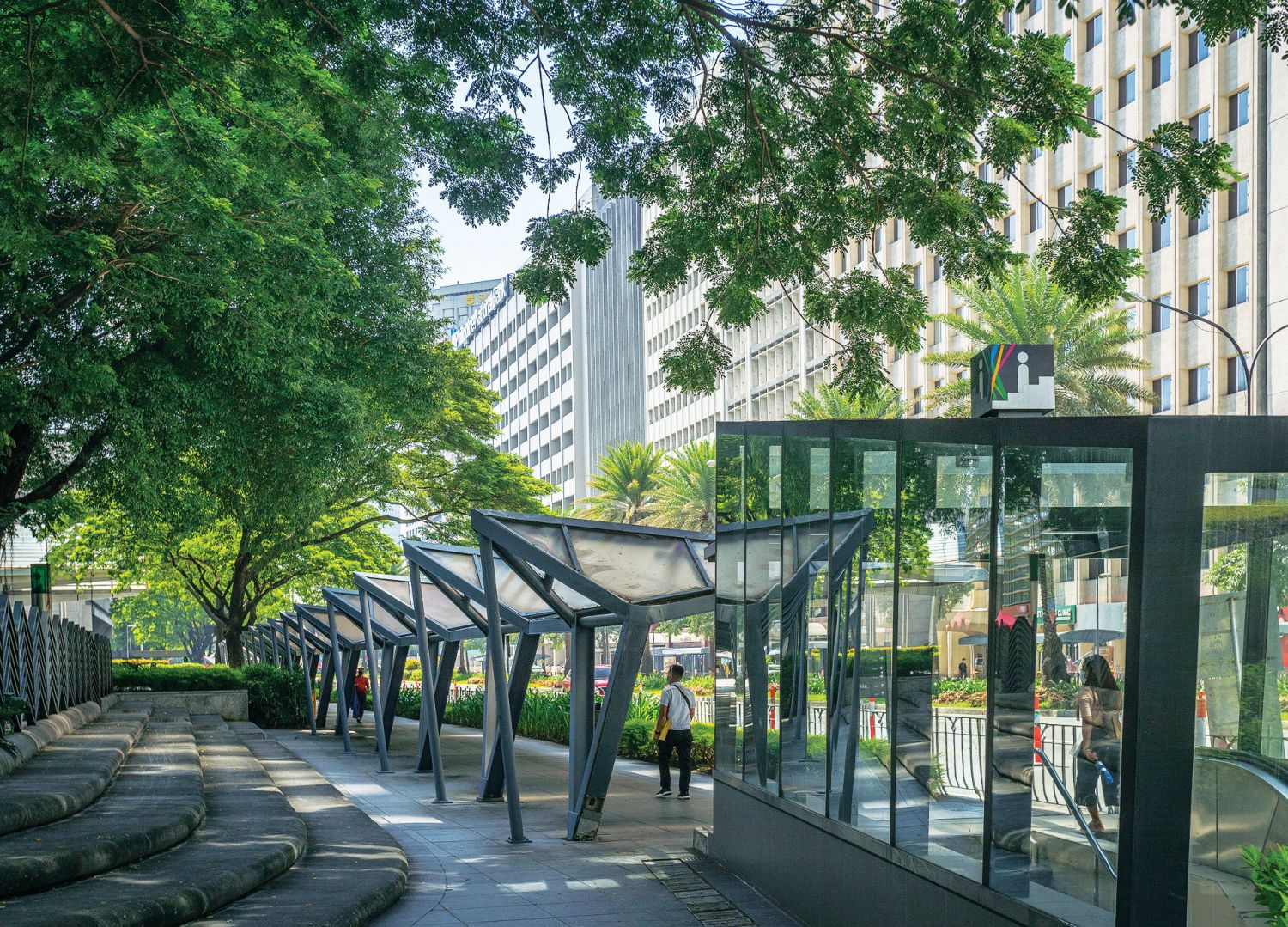
Above MACEA waiting sheds and glass vestibules to the underpasses
MACEA waiting sheds and glass vestibules to the underpasses
1 / 1
Absolutely no factories were allowed, especially the gas- or oil-burning kind. In any case, there was a sector for light industry in the Pasong Tamo zone, where the Don Bosco trade school (now a technical institute of higher education) was established in 1954 to train boys who lived outside the development to make a living. (Unemployment figures at the time stood at ten per cent of the population.)
This would, in turn, foreshadow the establishment of the Asian Institute of Management 14 years later on land donated by Col and Mrs McMicking. It would sit on 10,000 square metres of valuable commercial land and “was conditioned upon the full support of the Ateneo de Manila University and De La Salle College, and continuing support from the Harvard Business School and the Ford Foundation”. It was a parting endowment from McMicking, the man credited with the orderly development of Makati, as well as the rehabilitation of Insular Life and the organisation of Filipinas Life, upon his retirement on March 31, 1968.
Read also: Kumu Founder Roland Ros on How Social Media Can Spark Social Change

Above Ayala Avenue in 2021

Above A view of the Washington Sycip Park
Ayala Avenue in 2021
1 / 2
The first Makati Commercial Center would next unfold in 1960, with the Rizal Theater as its anchor and to be surrounded by one- to two-story malls, retail establishments and banks, restaurants and even a bowling alley. Again, two-thirds of each leased property needed to be earmarked for parking.
There were parks and open spaces featuring international-style amenities. Eventually, also created were a man-made lagoon and promenade designed by Peter Holsts of Denmark and an aviary designed by D Kenton Lint, curator of birds and later curator emeritus for the San Diego Zoo in California.
Today, MACEA remains committed to the principles that have stood both the Master Plan and the Makati Central Business District in good stead—that is, to maintain and evolve a sophisticated urban environment that is responsive to its stakeholders’ needs.
Read also: Tatler Time Capsule: The Ayala Center

Above An aerial view of the Makati Skyline
An aerial view of the Makati Skyline
1 / 1
Sir Isaac Newton, the man who helped us make sense of the world around us, once said that if he could see further than others, it was only because he stood on the shoulders of the giants who had come before him.
The Makati Central Estate Association in turn humbly acknowledges the giants whose foresight has allowed it to stay true to its purpose and continue to harness the past to create the future—Col Joseph R McMicking, Don Alfonso Zóbel de Ayala, Enrique Zóbel, Jaime Zóbel de Ayala, Col Jaime C Velasquez, as well as all the Ayala managers—and thanks to them for the privilege of safeguarding this important legacy.
NOW READ
A Closer Look at the Ayala Corporation, Philippines' Oldest Conglomerate
Fernando Zobel: Get to Know the Artist and His Dreams
A New Era Begins for Ayala Museum and Filipinas Heritage Library
Credits
Photography: Wig Tysmans
Images: Ayala Land Archives





