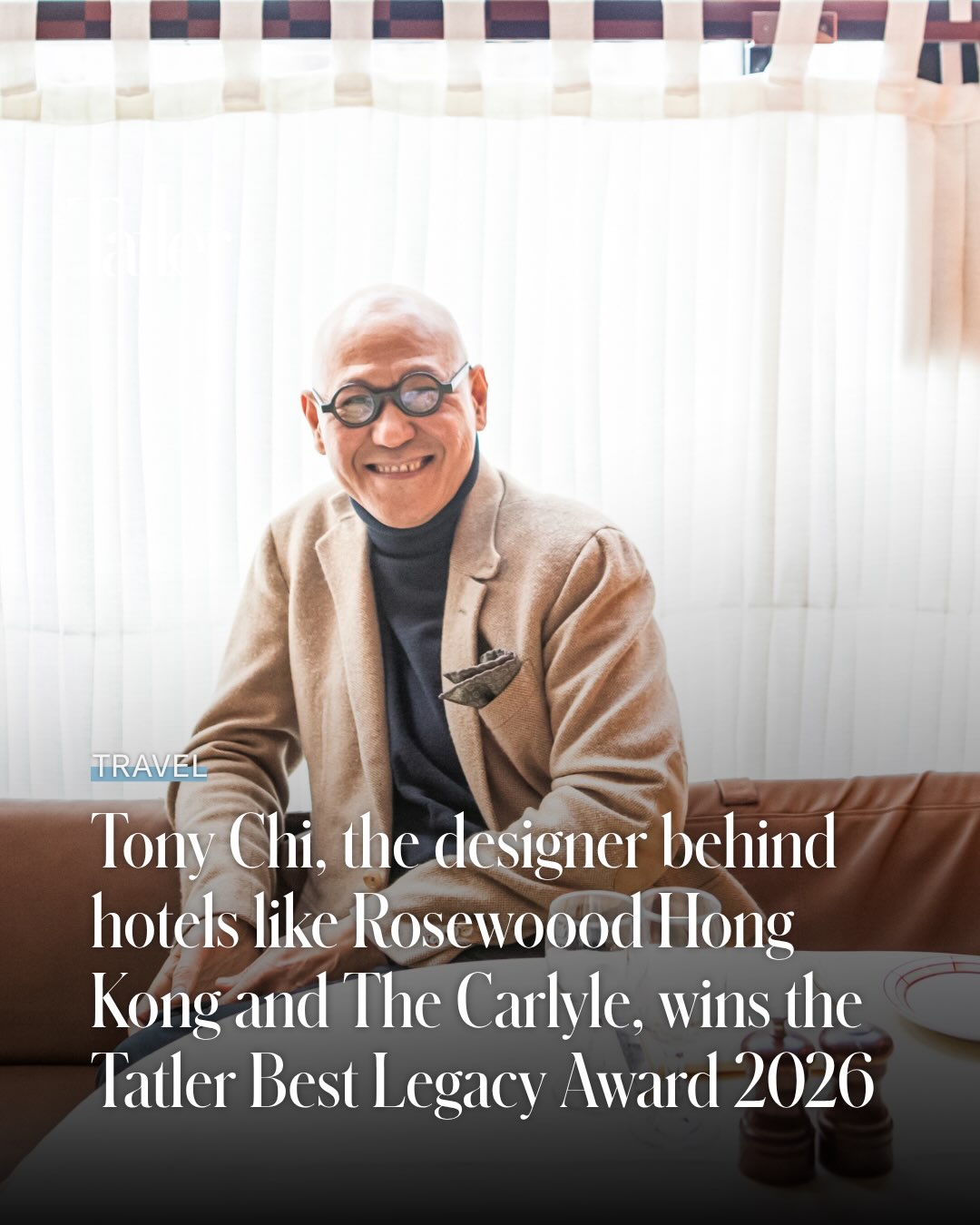

Cover Tony Chi, recipient of the Tatler Best Legacy Award 2026
Tony Chi, recipient of the Tatler Best Legacy Award 2026
1 / 1
Prominent designer Tony Chi has has built his legacy by preserving those of others
“Let me turn down my opera,” says designer Tony Chi as we begin our interview. It’s Friday afternoon when I call him and he’s at his home in Taipei, enjoying a glass of white wine. Life in semi-retirement looks good on him.
“Retirement isn’t about retiring from life. Rather, I have more time,” says Chi, who spends that time going back to school to take courses on subjects like history and archaeology. “Today is Friday, and I’ve come up to my home in the mountains, having my happy hour drink at sunset and beginning my weekend. These are the things I consider luxury—it’s not necessarily about living the ‘high life’.”
For Chi, luxury is about choice, and he’s chosen to live his life and build his career following the principle of quality over quantity. A principle that's informed his approach to designing some of the world's most coveted hotels, including Rosewood Hong Kong, Park Hyatt Kyoto, The Carlyle in New York, and Rosewood London to name a few.
Safe to say, presenting Chi with this year's Tatler Best Legacy Award was a no-brainer.
See also: Bill Bensley believes the world needs more whimsy, and he's certainly doing his part


Above Rosewood Hong Kong, designed by Tony Chi
Rosewood Hong Kong, designed by Tony Chi
1 / 1
In 1984, Chi founded his namesake Manhattan firm, tonychi studios, operating as a boutique practice of roughly two to three dozen multidisciplinary creatives. “I could have built a company with 1,000 staff, but we kept it very small. I could have done 40 projects at a time, but I would only do, say, five, and that was my choice,” he says.
As the hotel industry has become increasingly driven by scale and rapid expansion, Chi made the choice to step down from running his eponymous studio in 2019—a “conscious uncoupling”, if you will, from where he felt the industry was headed.
“I enjoy the creative process a lot more than the result. [Before stepping down in 2019] I found it harder to work on larger projects, because everything is so driven by monetary issues. Cost and time seem to be the only thing people care about, and I don’t deny the importance of it, but earlier in my career, operators had a bit more patience. They would react to ideas, they’d be enthusiastic about being involved in the process, but it’s different today. Most are looking for immediate or short-term results,” he says. “I keep telling them, you know, slow down, man.”
In short, he says, “greatness takes time”. His work proves his point: Rosewood Hong Kong took about eight years from conception to completion, and his redesign of The Carlyle, a Rosewood Hotel, in New York took 15.
The latter is a hotel that he was initially hesitant to work on. “Back in the Seventies, if you asked people where they lived, they’d tell you their zip code, which says plenty,” says Chi, who moved to New York from Taipei at the age of six. “So 10021, where The Carlyle is, was known for the snobs. Now we call it the Upper East Side.”
Chi experienced a different New York growing up in the Lower East Side. He spent four years studying at the High School of Art and Design in the city’s midtown, where he would paint for four to five hours a day, then spent the 1960s and ’70s hanging out what he calls the “black sheep” of the art world, including Keith Haring and Peter Max. “They were basically party animals living underground in New York,” says Chi, laughing. “I grew up in the art world and that guided my future.”

Above Dowlings at The Carlyle, designed by Tony Chi

Above Dowlings at The Carlyle, designed by Tony ChiDowlings at The Carlyle, designed by Tony Chi
Dowlings at The Carlyle, designed by Tony Chi
1 / 2
His artist’s sensibility shaped his “invisible design” philosophy, and The Carlyle is a perfect example of this. The hotel opened 96 years ago, and has been a playground for the rich and famous ever since. With a place that’s so sacred to so many, the challenge for Chi was deciding what to keep and what to change.
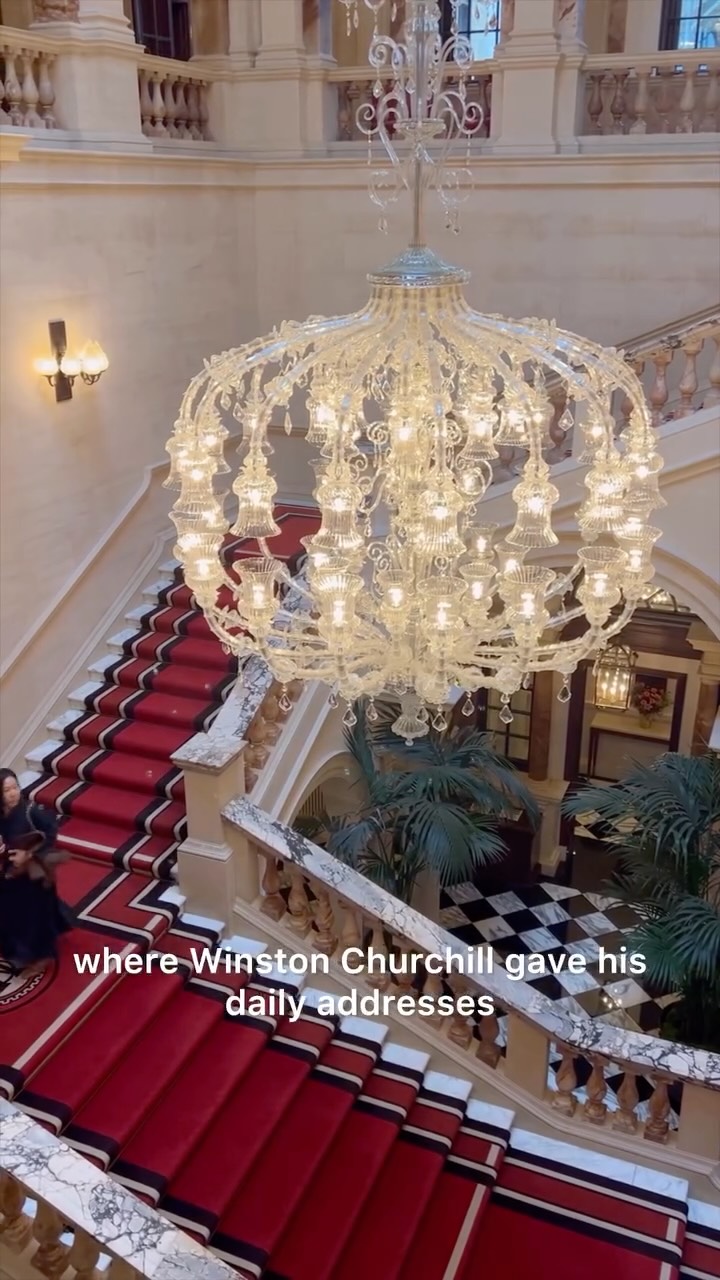
Guest rooms were upgraded and common spaces were polished, but some of the hotel’s most noteworthy elements remained: the iconic black marble floors of the lobby still sparkle; the walls of Bemelmans Bar still feature the original, faded murals by illustrator Ludwig Bemelmans, who wrote the Second World War-era children’s book Madeline—it’s his only work on public display; and the restaurant remains clad in hand-painted wallpaper by Milanese artist Enrico Brus and lined with banquettes dressed in antique Turkish kilim, tapestry-woven rugs. “[The Rosewood team] asked me, ‘Tony, I don’t see where my money went?'” he says laughing. “But that has been the trick. We wanted to change it without stripping the spirit of it.
“Another area I insisted we didn’t change was the concierge. A tiny room with a curved counter,” Chi tells me. “The concierge, Frank, is an older gentleman. He’s an amazing opera singer … if he likes you, he’ll sing for you.”

Above Park Hyatt Kyoto, designed by Tony Chi
Park Hyatt Kyoto, designed by Tony Chi
1 / 1
That same sense of sentimentality and personal connection was applied when Chi worked with owner Sonia Cheng to design Rosewood Hong Kong, where he incorporated design elements that represented three generations of Hong Kong’s prominent Cheng family.
For example, her father was a jeweller, so Chi incorporated chandeliers and various geometric patterns that adorn the hotel’s floors. Meanwhile, raw materials like wrought iron represent Cheng’s more contemporary taste. If you laid out every design element and every piece of decor at Rosewood Hong Kong, it would probably look like an incoherent mess. But when put together, Chi says, “it makes music. It’s like a symphony.”
Besides, there’s more to design than the visuals. “Don’t always trust your eyes,” he says. “Most people think design is based on what you see but I believe it’s about how you feel in a space.”
Today, he has shifted his focus from commercial to residential projects for private clients. He says, “I enjoy the pace, I enjoy working with a smaller group, and the work is something from which I learn continuously. When you’re dealing with families, they have four, five generations of accumulated wealth: both monetary and intellectual wealth. I get to work with them, learn and explore their family archives. Rather than shopping in a showroom, I look to their storerooms. I find that fascinating and invaluable.”
And while he says he’d love to do one more hotel, at 69 years old, Chi says dedicating 10 years to a new project doesn’t have the same appeal as it once did, and so he’s chosen to walk away to pursue smaller projects that speak to his soul.
“Just remember, you only have one lifetime,” he says. “Life is not going to wait forever.”
Curated for you
The stories, profiles, and cultural moments featured on our Instagram feed