
1 / 1
What’s even more valuable than diamonds? Stamps, believe it or not. Far tinier and lighter than women’s favourite rocks, some of the oldest, most unique stamps have fetched millions at auction—in some cases, outdoing bids placed on artworks by the great masters—and the history the four-sided pieces of paper holds is priceless. Another interesting fact: Singapore is home to some of the world’s most respected collectors. Melissa Gail Sing speaks to a few of them about the charm of the prints.

A childhood hobby for many, collecting postage stamps is a colourful way to document the passage of time. How many of us have had little stamp albums filled with pieces carefully removed from envelopes that we proudly displayed to cousins and classmates? But it’s only a handful who have taken this passion to a different level, treating those perforated four-sided rectangles or squares with the care one would accord a priceless artwork. And indeed, at an auction in June last year, a jaw-dropping US$9.5 million was paid for a One-Cent Magenta from British Guiana issued in 1856, making it the highest amount ever paid for a stamp at auction.
Even with the advent of email largely replacing snail mail, the “hobby of kings” as it is known, is still very much alive and kicking—even here in tech-advanced Singapore where millions of email are sent daily. There are a number of stamp clubs in the country including the grand dame of them, the 75-year-old Singapore Stamp Club, the Singapore Philatelic Society, the Kreta Ayer Stamp Society, the Chai Chee Stamp Club and smaller hobby groups. Some of our most serious and professional collectors are also widely respected globally. They have had their award-winning collections exhibited in large-scale events around the world and some have judged at international stamp competitions. Two of them hold the honour of being on the British Philatelic Federation’s Roll of Distinguished Philatelists: Koh Seow Chuan, a noted architect and art collector who helped establish the Inter-Asia Philately Federation in 1974, and Tay Peng Hian, president of Switzerland-based Fédération Internationale de Philatélie since 2010. Like the Nobel Prize of philately, this prestigious title is conferred to only three to five of the world’s best philatelists annually.
Further testament to the international repute of our country’s professional stamp collecting community, the prestigious World Stamp Exhibition returns to Singapore for the third time this year. Held from August 14 to 19, the exhibition also commemorates Singapore's Golden Jubilee and highlights include a Court of Honour worth over S$10 million with award-winning collections from local and international collectors, exhibits depicting the development of Singapore's postal history and stamps over some 180 years and in celebration of Singapore’s 50th year of independence. In addition to opportunities to meet stamp designers, attend seminars and participate in auctions, there are also activities catered to youth, ensuring the longevity of this meaningful past-time.
Melissa Gail Sing speaks to Singapore’s most prominent collectors about the charm of the prints.
Tay Peng Hian

Tay Peng Hian, President, Fédération Internationale de Philatélie
The chairman of Swee Hin Group of Companies, Tay Peng Hian has been the president of Fédération Internationale de Philatélie since 2010. He is also Honorary President of the Association of Singapore Philatelists and Honorary Member of the Federation of Inter-Asian Philately (FIAP).
How did you start collecting stamps?
When I was nine years old, my mother gave me a packet of colourful stamps of the world, which attracted me and my interests in stamps thus began. I was excited to learn the names of countries that were strange to me at that time and I wondered where were they situated. The illustrations on them prompted me to find out more of the tatler_tatler_stories behind them.
Is there a specific country, period or theme of stamps you like to collect?
I like to collect early stamps of the world issued in the 19th century. These are known as Classic Issues, the crème de la crème of stamps. My collections past and present include Straits Settlements Classic (stamps and letters of Singapore, Malacca and Penang of the 18th and 19th centuries), First Stamps used in Burma (known as Myanmar today) since 1854, and in the Netherlands East Indies (known as Indonesia today) from 1655 to 1870.
What’s the most prized stamp that came into your possession?
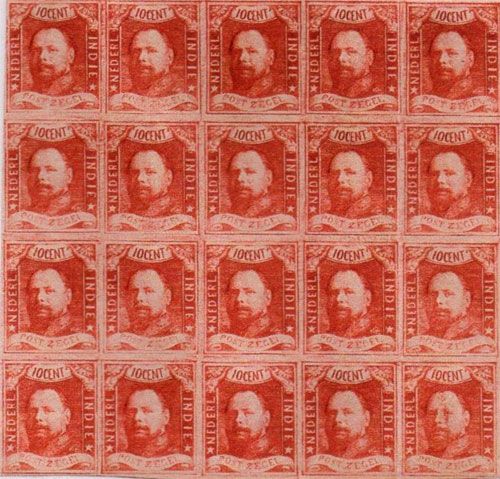
One: The First Stamp of the Netherlands East Indies (today’s Indonesia) issued on April 1, 1864. A full sheet consists of 100 stamps. I have the largest known sheet of 24 stamps. It’s a national treasure of Indonesia.
Two: The largest known used (postmarked) stamps of the First Stamp, consisting of 50 stamps. All the stamps were postmarked in Ngawi Post Office on February 16, 1869.

Tay’s most prized pieces include the First Stamp of the Netherlands East Indies (today’s Indonesia) issued on April 1, 1864. A full sheet consists of 100 stamps and he has the largest known sheet of 24 stamps

He also owns the largest known number of used (postmarked) stamps of the First Stamp, consisting of 50 stamps. All the stamps were postmarked in Ngawi Post Office on February 16, 1869.
What’s the greatest extent you’ve gone to, to get your hands on a particular stamp?
I had to use a commission agent to fly over to Brussels, Belgium to negotiate for the purchase of the First Stamp of the Netherlands East Indies (mentioned above). I also had to bid very hard to secure the used stamps of the First Stamp (mentioned above). I paid a six-figure sum for both items. They are unique and I could not have found the same quality. Philatelists collect classic stamps by their quality not by quantity. I have often been asked, “You must have thousands of stamps in your possession?” But in my Netherlands East Indies collection, for instance, I really collected only six stamps, and even with permutation and combination, it all only adds up to a few hundreds stamps.
How has philately made a mark on your life?
I have been very dedicated to this hobby since I was young. In 1978, I was the first Singaporean to display my Straits Settlements collection in an FIP World Stamp Exhibition held in Prague, Czechoslovakia (Czech Republic). The following year, I presented Singapore for FIP membership in the 1979 FIP Congress held in Sofia, Bulgaria. Singapore membership was approved and admitted. For the past 40 years, I’ve actively participated in the FIAP movement, the Asian arm of the world philately organisation (FIP). I’ve held various positions in the FIAP executive committee and I have been president of FIP since 2010.
To receive a Gold medal at the Olympics is never easy. Similarly, in the competitive world stamp exhibitions, achieving the Grand Prix award is no mean feat. One’s collection is pitted against that of some 400 collectors from the cream of the world’s top philatelists, but only one will win the Grand Prix International in a single year. I’m proud to say that from 1984 to 2011, four Singaporeans have won the coveted Grand Prix. We bring glory to our country and the world begins to respect this “little red dot”.
Tan Ah Ee

Tan Ah Ee, council member of The Association of Singapore Philatelists
The chairman and managing director of a private manufacturing firm, Tan Ah Ee is a council member of The Association of Singapore Philatelists. He has been collecting stamps seriously for the past three decades and has spent more than $15 million on his hobby.
How did you start collecting stamps and what do you enjoy about it?
When I was young, I would go to my father’s office to collect disused envelopes and wash out the stamps to put in my stamp album. I have been collecting stamps for 50 years but seriously for the past 30 years. I particularly like to collect Straits Settlements stamps as well as India De La Rue and Queen Victoria issue.
What’s the first, most prized, stamp that came into your possession?
The King Edward VII $500 mint stamp with a corner plate number. Only nine pieces are known to exist in the world.
What’s the greatest extent you’ve gone to, to get your hands on a particular stamp?
Flying to London to attend a stamp auction to purchase the above for more than $150,000.
How has philately made a mark on your life?
It has helped me to understand the history of Singapore, the Straits Settlements as well as our neighbouring countries.
What’s the most precious stamp you have now?
A cover from Singapore to Hong Kong with a bisected 2 annas stamp (1857). (anna is a currency unit once used in India, equivalent to about 1/16 of a rupee). I paid $250,000 for this cover in 2000 during an auction.
The stamps in my collection that speak to me the most are the earliest recorded stamps used in Singapore. These stamps were carried by an Indian trader to Singapore and used even before the Post Office was issued with the stamps as well as the obliterator. Therefore, the stamp was cancelled with a pen.

Part of Tan Ah Ee’s collection is this 1854 2 annas bisect struck with Singapore “B172” Type II cancellation. It is the only known example of India First Issue imperforate bisect. The India bisects from issues between 1854 and 1860 were used in the Straits Settlements during shortages of certain values. The bisects were recorded used in Singapore and Penang
What’s the biggest misconception about stamp collecting and stamp collectors?
Most people think that stamp collecting is about tearing out a stamp from an envelope, soaking it in water, drying it and thereafter placing it in an album. In fact, a stamp on an envelope (cover) is more valuable because it tells the story of its origin and travel pattern.





