

Cover A pair of vibrant paintings by Miru Hayung in the Starbucks Taiwan Community store in Hualien
A pair of vibrant paintings by Miru Hayung in the Starbucks Taiwan Community store in Hualien
1 / 1
From the hanok-inspired Starbucks Daegu Jongno Goteak in South Korea to the Kengo Kuma-designed Starbucks Tokyo Reserve Roastery, we list some of the most stunning Starbucks outlets in the region
More than just a place for their signature Frappuccinos, several Starbucks stores around the world have amazed design enthusiasts and coffee lovers alike. With beautiful venues conceived by star architects the likes of Kengo Kuma (he designed the massive 32,000 sq ft complex of Starbucks Reserve Roastery Tokyo), these locations have become a place to immerse yourself in the coffeehouse culture and also to admire its local design nuances too.
Chief among these key new locations in Asia is the Starbucks Daegu Jongno Goteak in Dageu, which opened just earlier this month in a structure inspired by the historic hanok houses in South Korea. Here, we list some of the places to visit, whether you enjoy your cold-drip brews or have a weakness for cups of pumpkin spice and peppermint mocha lattes.
Don’t miss: McDonald’s Cube: Steve Leung Designs the Fast Food Chain's New Restaurant Concept
1. Starbucks Taiwan Community Store in Hualien


Above The entrance of the new Starbucks Community store in Hualien, Taiwan
The entrance of the new Starbucks Community store in Hualien, Taiwan
1 / 1
Starbucks Taiwan’s first community store is an elegant venue located in the Xiulin Township in Hualien County, and set against verdant sights of the mountainous terrain.
Opened on 5 January, this boutique is one of 150 Community Stores worldwide, the venue extends the brand’s social initiatives to Taiwan, wherein a portion of profits from this Community store will be donated to Hualien County Private Heping Sustainable Charity Foundation, in aid of under-resourced communities in the region.


The mixed-media work by Eleng Luluan, an indigenous artist who combined local textiles and embroidery cloth to create this sculptural addition to the store
1 / 3
The modern design concept blends influences from the rich indigenous community and culture in Hualien, and incorporates vibrant art installations by indigenous artists Miru Hayung and Eleng Luluan; the latter has created a mixed-media work featuring local textiles and embroidery cloth for a richly tactile addition to the store.
Light wood furnishings complement the soothing atmosphere provided by the neutral scheme; these are accompanied by metal structural elements and details in a matte black finish.
2. Starbucks Korea Kyungdong 1960 Community Store


Another view of the Starbucks Korea Kyungdong 1960 Community Store
1 / 4
Seoul, South Korea
Visiting Seoul soon? Opening on December 15, this notable new Starbucks store in Seoul’s Kyundong Market combines its historic beauty with a focus on the local community.
Taking over the site of the former Kyungdong Theater, which was first constructed in the 1960s, the new Starbucks store has not only restored the historic architectural elements of the venue while combining contemporary and retro design details; it will also host various cultural and music activities featuring local artists. On top of that, Starbucks Korea will donate 300KRW (Korean won, which is approximately US$0.25) for every item sold in this store to the Korean Commissions for Corporate Partnership (KCCP), as part of the ongoing plans to revive and refurbish the Kyundong market.
The two-storey store features 143 seats in its total 8,664 sq ft floor plan, with seats faced towards the coffee bar in an experience akin to being in the theatre, with visitors watching the baristas at work.
3. Starbucks Daegu Jongno Goteak
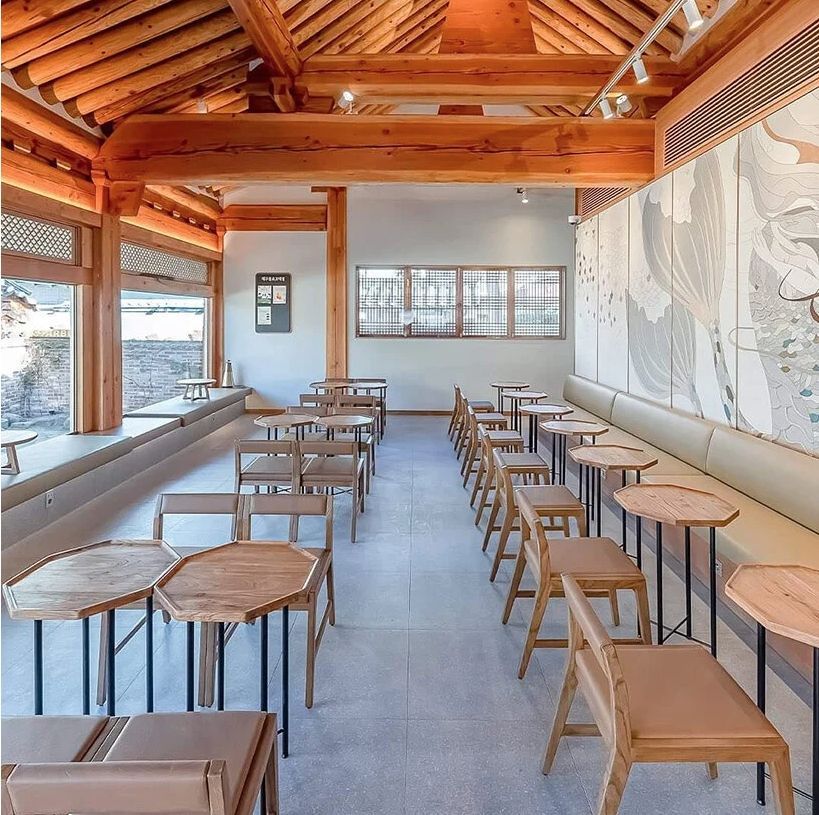
Above The interior of Starbucks Daegu Jongno Goteak (Image: Starbucks Korea)
The interior of Starbucks Daegu Jongno Goteak (Image: Starbucks Korea)
1 / 1
Daegu, South Korea
This newly launched flagship in Daegu, South Korea, continues the brand’s dedication to creating memorable venues. Opened on October 20, the Starbucks Daegu Jongno Goteak outlet stands out for its traditional-style structure that is a tribute to the hanok-style house and the city of Daegu’s rich cultural heritage.
In case you missed it: 10 Korean Celebrities Who Own Million-Dollar Buildings and Businesses
The giwa-tiled gable roof and ample use of wood add to the charming atmosphere inside the cosy 120-seater venue, coupled with Korean-influenced murals, modern furnishings and soothing beats played off Bang & Olufsen speakers.
This outlet also marks the start of the American coffee chain’s ongoing collaboration with the Danish audio brand, which will soon co-host a series of music-themed workshops and events at the said store.
4. Starbucks Reserve Roastery Tokyo

Above Starbucks Reserve Roastery Tokyo (Image: Starbucks)
Starbucks Reserve Roastery Tokyo (Image: Starbucks)
1 / 1
Tokyo, Japan
Located in Tokyo’s Nakameguro neighbourhood is a landmark that has become well-visited by coffee connoisseurs and design lovers alike. The work of Kengo Kuma Associates (KKA), this notable structure that covers nearly 32,000 sq ft was previously the largest Reserve Roastery in the world; the Reserve Roastery Chicago in Magnificent Mile is now the largest, measuring at 35,000 sq ft). Ever since its first Starbucks Reserve Roastery opened in Seattle’s Capitol Hill neighbourhood in 2013, the international coffee chain has been steadily expanding the reach of its speciality store and roastery around the world—other locations include Milan, Shanghai and New York—serving up not only its signature drinks but also its small-batch roasted brews and hosting coffee appreciation sessions.
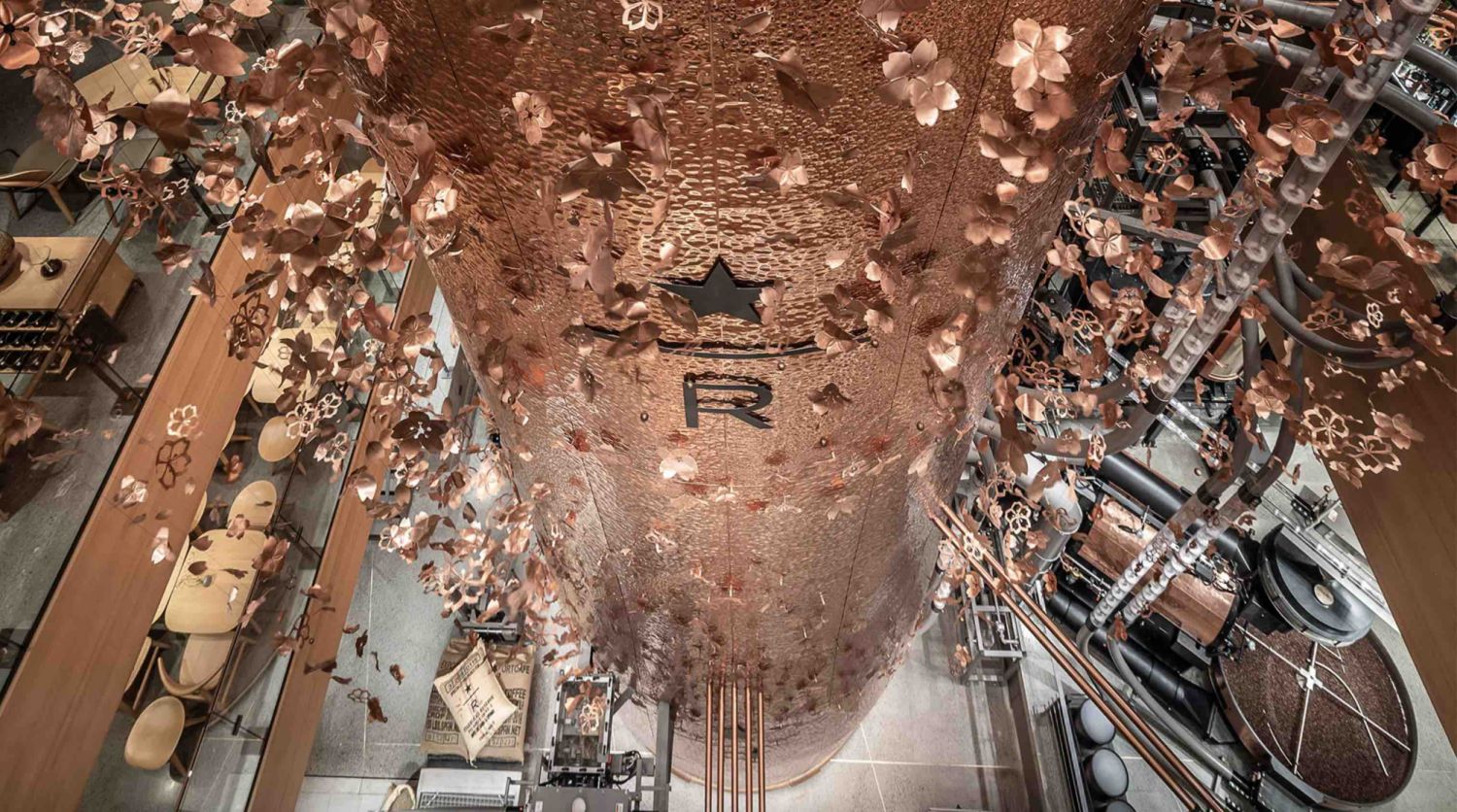
Above The copper cask and the cascading cherry blossom motifs (Image: Starbucks)
The copper cask and the cascading cherry blossom motifs (Image: Starbucks)
1 / 1
In this Tokyo location, nods to the local Japanese culture can be found in the origami-inspired roof, and cherry blossom copper motifs that cascade down the ceiling; the latter references the rows of riverside sakura trees in the vicinity that make it popular for sakura viewing in spring.
This massive store is part of a series of collaborations between the Japanese architecture firm and Starbucks, with past collaborations including the elegant Starbucks Dazaifu Tenmangu store (see below) in Fukuoka, Japan, that references kigumi woodwork, a traditional local method of building wooden framework for houses.
5. Starbucks Dazaifu Tenmangu Omotesando
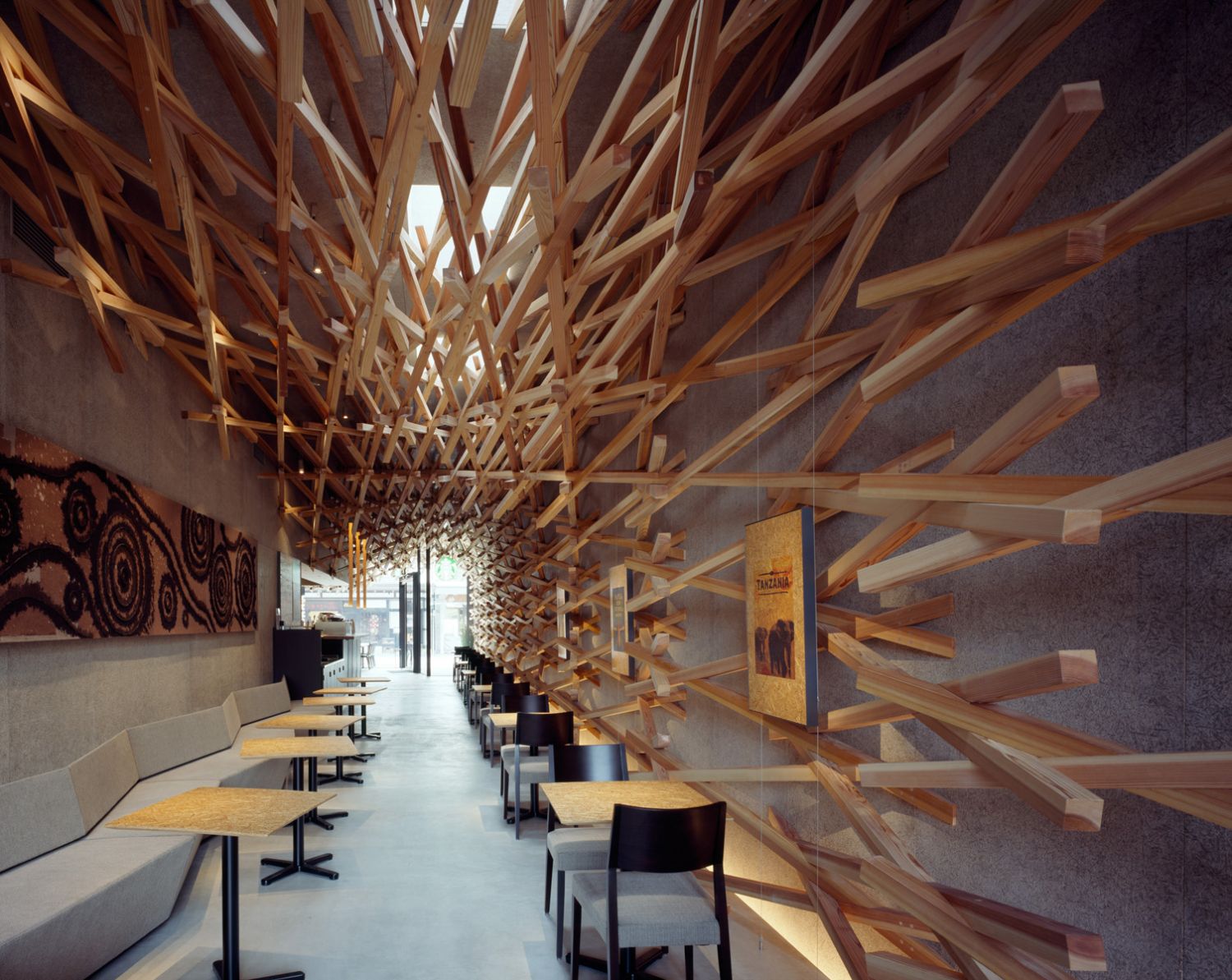
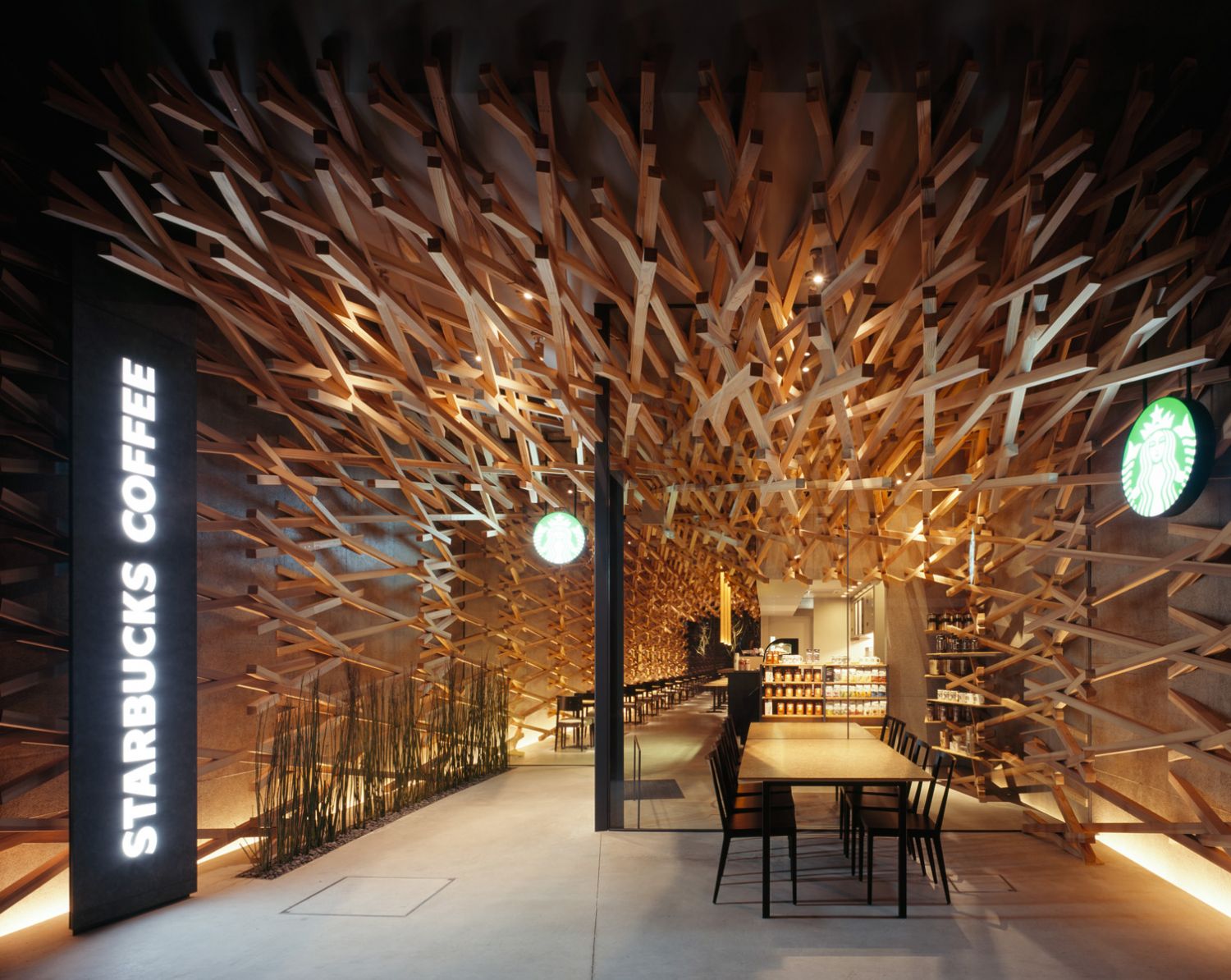

Starbucks Dazaifu Tenmangu (Photo: Masao Nishikawa / Kengo Kuma Architects website)
1 / 3
Dazaifu, Fukuoka, Japan
This outlet may be off-the-beaten-track for the average traveller, but if you ever find yourself in the region, die-hard Kengo Kuma fans might still consider making the pilgrimage to this particular concept store. The small city of Dazaifu is a day trip away from the main Fukuoka city, and is most known for the Dazaifu Tenmangu shrine, which is in the vicinity of this outlet.
Nearly 2,000 pieces of cedar—each between 1.3m to 4m in length—were assembled to create this memorable design, and assembled diagonally to provide structural support. The store is also furnished by Time & Style, a Tokyo-based modern furniture brand.
6. Starbucks Reserve Roastery Tianjin
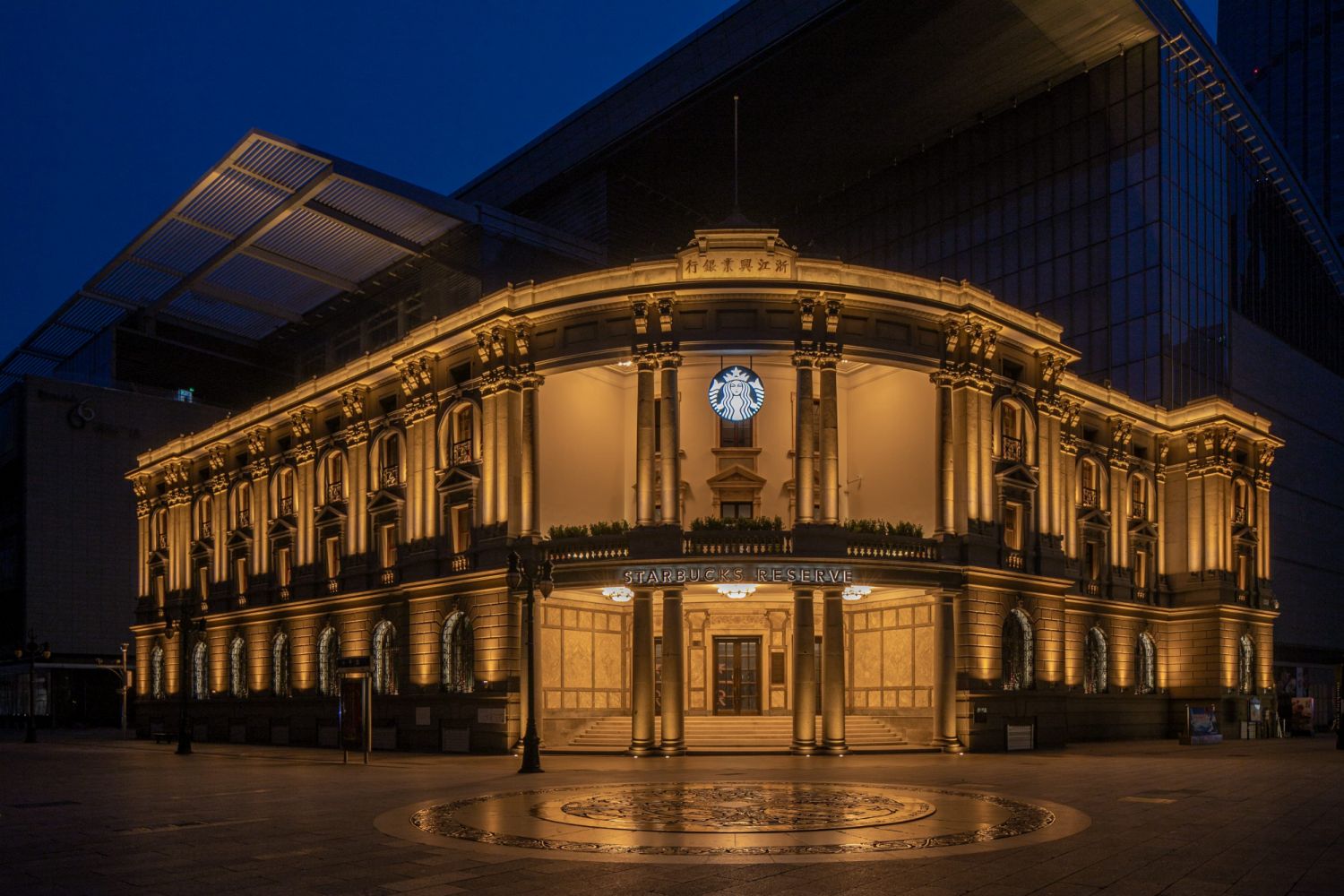
Above The exterior facade of Starbucks Reserve Tianjin
at night (Image: Starbucks China)
The exterior facade of Starbucks Reserve Tianjin at night (Image: Starbucks China)
1 / 1
Tianjin, China
If you’ve ever had the chance to visit the bustling city of Tianjin, do check out this elaborately designed store in Riverside 66, a renaissance-style structure that was originally built in 1921 and designed by notable Chinese architect and engineer Shen Liyuan. Formerly the location of the Zhejiang Xinye Bank, a tailor shop and mall, the local landmark became recognised as a heritage site in 1997 but was left vacant in the last 20 years until the recent three-year-long refurbishment completed by Starbucks in 2019 to transform the historic landmark into a modern coffee roastery and store.
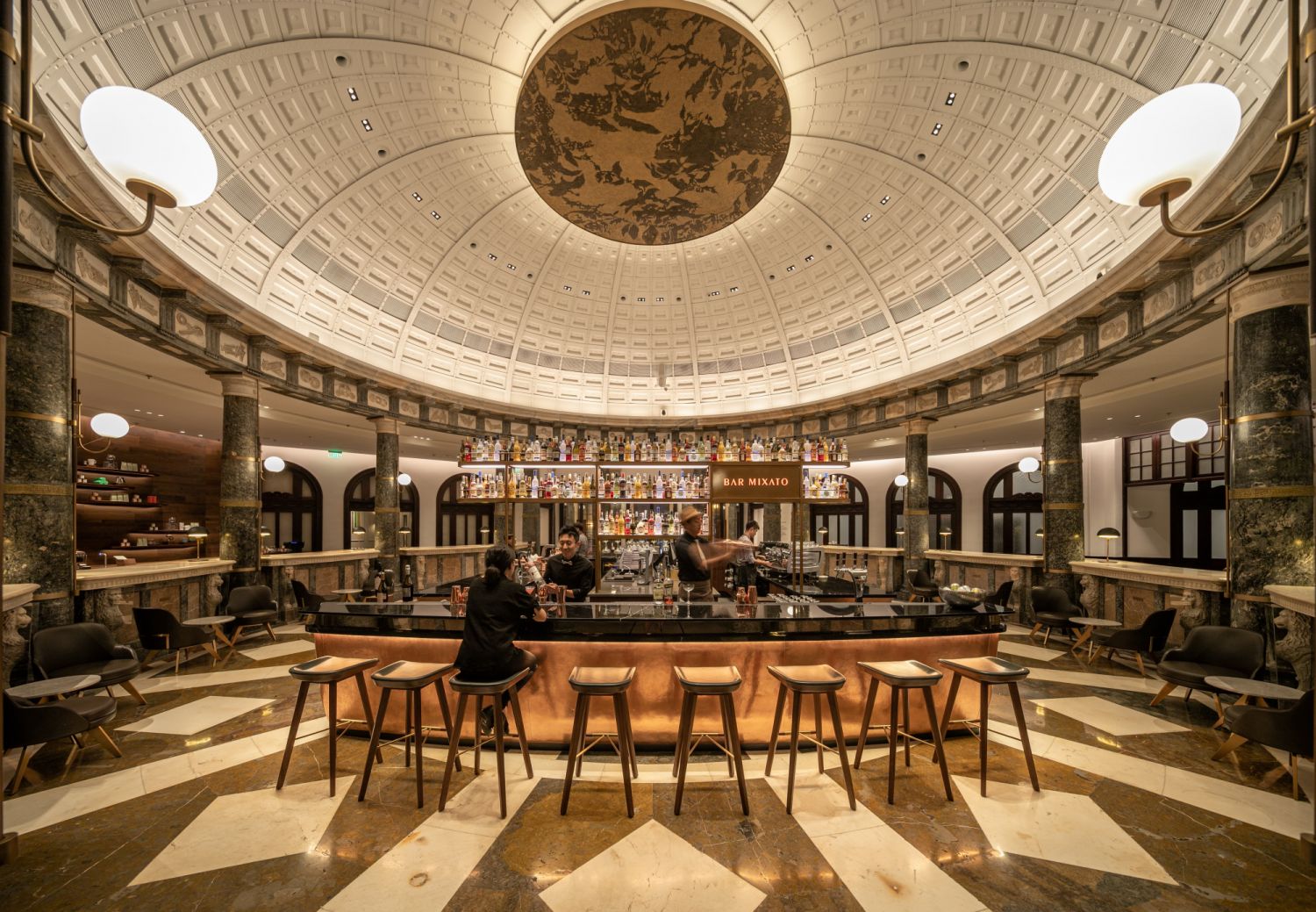
Above The stunning ceiling of the Starbucks Reserve Tianjin
The stunning ceiling of the Starbucks Reserve Tianjin
1 / 1
A wider range of drinks is available at the Mixato and Teavana bar within the store, which serves up nitrogen-infused teas as well as creative cocktails and craft beers.
7. Starbucks Reserve Dewata, Bali
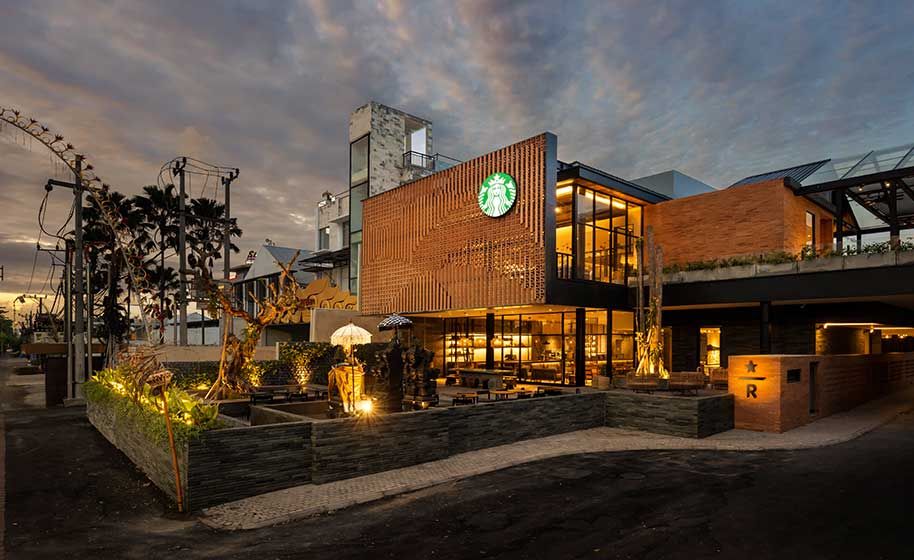
Above Starbucks Reserve Dewata, Bali (Image: Starbucks)
Starbucks Reserve Dewata, Bali (Image: Starbucks)
1 / 1
Bali, Indonesia
With Indonesia’s longstanding history of coffee production, it seems apt for the country to boast the Starbucks Reserve store which is currently the largest in Southeast Asia. The distinctive red-brick facade of this 20,020 sq ft features curving elements that reference the beach destination’s amazing waves; step inside and you’ll find a striking 30-foot hand-carved wooden mural that depicts coffee-growing regions in Indonesia.
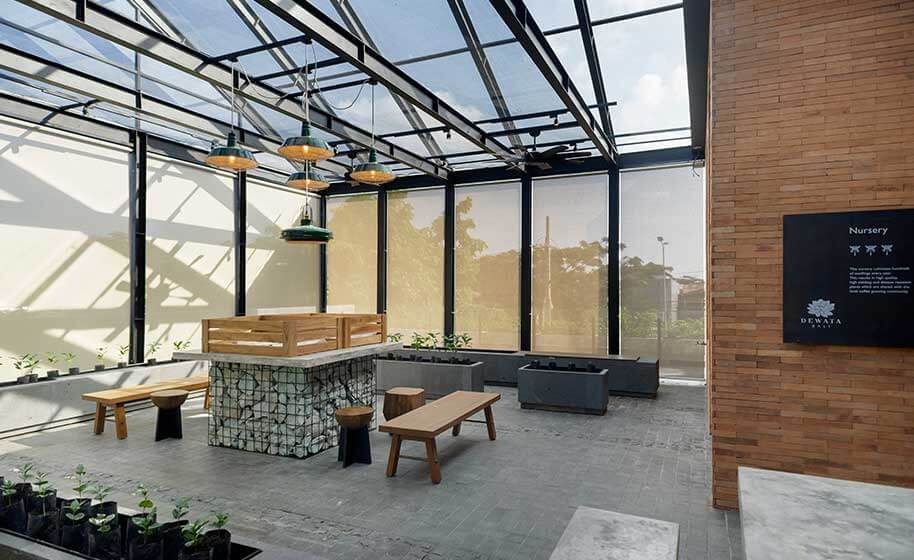
Above The second storey of Starbucks Reserve Dewata, Bali (Image: Starbucks)
The second storey of Starbucks Reserve Dewata, Bali (Image: Starbucks)
1 / 1
Other beautifully locally-designed and crafted installations can be found within; the venue also houses a 1,000 sq ft working farm with Arabica trees, where visitors can get a peek at what goes into coffee production.
This story was first published on October 10, 2022 and updated on January 13, 2023.





