
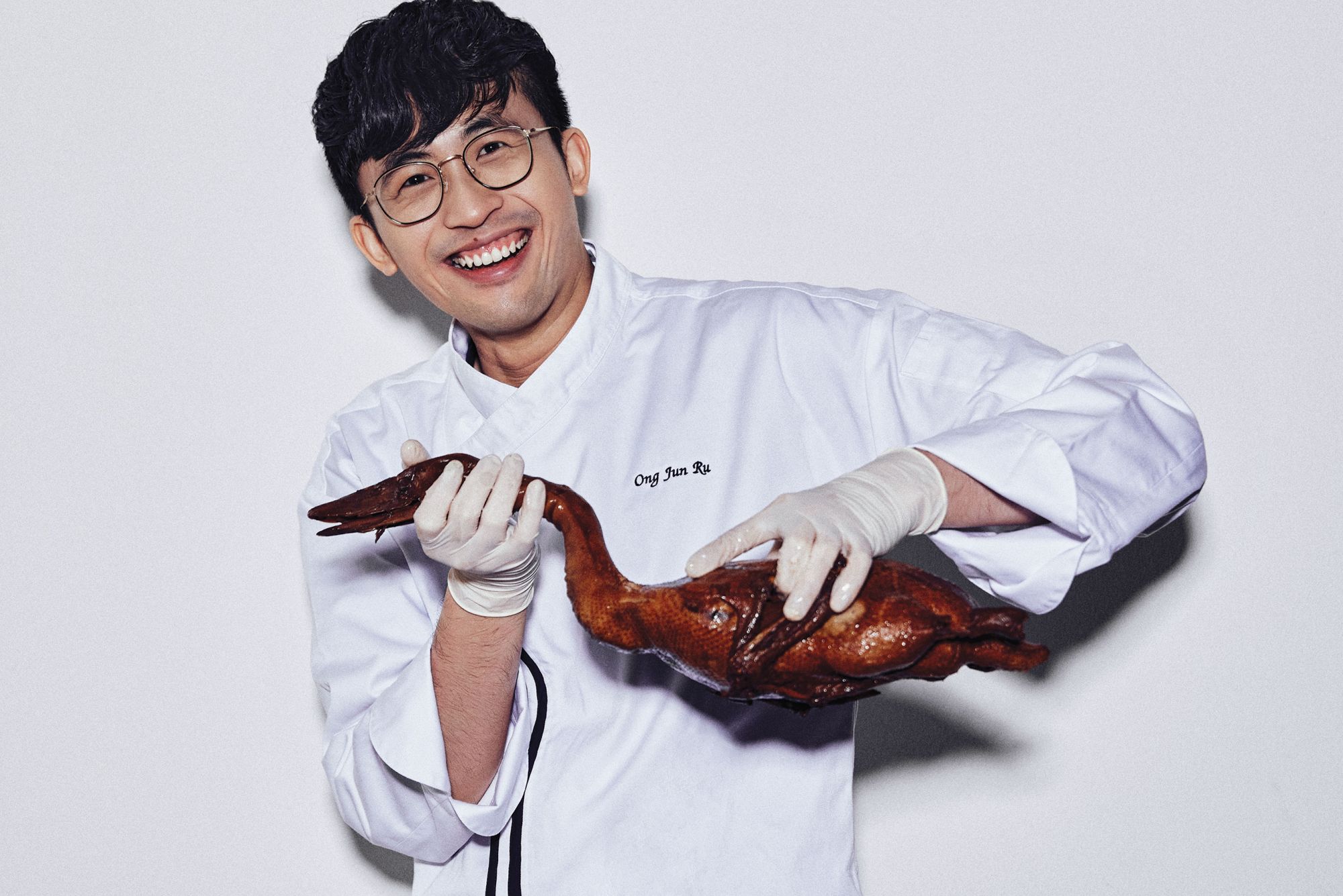
Cover Ong Jun Ru of Long House Soon Kee Boneless Braised Duck (Photo: Darren Gabriel Leow)
Ong Jun Ru of Long House Soon Kee Boneless Braised Duck (Photo: Darren Gabriel Leow)
1 / 1
In this three-part series, we talk to savvy young chefs who are injecting new life into the time-honoured trade
At 27, Ong Jun Ru was living his culinary dream—he was running his own bistro for two years, after graduating from the At-Sunrice GlobalChef Academy with a Diploma in Culinary Arts. However, he gave up his business in 2019 to help run his family’s famed Long House Soon Kee Boneless Braised Duck stall in Ang Mo Kio.
When he was fresh out of culinary school, Ong wanted to expand his culinary horizons and build up on his restaurant internship experiences. He took on the “gutsy” move of pumping in $45,000 to start Pardon My French in Tanjong Pagar. He says: “I wanted to carve out a name for myself and have the freedom of coming up with my dishes in my place.”
However, Ong knew that the clock was ticking when it came to learning his father’s time-honoured lor ark (Teochew braised duck) recipe, which dates back to 1984—when the older Ong opened his stall at Long House in Jalan Besar before shifting to the Long House Food Centre in Upper Thomson in 2000.
See also: You’ll Soon Be Able To Get Prata and Chicken Rice in Las Vegas Thanks to Zouk Group
The stall, which was run by Ong’s father and three uncles, later moved to a Jalan Besar coffee shop in 2014 for a year before the brothers split up. The older Ong, who has been working as a hawker since age 14, decided to front his duck rice business in 2016 after decades of cooking and chopping in the background. But he could not do it alone.
After mulling over the tough decision, Ong dutifully hung up his chef whites and opted for longer and stuffier hours in his father’s stall. He explains: “Modern cooking techniques can be easily picked up next time, but the time that I have with my dad to discuss and fully learn the traditional ways of braising duck is limited. And once the opportunity is gone, the ‘old taste’ is lost.”
Now 30, the second-generation owner of Long House Soon Kee Boneless Braised Duck runs the business with his parents. Despite his culinary background, he started from ground zero at the stall. He started out observing and preparing condiments such as cucumber slices and the tangy vinegar-laced chilli sauce, and sides including braised tau kwa, eggs and soya sauce rice, and washing the ducks.
It took him two years of helping at the stall before his father entrusted him with chopping the duck and concocting the braising liquid—but not without springing impromptu tests on him along the way.
One of the challenges Ong faced was manoeuvring the hefty iron cleaver as he was too accustomed to using chef’s knives. “The chopped duck pieces had shreds as the cleaver needs to be held at a certain angle and the chopping had to be done faster,” he sheepishly recalls. “I was also scared as my fingers were rather close to the blade.”
The final hurdle was perfecting the all-important braising sauce, which is a herbal concoction of 12 ingredients including soya sauce, cinnamon and tangerine peel. Learning the recipe was particularly challenging as his father is used to cooking based on his sense of touch by “using his hands as a measuring scale”. After much convincing, Ong helped his father to weigh the ingredients in the recipe. He says: “This ensures that the braised duck recipe can be properly passed down and that the flavours can be consistently replicated.”
See also: The Best Peking Ducks in Singapore
Outside of the kitchen, Ong spruced up the stall’s branding with a new logo and social media presence, which has brought back many former customers from its Long House days. He also implemented group buying to drive sales during the dining-in restrictions in May. Customers could place takeaway orders in bulk via WhatsApp and pick them up at the stall. The timely move enabled the stall to continue to sell its daily supply of 20 ducks.
Looking ahead, Ong hopes to introduce fusion duck dishes if plans for an outlet takes off. One east-meets-west dish that has earned the approval from his father is duck confit deep-fried in oil from the braising liquid that is redolent of Chinese herbs.
On finding the motivation in the gruelling hawker trade, Ong shares that receiving encouragement from customers fuels him—be it praises on his decision to continue his father’s legacy or how a young customer wrote about enjoying his dish in a school essay. He says: “Although I have the passion, I still need some form of appreciation to feel motivated to carry on this path.”
See also: Best Chicken Rice in Singapore: Where Do Chefs Go for This Popular Hawker Dish?





