
1 / 1
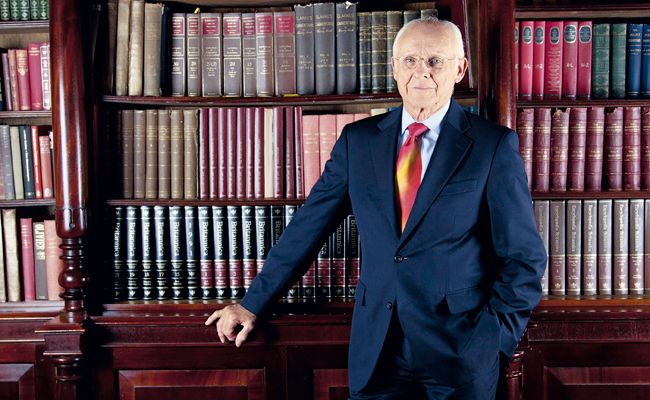
As the press secretary to Queen Elizabeth for 12 years, Dickie Arbiter was witness to some of the most significant events in contemporary royal history.
With his experiences in negotiating relations between the British royal family and the media for more than a decade, no wonder that former press secretary Dickie Arbiter shared that the important lesson he learned from his years of service was “Tolerance. You have to be tolerant in being interviewed, in listening to people’s questions and answering them the best you can.”

Arbiter, born to German-Jewish parents in London during one of the air raids of World War II, had never envisaged a future hobnobbing with the aristocracy. According to his new autobiography, On Duty with the Queen, his mother left the family when he was still in short pants but, before her departure, she had been a strict advocate of the “proper” manners and etiquette that would serve Arbiter well in his later career.
After an early start in theatre, Arbiter got his first big break at the Rhodesia Broadcasting Corporation, reading the news on radio. He married during his time in Africa and his daughter Victoria (now a TV personality in the US as a royal correspondent for CNN and other networks) was born there. The family moved back to the UK in 1974 and Dickie began work at talk-radio station LBC. He was still working that side of the news desk, reporting on royal events, when the palace asked him to switch teams in 1988.
Arbiter, 74, has travelled the world with the royals since being brought on board—literally, given that he received his offer of employment during a reception on the royal yacht Britannia. In his new role he was responsible for controlling the public image of the queen (and, later, that of Prince Charles and Diana, Princess of Wales). A deep level of trust grew between Arbiter and the monarch and, asked if the queen has an Achilles’ heel, Arbiter struggles to find one. “That’s sort of subjective. If you’re looking overall for a weak point, maybe it is that first consultation with somebody who she doesn’t know.”

Arbiter (centre) shares a laugh with Princess Diana and Ronald Bell, a member of the British Parliament
In Arbiter’s line of duty, “there wasn’t a typical day” and the job had its fraught moments, including the 1992 fire at Windsor Castle. A spotlight ignited a curtain in the castle’s chapel, starting a fire that caused £36.5 million of damage. Buckingham Palace was opened to the public for the first time to raise funds for the repairs. “I was there within half an hour of the fire starting,” Arbiter recalls, “and didn’t leave for days.”
One of Arbiter’s most intense periods was the seven days after Diana’s death in a Paris car accident in 1997. He explains how he fought with police at Buckingham Palace about the floral tributes blocking the gates. “I told [them] in no uncertain terms… the flowers were staying.” He worked around the clock, all the while dealing with his own grief, and felt comforted that the late princess received a fitting tribute. “I believe that we gave her an incredible send-off, having planned a funeral in only five days,” he says.
Asked his standout moment of his years of service, Arbiter says, “I’d have to put my hand on heart and say the whole 12 years.” While he doesn’t keep in contact with his former boss (“Do people socialise with their employer?”), writing his memoir has given Arbiter a chance to relive his time with the royal family. He declares that the period was an incredible adventure—not bad for someone told he was offered the job because “you speak well, with a good broadcasting voice, and you are always dressed properly in a suit.”
Discover more about the British royal family through Dickie Arbiter in the December 2014 issue of Philippine Tatler. Download it on your digital device via Magzter and Zinio.





