
1 / 1
All of us have family trees, but when your family tree becomes a giving tree, collectively spreading love and hope to the less fortunate, family ties run so much deeper, the pay-it-forward effect goes so much further, and a family legacy of giving is cultivated. We speak to Durreen Shahnaz, founder of Impact Investment Exchange Asia (IIX) and Impact Investment Shujog

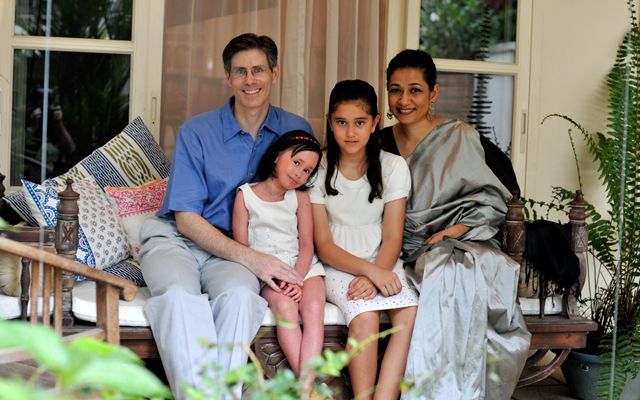
Durreen Shahnaz with her husband Robert Kraybill, older daughter Diya Shahnaz Kraybill and younger daughter Aliya Shahnaz Kraybill
Durreen Shahnaz
Founder of Impact Investment Exchange Asia (IIX) and Impact Investment Shujog
Born in Bangladesh, Durreen Shahnaz and her siblings were taught the value of sharing what they had with the needy, and the poor were often invited to their home to share a meal. In 2009, combining her finance and media background with a desire to effect change in less affluent countries like her home country, she founded a social enterprise. Based in Singapore, Impact Investment Exchange Asia (IIX) helps Asia Pacific-based social enterprises stay profitable by matching them with potential investors. Shahnaz, who is Adjunct Associate Professor at the Lee Kuan Yew School of Public Policy, also founded Impact Investment Shujog, a social enterprise which helps to foster growth within the social enterprises and impact investment sectors in Asia. Her husband Robert Kraybill is managing director of IIX and board member with Shujog. They have two daughters, Diya, aged 11, and Aliya, aged seven.
Singapore Tatler: Do you agree that charity begins at home?
Durreen Shahnaz: Charity not only begins at home but it is also nurtured, discussed and taken to the next level at home. For our family, charity is a part of life. It is our honour and privilege to be able to work with or assist people who are not as fortunate as we are in life and make them part of our lives.
ST: How does your family engage in giving together?
DS: For our family, “sharing” with others happens in two ways – directly and indirectly. Indirectly, we make regular monetary contributions to international and local charities. Directly, we work with a school for street children in Dhaka, Bangladesh called Shurovi, which gives children from slum areas an opportunity for education. They receive four hours of schooling and a meal a day, a school uniform and a bag. For as little as S$60, a child can go to school for the entire year.
It is our privilege to not only financially support the school every year, but also have my daughters Diya and Aliya attend the school whenever they visit Bangladesh, my home country, for school breaks. Both my daughters are happy to go to school with their new friends and are always amazed at how generous these children are. They have so little and yet are always eager to share their little pencil, notebook or eraser with my daughters. These children embrace my daughters as a part of their family. They help my daughters with their Bengali and my daughters help them with their English.

I was thrilled when on her 10th birthday, Diya asked that everyone give her money instead of gifts so that she could donate the money to Shurovi. Diya raised S$500 and was besides herself when she donated the money. The school principal told her that thanks to her help, eight new girls could now attend the school. I could not have been prouder of Diya.

Diya Shahnaz Kraybill donating the money to the principal of Shurovi
It is also wonderful that my daughters’ school in Singapore, United World College of South East Asia, emphasises doing social good as part of their learning process. They are constantly doing charitable work through their school, which is a wonderful way for children to absorb the notion that “doing good” is something very much part of their lives.
In addition, my husband and I run two companies – IIX and Shujog – both of which are focused on creating social good through channeling investment capital to social enterprises. We discuss our work with our children a lot, and it has been a great influence for our daughters and their outlook on what they can do now for social good and want to do when they grow up to continue on that path.
ST: What fulfillment do you get from giving as a family?
DS: Family bonding through acts of giving is a bonding of doing something good for this world together, which is long-lasting. It is an act that is not selfish or self-centred, but is about one's responsibility towards society and the planet. It brings an immense sense of long-term satisfaction that is impossible to get from anything else, be it playing sports, music or travel.
Having said that, both my daughters and husband share a special bond through swimming and competing in swimming meets. That is their bonding with their father and something they do for fun, which is necessary as a family.
Interestingly, as a family, we have more conversations about our daughters' time at Shurovi than their sports or music activities. Their experience at Shurovi and the community activities they are involved in at school are so precious that they have made my daughters incredibly self aware about their responsibility in this world. Once children have that self awareness, doing social good is very much a part of their lives – which should be the case for all of us.

Diya and Aliya Shahnaz Kraybill with students of Shurovi
ST: Why is it important to nurture a tradition of giving in the family and ensure that this legacy is handed down across generational lines?
DS: One can nurture a tradition of giving only when “giving” is seen as an honour and part of life. Growing up in a middle-class family in Bangladesh, my siblings and I were frequently told by my parents and grandparents how lucky and privileged we were. It was thus our duty and honour to help others who were not as fortunate as us. Every Friday (a holy day for Muslims), all of us siblings had “gate duty” where we would give rice to the beggars. We would give a cup of uncooked rice and say, “Thank you for letting us help you. Please pray for us."
With that simple act, it was taught to us that we were “taking” as much as we were “giving”. Yes, we were giving the rice but in return, we were getting blessings, which were so much more valuable. In the same way, my husband and I try to instill in our children the belief that the limited help that we can give has such incredible social impact and returns (and blessings) that we are indeed lucky to be able to receive these blessings and social impact/returns.
Also, given that the girls are very aware of our work and want to be associated with our work at IIX and Shujog, the whole notion of doing good comes very naturally for them.

Durreen Shahnaz, Robert Kraybill, Diya Shahnaz Kraybill, Aliya Shahnaz Kraybill
ST: What are the advantages of being exposed to the experience of giving from an early age and as a family?
DS: The biggest gift that my parents gave me was the belief that “giving” is “receiving”. For a few fist-fulls of rice that I shared or a few dollars I gave, I received blessings, happiness and fulfillment. I got so much more than I gave. This is something I try to impart to my children as well. Charity is not giving away but receiving endless happiness. Charity is not a duty but a privilege. Charity is not an occasional indulgence but a lifetime obsession – it is a part of our life.
Durreen's daughters, Diya and Aliya, attending classes at at Shurovi, a school for street children in Dhaka, Bangladesh
Photos: Durreen Shahnaz





