
1 / 1
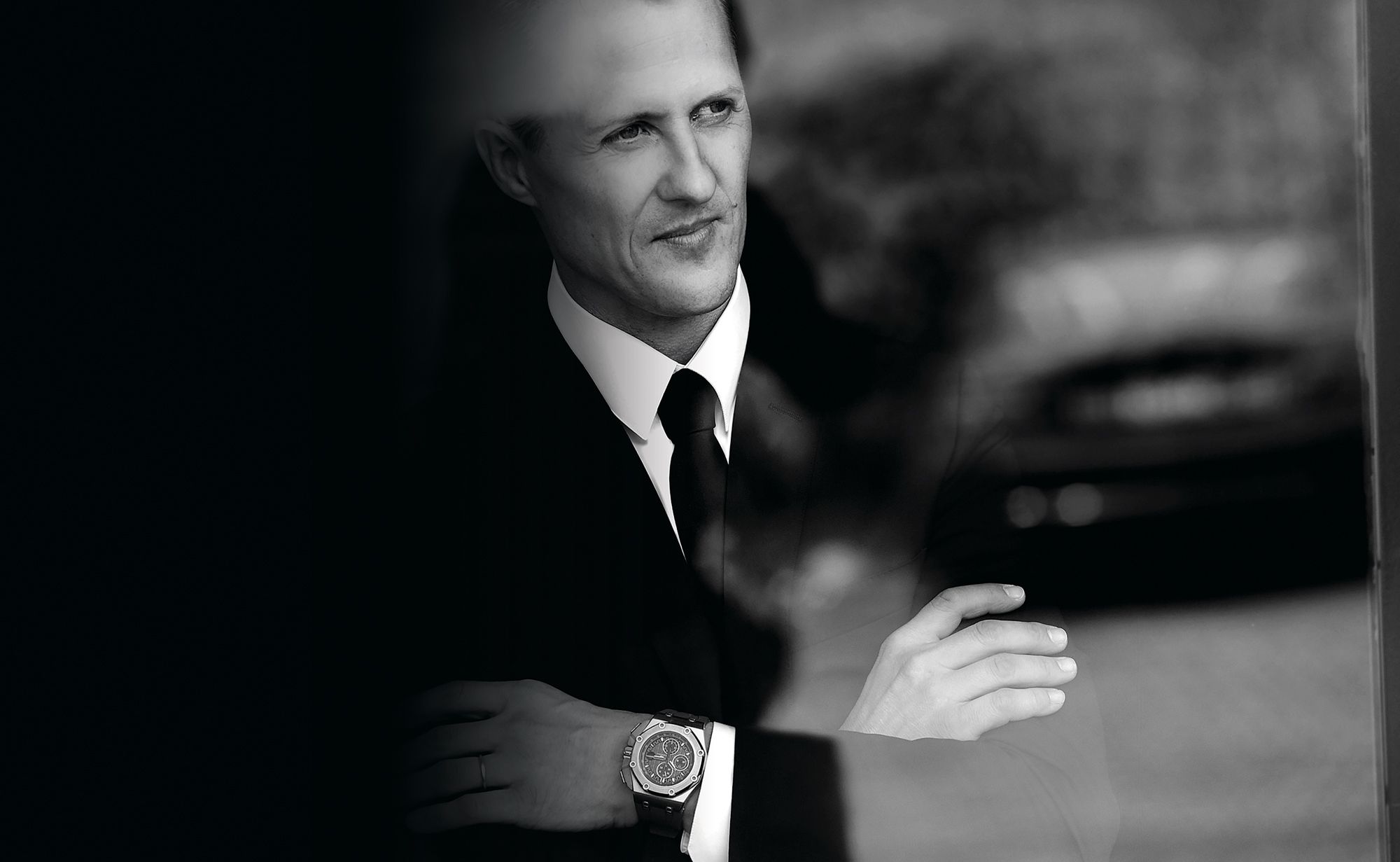
The partnership between Audemars Piguet and Michael Schumacher has produced an extraordinary mechanical chronograph. We visit Switzerland to discover their winning formula
Motor racing by its nature is a sport of precision and accuracy, where timing means everything. Races can be won by infinitesimal margins—and no matter how small the margin, the win is the result of a team effort. Even the most talented driver rides a group effort to get to the finish line, let alone cross it first. It takes even greater talent to perform at a consistently high level so as to become a benchmark with which contemporaries and other racing legends are compared.
Few racing drivers have understood and mastered all aspects of their craft as well as Michael Schumacher. The statistics speak for themselves: seven Formula 1 World Championships from 91 race wins out of 308 races, with 1,566 points scored in an F1 career spanning two decades. There have arguably been more naturally gifted drivers, but few if any able to dominate the sport for so long—and who understood the importance of the team effort as well as he did. Stories abound of the German driver working with his engineers long into the night, preparing for the race, while most of his peers were well into the glamorous social activities associated with F1.
Given his meticulous nature, Schumacher has always chosen his associations carefully, so there were very high expectations when in 2010 he partnered with Audemars Piguet, which was a familiar sight in the F1 paddock after collaborations with a handful of drivers over the years. It wasn’t until 2012 that we saw the first watches the Swiss brand designed with Schumacher, in a somewhat familiar pattern of limited editions in titanium, rose gold and platinum. At the time of their release, the watchmaker and Schumacher were already hard at work on another timepiece, one that would take the collaborative element further than any previous association.
Today, that project is finally unveiled in the form of the Audemars Piguet Royal Oak Concept Laptimer Michael Schumacher. It’s the result of a challenge Michael Schumacher issued to the brand’s watchmakers—to produce a mechanical watch capable of precisely timing consecutive laps during a race. It may sound like a simple request, but at that time such a feat had not been accomplished mechanically in the history of watchmaking.
The difficulty of the task didn’t stop Audemars Piguet’s technical skunkworks at Renaud & Papi (APRP) from taking on the project. When Schumacher laid down his challenge, team leader Giulio Papi is reported to have responded emphatically that it could be done. Schumacher made regular visits over the next few years to monitor progress on what had become one of his pet projects, and to ensure no compromises were allowed.
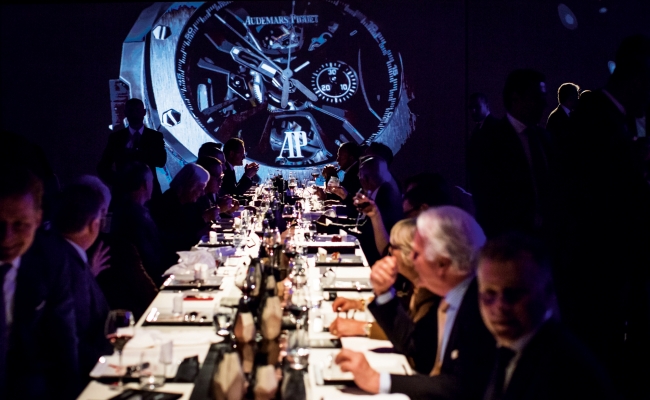
Unfortunately, a few weeks after visiting the manufacture in September 2013, Schumacher suffered severe brain damage in an off-piste skiing accident and spent many weeks in hospital. While he is now at home in Switzerland, the family is guarded about his condition and pace of recovery. His wife, Corinna, and manager, Sabine Kehm, aware of the importance of this watch to Schumacher, gave their wholehearted support for the launching of the Laptimer, which took place at Corrine’s ranch in Switzerland.
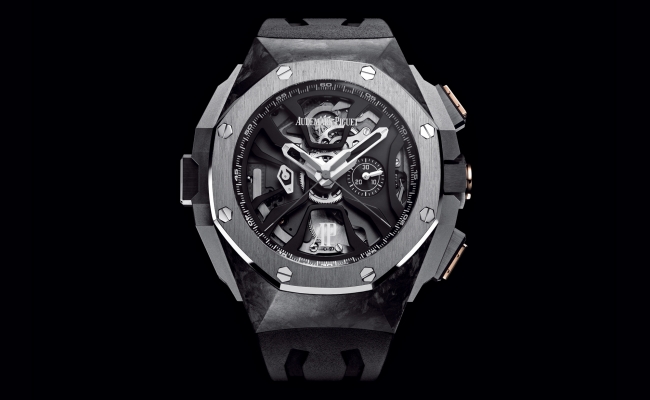
It was there that I discovered the mechanical marvel that embodies Schumacher’s ideas. You’ll see three pushers around the watch’s forged carbon case, and it’s the pusher at 9 o’clock that’s the key to the Laptimer’s innovation. While you start and stop the chronograph with the usual pusher at 2 o’clock, and the pusher at 4 o’clock functions as a flyback or a reset, the pusher at 9 o’clock is used whenever a lap time is required.
By activating the laptimer, a second chronograph hand, which had until now been synchronized with the first, reverts to zero and starts timing the new lap while the first chronograph hand stops. You can then record the time for the previous lap while the Laptimer continues timing the race uninterrupted. The next time the car crosses the line, press the 9 o’clock pusher again, and the chronograph hands switch places, allowing you to record the new lap time, again without interruption to the race timing.
Great attention was paid by the APRP developers to the ergonomics of the watch, to ensure it would remain wearable on the wrist, and to the requirement that the movement fit within the 44mm diameter of the Royal Oak Concept case. They also focused on the ergonomic feel of the chronograph and its pushers to minimise the slight lag present in most mechanical chronographs on activation due to the resistance of the pushers. This was also the result of input from Schumacher, in whose world hundredths of a second can make a significant difference.
Only 221 examples of the Royal Oak Concept Laptimer Michael Schumacher will be produced. This may seem like an odd total, but it’s apt; it’s the number of races in which Schumacher scored points during his F1 career. The watch is a tremendous tribute to the racing career of a man who redefined his sport. Of course, the launch is tinged with a certain sadness that Schumacher could not be there to see for himself the results of the team effort that brought his idea to fruition. We can only hope his fighting spirit will continue to propel him along the road to recovery.
Sean Li is the Editorial Director of Watches for Hong Kong Tatler and Revolution





