

1 / 1
With its cosmic curves and futuristic dome, the Marden family’s incredible yacht is out of this world
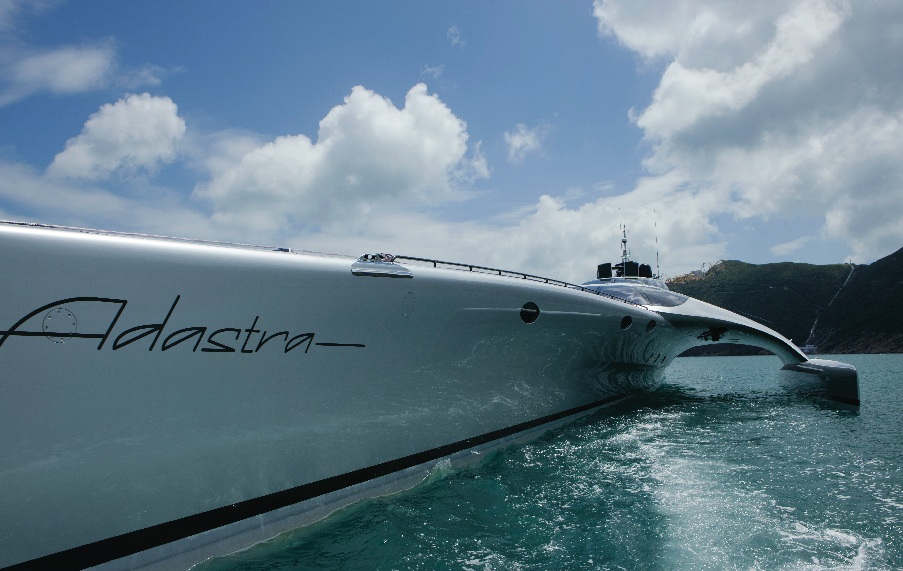
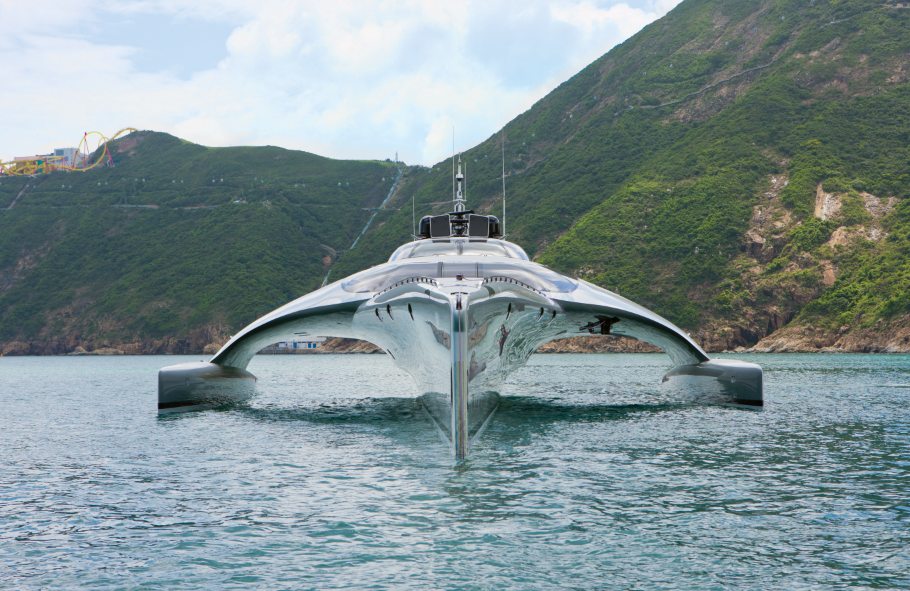
The US$15 million, 42-metre luxury trimaran, christened Adastra, took about five years to build and, on a bright hot April morning in Zhuhai, she stands glittering in the shipyard of McConaghy Boats, the company that built her. Out of the water, she looks as though she’ll live up to her name (ad astra is a Latin phrase meaning “to the stars”) and blast off into orbit.
“When the covers came off Adastra, I had to sit down for an hour and just look at her,” says Marc Evans, McConaghy’s joint managing director. “One word came to mind: awesome.”
Click here to learn the rules, manners and courtesy to abide by when out at sea in Hong Kong.
Tork Buckley, the founder of Big Blue Consulting, says Adastra is “the most visually spectacular super-yacht delivery anywhere in the world in 2012.” In his speech, Evans described the finished project as the first to “put China super-yacht building on the map.”
In a meeting of traditions, a magnum of champagne is smashed – on the third try – to send Adastra out to sea, while a ratatat of firecrackers signals the beginning of a lion dance. From the yacht’s gleaming propeller hangs a head of lettuce as an offering to the Chinese sea goddess Tin Hau.
Anto’s reasons for commissioning Adastra were simple. “I’ve always wanted to build a big boat to travel around the world in,” says the shipping magnate. “I knew I wanted a power boat because time is short and distances are long, and I’m old.”
He adds, “A power trimaran is very easily driven and it’s very economical on fuel. It also looks amazing.” In fact, Adastra’s range is a stunning 4,000 nautical miles at 17 knots (her maximum speed is 22.5 knots) – enough to travel across the Atlantic Ocean without stopping to refuel.

“I think Anto very much had his heart set on doing this, and then had to work to persuade me,” says Elaine. “I’ve always been a sailor. I love that sound when the engine is off and you just whoosh along.”
Anto approached friend and yacht designer John Shuttleworth with the idea of creating the first luxury power trimaran of its size in the world. John designed the sailing trimaran Mazinga for the Marden’s some 30 years ago – for £1,000. “He was living with his mother then,” Anto laughs.
“Adastra has been a sort of Everest of designing for me,” says Shuttleworth. “It’s a really complex challenge to do something like this.” He remembers Anto asking what the boat was going to look like. In response, John sketched something on a piece of paper in two minutes and faxed it to him. “It still looks a bit like that,” says the British designer.
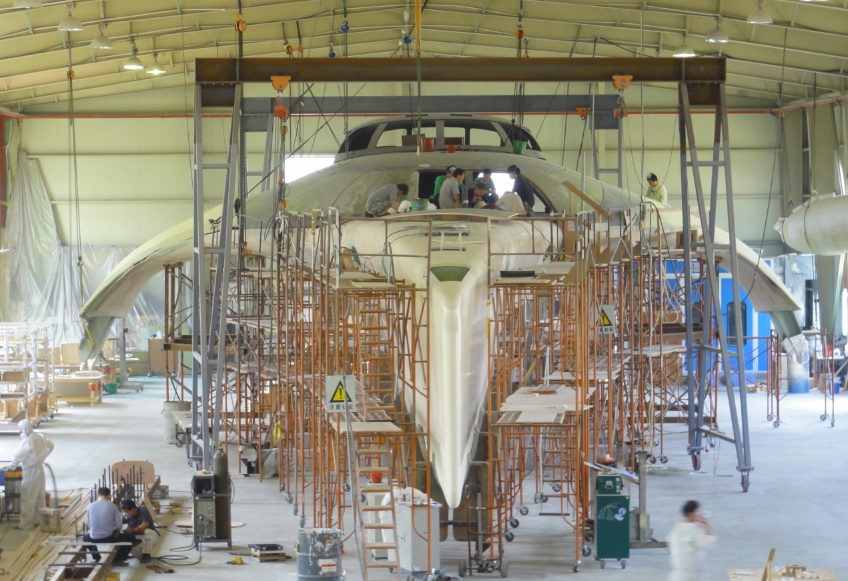
Shuttleworth admits, “I don’t know that we fully realised, at the beginning of the project, what we’d be getting into. We were doing something we knew was an extension of the known, and then we went past it. It’s such a complicated shape.” The yacht’s design began in earnest in November 2007, starting four and a half years of “the mayhem of building boats,” as Anto describes it. “Everything has taken longer and cost more money than it was supposed to, because everyone was feeling their way. No one else has ever built anything like her before.”
Anto also says the most important feature of the 50-tonne boat is her lightness in relation to her size. Every aspect was considered according to weight sensitivity, right down to the carbon-fibre loos. “I drew the line at them weighing me,” Elaine jokes, “but everything on that boat has been weighed. From every darn piece of crockery to a little dish or a plate or a cup.”
Shuttleworth explains, “The concept of a power trimaran has been done before solely for record breaking, with almost no interior comforts. In order to achieve a luxury interior and still maintain the performance, we had to rethink almost everything about the way the boat would perform at sea.” After conducting tank tests and building a two-metre model, Hthey then “e continues, “This meant conducting tank tests, and building a two-metre radio controlled model and filming it going along in waves. Then we had to find ways of engineering and building her so that we could keep weight down. We ended up custom-designing more parts than we have ever done before.”

Adastra’s interior design is the careful work of Inge Strompf-Jepsen, who runs Jepsen Designs in Wan Chai. Her team of eight works on everything from landscape gardening to remodelling wooden junks into chic pleasure vessels, and she’s overseen the design of more than 20 boats.
An architect by profession, Inge moved to Hong Kong from Denmark 35 years ago. “The idea was to have the inside reflect the outside, in that it would be round, modern and streamlined,” she explains. “Elaine and I agreed on the shape and layout very quickly. From there, we fine-tuned the concept.”
Adastra’s interiors are the result of a joint effort. “You know, Elaine knows what she wants,” the designer notes with a laugh. “Sometimes I would say ‘I suggest’ or ‘I propose,’ and she’d say, ‘I take the gauntlet, but no.’” Elaine recalls, “We were very much on the same page. She’s very diplomatic, and brilliant at agreeing with me. But I think actually we shared a lot of the same taste.”

Less is more, Strompf-Jepsen says, when it comes to materials. The yacht’s carbon-fibre walls have a coat of satin paint. To soften the white, the surfaces and cabinets are made of a light-coloured oak. Other than that, she’s used hairline-brushed stainless steel. And, in the middle of the beautiful salon, there is an espresso-coloured fibre-woven “bird’s nest” that serves as a backrest for the deep, wide, white sofa. The main fabrics on Adastra are antique ikat from Indonesia and a quick-drying marine cloth from England.
Nothing in the salon is square, and the winding layout reminds Strompf-Jepsen of a snake. She refers to this and the “wine glass” as examples of how important shapes are on Adastra, where there is relatively limited living space. The “wine glass” is the slick helm station, which is wider at the top than the bottom, and can be closed off giving privacy to those on deck as well as preventing light spillage during long ocean cruises.
Strompf-Jepsen, who also happens to be the Royal Hong Kong Yacht Club’s first-ever female commodore, recalls her first encounter with the project. “Initially, the boat yard seemed very worried. They thought, ‘Here comes a fluffy-duffy lady to do the interiors. She knows nothing about boats, and will probably delay the whole project.’ I was told quite strictly that I had to perform.”
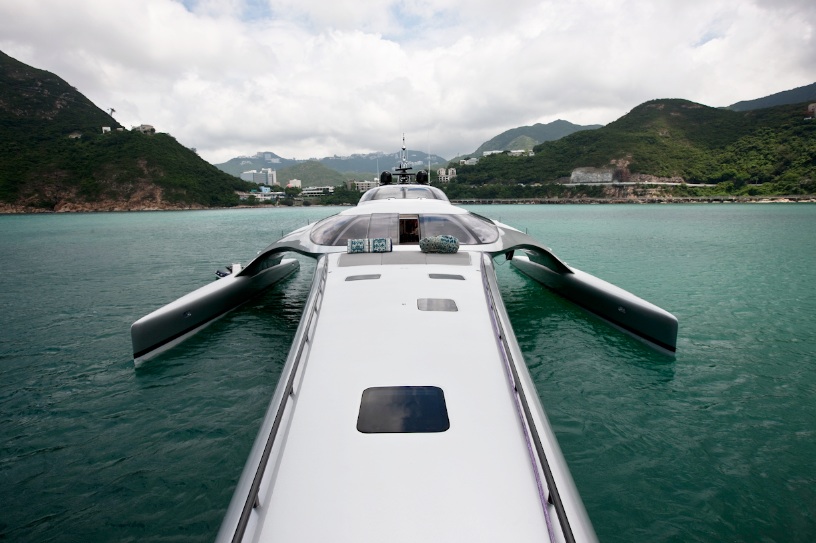
The ikat cushions, together with details like the blue and white porcelain vases or the bamboo sculpture from Cambodia, bring out the salon’s Eastern vibe. It was important, says Inge, to have the design reflect something of Anto and Elaine’s Asian backgrounds.
Anto has been sailing for many years, both growing up in Hong Kong and then at boarding school in England. Although he sailed dinghies from the age of seven, he jokes that the reason everyone joined the sailing club at Charterhouse (then an all-boys school) was because the lake, Frensham Pond, was near the girls’ school at Frensham Heights. Since those youthful days, he’s been sailing around Southeast Asia for almost 40 years.
Adastra is the third in the Mardens’ collection of recreational vessels, which also includes Mazinga and Haung Tuah, the latter being a 42-metre steel motor cruiser based in Indonesia, where the family has two private islands.

The Mardens plan to sail around the world, taking regular breaks to fly back to Hong Kong. They’ll also have family and friends join them for cruises along the way. Adastra sleeps nine, with additional room for five or six crew. The journey, Anto says, will take years.
Adastra’s planned itinerary, which is set to begin in January next year, is ambitious. The journey will take the Marden family across the Pacific Ocean to Palau, Vanuatu, Fiji, Tonga, Samoa, the Cook Islands, Tahiti and the Galapagos. From there, they will sail through the Panama Canal and up the east coast of Central America, into the Caribbean, across the Atlantic Ocean to Iceland and the Baltic, then down to the Mediterranean. “After that, we’ll see what happens,” Anto says.
McConaghy’s shipyard in China produces some of the best yachts in the world.





