
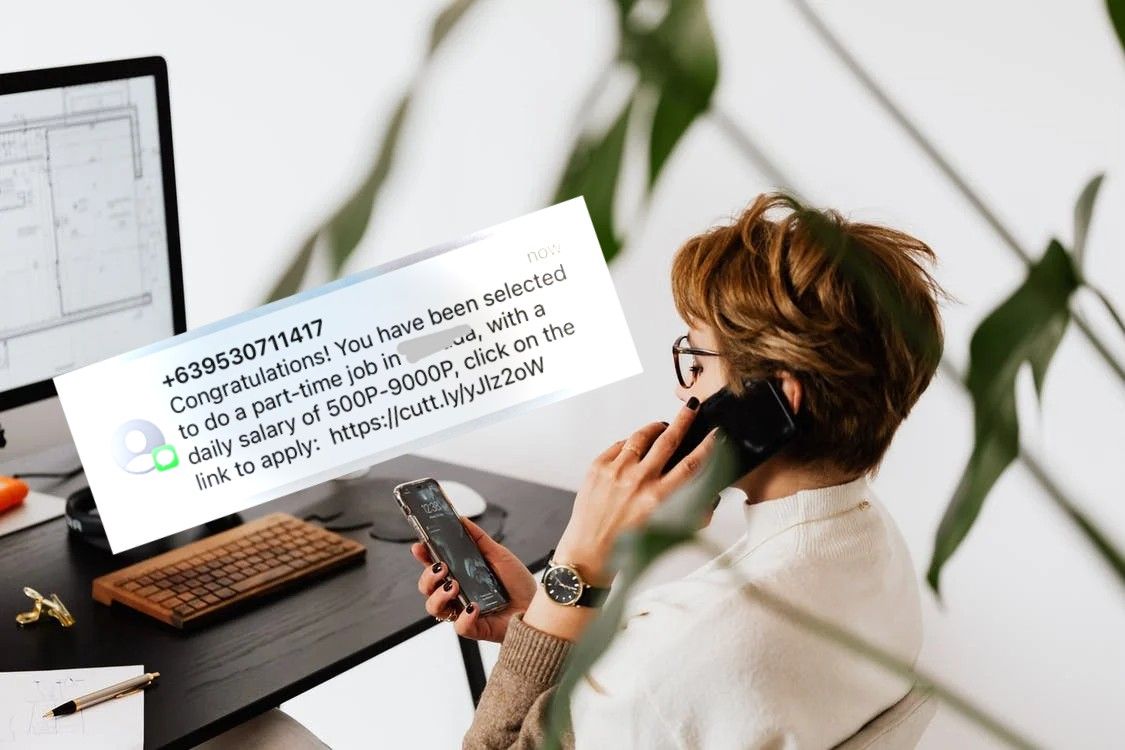
Cover Have you been getting lots of job offers lately? Here's what you need to do (Photo: Karolina Grabowska/Pexels)
Have you been getting lots of job offers lately? Here's what you need to do (Photo: Karolina Grabowska/Pexels)
1 / 1
It's an offer that's hard to resist: a high-paying job that's one tap away. Are you one step closer to your dream career landscape or is it too good to be true? Here's everything you need to know about this brand new hacking scheme
How qualified are you? In the past few weeks, I've lived every corporate savvy's dream: my phone buzzed bearing messages of at least seven companies that promise high-paying salaries. The catch is that I am not actively looking for a job.
Soon enough, my friends started sharing the same woe: each of them was pestered by piled-up texts from unknown numbers: "Want a high-paying job? Earn PHP500 to PHP9,000 a day; just click this link." If only we were oblivious about the latest hacking techniques, we would have added to the growing number of 'smishing' victims.
In smishing, scammers may text links masked in convincing phrases that legitimate companies or authorities use. For example, a suspicious email may say that the victim has won a specific amount of money from a contest. It may also lead the victim to believe that there are important files they need to check by going to another website.
Read more: How To Safeguard Your Online Presence? Experts Weigh In On Phishing, Passwords, And More


Above Vector illustration of smart phone controlling man. Social media, gadget, technology dependency concept (Photo: Getty Images)
Vector illustration of smart phone controlling man. Social media, gadget, technology dependency concept (Photo: Getty Images)
1 / 1
Privacy Issue
The spate of job offer scams has been rampant in the country since the latter parts of 2021; the Malacañan labelled it as a "cause of concern", especially because it violates privacy. According to incumbent Cabinet Secretary and acting Presidential Spokesperson Karlo Nograles, the National Telecommunications Commission (NTC) has begun its investigation last November.
On June 13, 2022, the Commission also released a memorandum to intensify its efforts in raising smishing awareness. "In the interest of the service, you are once more directed to appear before local radio and television stations within your respective jurisdictions to warn the public against the continuing text scams from June 11, 2022, to June 17, 2022," it said.
Many people speculate that the scheme has something to do with the contact tracing forms everyone used to sign at the height of the pandemic, something that NPC Commissioner Raymund Liboro firmly denied. "This is a big scam. Based on our monitoring, it happens not only in the Philippines but also in other countries. It is an organised syndicate that does it," he said in a press briefing. "We do not have direct evidence that shows [it's from the forms]. We saw it comes from an organised, international, global syndicate, and they got the numbers from other ways."
Related: Review: 'On The Job: The Missing 8' Exposes The Philippines' Long Battle Against Corruption
It can be recalled that there were already concerns about privacy and filling out forms that collect loads of information. Online, people appealed that requiring people to fill out these forms without a safety net breaches RA 10173 or the Data Privacy Act of 2012, which protects all forms of information, whether it be private, personal, or sensitive.
Unaddressed Labour Problems
Cybercriminals behind the job offer swindle can easily prey on a Filipino whose vulnerabilities include unemployment. As of March 2022, the National Economic and Development Authority (NEDA) tallied a 5.8 per cent unemployment rate, meaning there are more or less 2.87 million people in the country in dire need of stable jobs.

Above Job scammers target the vulnerability of Filipinos: unemployment. (Photo: Ron Lach/Pexels)
Job scammers target the vulnerability of Filipinos: unemployment. (Photo: Ron Lach/Pexels)
1 / 1
What to Do
According to tech expert and cybercrime analyst Art Samaniego Jr, the scam is not exclusive to the Philippines. He also shared what happens when an unsuspecting person clicks the links given by smishers. "The scam starts when you get a message with wa.me link. I clicked the message, and a chat box opened that appeared as if I had initiated the conversation. This is possible because of the 'click to chat' feature where the scammer could pre-fill a chat box with a message from the one who would click the link. The five messages I got all had the same outcome when I clicked the link," he wrote.
"The cybercriminal then informed me that I could get a job using my phone to complete virtual orders. I could then get a commission for every completed virtual order. The scammer then asked me to register. After the registration, I logged in to the scammer's platform and 'got' my bonus of PHP68. All the five scam messages I got are using different UnionBank accounts to accept money and GCash for victims to send payments," he further explained.
"I was then assigned to do tasks. The scammers claimed that the company is helping eCommerce sites to increase their ranking online, hence the need to order products. For PHP100 pesos, you could withdraw PHP188, deposit PHP300, and get PHP460, give them PHP500, and get PHP722, PHP1000 and get PHP1880. The scammer assured me that I could get the funds via my GCash in just 10 minutes. That's how easy to earn money from their platform. This is, of course, called the advance fee scam. Scammers would promise to give you money in exchange for your money sent via GCash to a UnionBank account. They could have compromised or willingly given it by the account holders for a commission, a digital money mule fraud. Scammers would provide you with the PHP188 pesos first but believe me; the subsequent transactions would be all for them."

Above Have you gotten texts asking if you need a high-paying job? Here's what you need to do (Photo: Tima Miroshnichenko/Pexels)
Have you gotten texts asking if you need a high-paying job? Here's what you need to do (Photo: Tima Miroshnichenko/Pexels)
1 / 1
Kaspersky, a multinational cybersecurity company headquartered in Moscow, Russia, has provided a list of things to do when dealing with bothersome smishers; in an Interaksyon report, the group revealed the following:
- Limit job searches to official sources.
- Install a trusted security solution with fraud and phishing protection and follow its recommendations. This will solve most of the problems automatically and alert you if necessary. Remember, personal vigilance is not enough when dealing with sophisticated scam methods used by cybercriminals.
- Use multi-factor authentication. A common variant is a two-factor authentication which often uses a text message verification code while a stronger variant includes using a dedicated app for verification (like Google Authenticator).
- Be wary of offers to discuss a job or hold an interview in secret chats where messages are encrypted and cannot be forwarded, and alert the participants if anyone takes a screenshot.
- Report all SMS phishing attempts to designated authorities.
NOW READ
Kumu Founder Roland Ros on How Social Media Can Spark Social Change
Have Fun on the Go: Rakuten Viber and Mineski Global Introduce Mini Games via Chat
7 Exciting Apple Updates and Features: Personalise, Unsend Messages, and More

Jove holds a degree in Journalism and is currently pursuing graduate studies in Philosophy at the University of the Philippines–Diliman. She has flair for in-depth, interview-driven stories that explore politics and culture, shaped by her background in national broadsheets.
When she’s not on assignment, Jove spends her days painting, sipping lemonade, and walking her dog, Jupiter. She can often be seen in Escolta with a film camera in hand, browsing novelty shops in search of rare memorabilia. For leads, reach her at Jove@tatlerphilippines.com.





