
1 / 1
Operation Smile faces the future equipped with 33 years of experience, inspired by its innovations in safe cleft surgery, and challenged to change more lives for a better world.

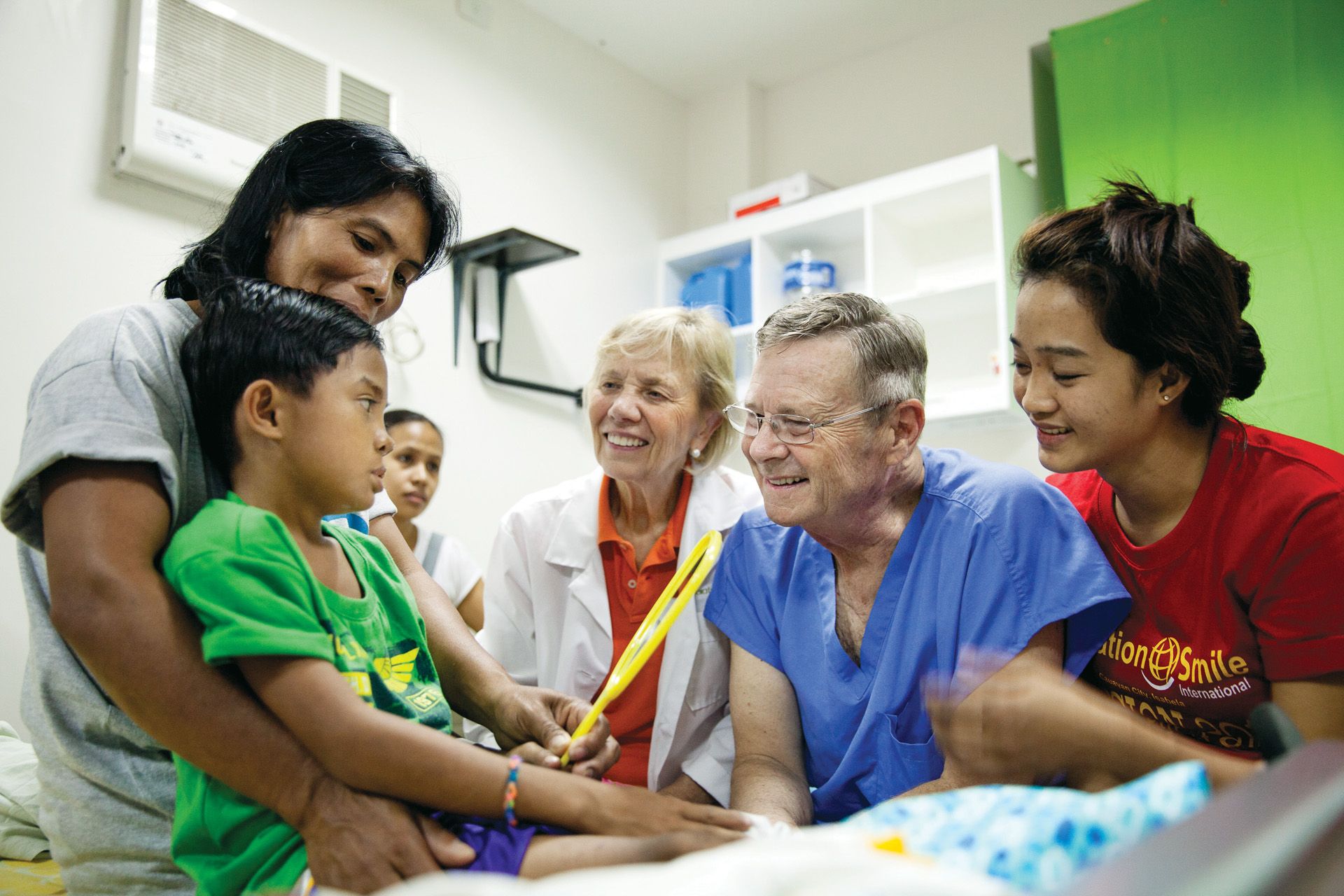
Kathy and Bill Magee founded Operation Smile after a memorable visit to Naga City
"She came up to me cradling a basket of ripe bananas, her 8-year-old daughter with a big hole on her lip by her side. She said she wanted to give the fruits to me for trying to take care of her child, even though we had turned her away. She said bananas were the only things she could afford, but said she really wanted to give me something. All I could mutter was a weak ‘maybe next year.’ It was more a wish than a promise; I knew there was no next year because the team I was with was not returning. Tears streamed down this poor woman’s cheeks, and my wife Kathy and I had tears streaming down ours as well. I believe it was at that moment that the idea of Operation Smile was formed,” said Dr Bill Magee who, together with his wife, founded this international advocacy group addressing the problem of cleft lip and cleft palate.
The recollection goes all the way back to 1982, in Naga City on the southeast tip of Luzon island. Magee was then a young plastic surgeon with a medical and dental degree, focusing on cleft lip, cleft palate, and reconstruction of children’s facial deformities. He and Kathy, with their 13-year-old daughter Brigette, were on a Philippine cleft surgical mission together with a team from Houston, Texas. Their last stop was Naga City, where over 300 patients sought their help. “We were able to operate on only around 40 children in those two days, and had to watch 250 get turned away,” Magee said.
The images were difficult to erase and so the next year, Bill and Kathy, plus a group of friends in the profession, went back to Naga to fulfil a promise. That trip developed into a yearly habit and, eventually, to the institutionalisation of a worldwide mission specifically for cleft lip and cleft palate concerns.

A young beneficiary of Operation Smile
Bill’s initial goal was continuity of care. “When we began in 1982, mission groups such as Operation Smile came in for about two weeks and then went home, maybe to return one year later,” he says. “There was no continuity or consistency of treatment. There were no global standards developed for safety, and research and education were not an orchestrated part of the overwhelming majority of these types of groups.”
The answer was crystal clear: find partners in the Philippines so that missions can be conducted as regularly and as often as possible. And for better organisation, Operation Smile Philippines Foundation, Inc was created on 18 August 1988, the first resource country of the Operation Smile, Inc (OSI) global network. The formula has been replicated in 60 other countries and today, OSI has established itself as a solid and trusted name in this specific philanthropic endeavour.
Learning from Experience
Successful surgeries are great statistics, but Operation Smile can also take pride in several innovations developed through the years, like the Global Standards of Care that, according to Bill, “meet or exceed the standards that we use at major hospitals in the US.”
Bill also says that OSI has developed instrument sets with companies like Stryker to increase the efficiency of surgical care, and has undertaken research in educational platforms that are unique within surgical care.

FOR A BETTER FUTURE. Doctors team up for a surgery
What he is most fond of, perhaps, is the Student Programme that allows high school and middle school students to experience the missions, helping develop sensitivity and leadership at an early age. “This programme was a result of seeing for Brigette,” Bill says. “When Kathy, saw the impact this trip had on our daug hter, she vowed to include students in missions from that point forward. We have seen the lessons that these students learnt in this environment that help set their values in an unbelievably productive and positive way.”
Safety, however, tops the list of Operation Smile’s priorities for the future. “After 33 years of taking care of families in low and middle resource countries, we recognise that there is a very significant difference in not only the access to surgery, but also in the infrastructure which would allow a safe surgical environment,” Bill says.
New Challenges
An organisation must periodically examine its goals. As it marks over 30 years of continuous service, OSI has identified the global challenges it must now face: eliminating the backlog of cleft cases and treating new cleft cases before age one.
“In our lifetime, unfortunately, a cleft-free world is not possible,” says Magee. As such, OSI targets the reduction and final eradication of backlog cases. As this ideal situation is reached, more children below a year old can be given this early medical treatment which is more beneficial the younger the patient.
In the Philippines, Bill says that one out of every 500 children will be born with a cleft. “Our goal is to have the necessary manpower and talent to be able to take care of those children at the time they are born,” he says.
Now that the status of the problem of cleft is known, OSI has mapped its strategies, foremost of which is still medical mission work. This time, however, the missions will be larger and more regular. International mega missions are an interesting strategy OSI started. The “Gift of Smiles” mega mission last June, for instance, involved 301 volunteers from 17 countries simultaneously performing surgeries in five cities (Bacolor, Manila, Cebu, Bacolod, and Davao), changing the lives of 750 patients in seven days.

A cleft operation is life-changing, as this young patient will soon find out
Over and above these mega missions, however, Operation Smile taps local partners to perform cleft surgeries anywhere, anytime needed.
The knowledge of where the cases are will also be most useful, and so OSI is embarking on a nationwide patient mapping system in the Philippines with the end goal of putting together a national cleft registry. This tedious task of collating data will be easier now with a special application especially developed for this purpose.
The years have given Operation Smile the confidence to face its future, which is one that, Magee says, holds great opportunity. But it needs valuable support from like-minded individuals to elevate surgical care in the Philippines and elsewhere. “I believe if we get corporations, foundations, and affluent individuals to work side by side with us, we will create a change in the next decade that will be remembered forever,” he says.
Printed in Philippine Tatler October 2015 issue, available in all leading newsstands and bookstores and downloadable via Magzter, Zinio, and Pressreader.

A journalist of more than 30 years, Chit has had varied exposures in this field, both in hard news as well as in soft news, and brings everything she has learnt to the production of the magazine. When not writing or editing, Chit is deeply involved in her chosen service organisation, Rotary International.





