

Cover Photo: Solis Breast Care & Surgery Centre
Photo: Solis Breast Care & Surgery Centre
1 / 1

We sit down with breast cancer surgeon Dr Chan Ching Wan to find out more about how she came into the specialised medical field by accident and how she’s trying to change the way we treat the disease using pulsed electromagnetic fields
How I’m Making It is a weekly series in which Tatler speaks to influential individuals about their unique journeys and what keeps them going.
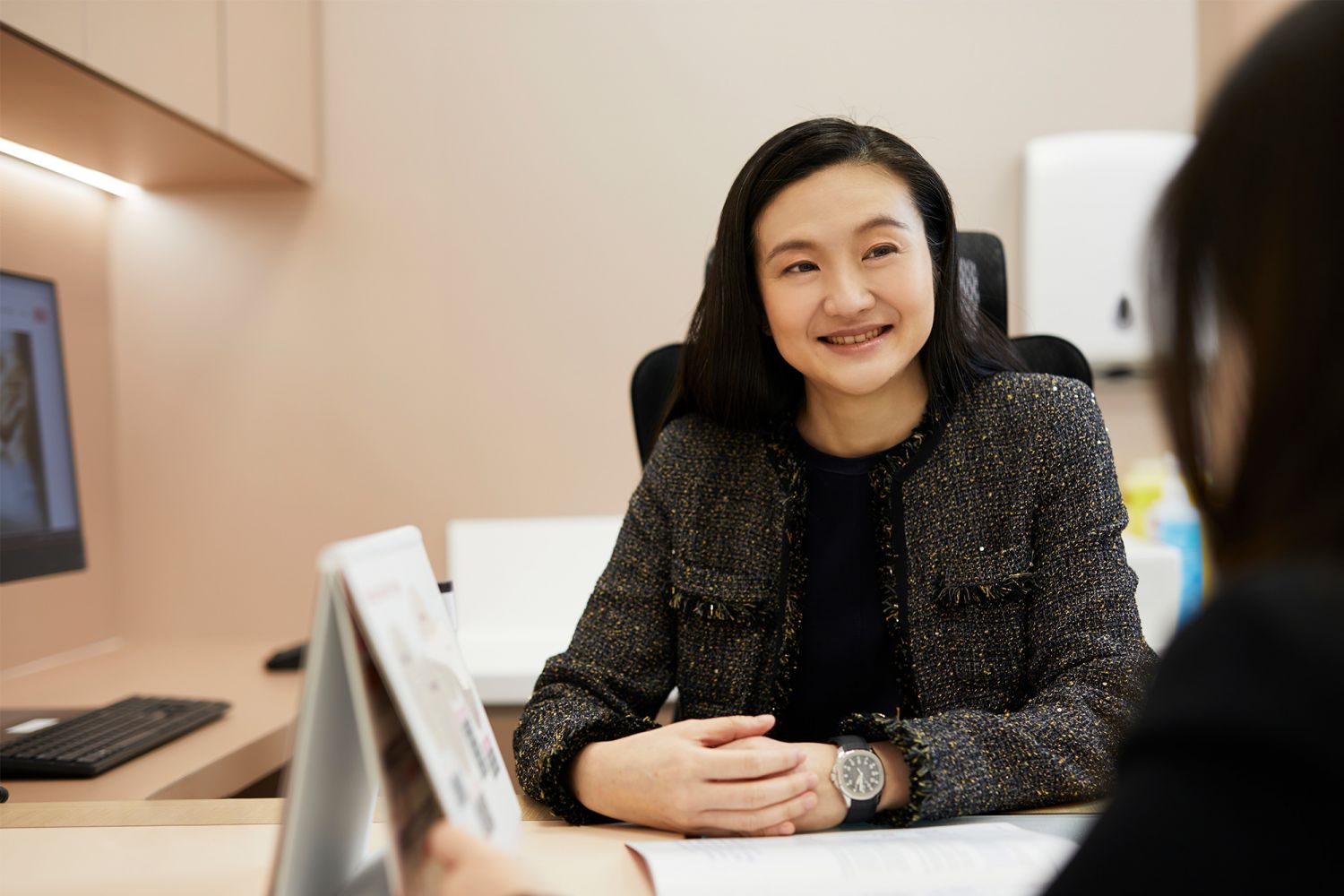
Looking at the way Dr Chan Ching Wan, a senior consultant and breast surgeon at Solis Breast Care & Surgery Centre, manages her patients—deftly slipping from surgeon to doctor to researcher seamlessly—one would immediately recognise that specialising in breast cancer was something she was always meant to do. However, you would also be surprised to note that breast cancer was never a speciality Dr Chan considered as it was something that she found by complete accident.
“I knew I wanted to go into surgery but honestly when I was still studying, I was very focused on getting into orthopaedics,” admitted Dr Chan on a phone call just shortly after completing a surgery and consulting with a patient.
Don’t miss: Cheryl Han on Opening a Postpartum Clinic After Getting Retrenched
However, things changed when the doctor decided to pursue her PhD at the University of Bristol in 1999.
“In those days, we were offered a direct PhD that was done in collaboration with Singhealth and Singapore General Hospital which had a joint programme with the university,” explained Dr Chan. “So because of the nature of the PhD, we actually did not have a lot of choices when it came to the projects we could choose to work on. There were a few and I got assigned to breast cancer,” she continued.
At that point, Dr Chan was in general surgery and dealing with a variety of cases but primarily ones involving general cancers.
“It was really a detour in my training but doing a project on breast cancer ended up being one of the best things for me because I realised quickly how interesting it was and how it opened up my thought processes. It really made me consider things from many different perspectives and I think I just fell into it after that,” Dr Chan said.
Explaining what drew her to the speciality, Dr Chan explained that the knowledge base for breast cancer is always changing and that there was always something new to learn.
Don't miss: Why This Doctor Quit Her Job to Start Her Own Functional Medicine Practice in Singapore
“In those days, if a woman had to do a mastectomy (a procedure to remove the whole breast) due to cancer, it was just that. It would deform her body. It would cause her self-confidence to plummet,” Dr Chan said. “Beyond the cancer diagnosis itself, so many patients had the added worry of what would happen to their bodies and what they would look like when it's over.”
“Today, science has progressed so far and now we are able to combine breast surgery with plastic surgery techniques to recreate the breast and to do our best to fix any form of deformity that might arise from surgery,” Dr Chan explained. “It's honestly so great that we can offer our patients this.”
In addition to consistently learning and adapting herself to new technology and science in the field of breast cancer, Dr Chan is also attempting to make a significant contribution to the research herself.
The doctor, besides juggling her client load and schedule, is also engaging in pulsed electromagnetic research to improve the way we care for cancer patients.
“What we are working on basically is using pulsed electromagnetic fields to enhance the effects of chemotherapy,” Dr Chan explained.
“So the system essentially enhances the killing effect that chemotherapy gives which means that eventually, we might be able to reduce the amount of chemotherapy a patient requires. Considering how many side effects there are to chemotherapy, this would be a game-changer.”
Don’t miss: Meet Dr Tan Sok Chuen, the Only Female Hip and Knee Surgeon in Singapore
While this certainly sounds exciting, unfortunately, Dr Chan is currently struggling to acquire the funds needed to bring her project to life.
“It’s slow progress right now. We are still trying to get it to clinical trials and funding is a problem as well so this is certainly a distant future goal,” she elaborated.
Despite the difficulties, Dr Chan is clearly made for the speciality and draws inspiration and motivation from her patients.
When asked what her most heartwarming experience has been so far, Dr Chan is quick to tell us that there is no particular case.
“When I see patients go through the trauma of cancer treatments and then they come back to me years later and they have resumed life as per normal, that’s the greatest satisfaction for me. I had a job and I did it,” she said proudly.
With it being Breast Cancer Awareness month, Dr Chan was also eager to encourage more women to come forward to get screened.
“Breast cancer awareness is high amongst Singaporeans but many still don’t come forward for mammograms,” she said. “You need to take time off and go for your screenings regularly. At least one every two years. It makes such a huge difference.”
With her hectic schedule, research and son who is about to enlist in the army, we asked Dr Chan how she was making it. Read what she has to say below.

Above Photo: Solis Breast Care & Surgery Centre
Photo: Solis Breast Care & Surgery Centre
1 / 1
What is a typical morning like for you?
Chan Ching Wan (CCW): My mornings tend to be quite random and really depend on the day. I typically am up by 6.30 am and I will then bring my son to school. I will then go to work where I’m doing biopsies, and surgeries or am in the clinic depending on what’s happening that day.
What do you usually have for breakfast?
CCW: Honestly I typically skip breakfast. I only have a cup of lemon juice and some supplements in the morning.
What does a standard work day look like for you?
CCW: I start by 9 am and I usually finish by about 5 pm or 5.30 pm. However, what it looks like in between, well, every day is different and it’s really about what is necessary or what is needed. I might be doing procedures or surgeries or visiting clients in the wards or seeing patients in the clinic. It varies every day.
How would you describe your working style?
CCW: I don’t think doctors really have a working style but my personal philosophy is to just get on and do it. If there is work to be done do it.
What time do you usually have lunch? What do you usually have for lunch?
CCW: Lunch is typically between 1 pm to 2 pm and I like to go for the shortest queue in the food court so I don’t have to wait long.
Free time: overrated or underrated? Why?
CCW: Free time is very important. It’s important to be able to relax and disassociate yourself from work. It’s also good to take time so your brain is relaxed otherwise you are always wound up and its really harder to function in that state.
How do you achieve a work-life balance? How do you set boundaries?
CCW: I think work-life balance for a doctor in particular really depends on where you are in your career. When I was more junior, I had no work-life balance. If work needed to be done or you were on call or on the roster, you just did it. Once I graduated and began moving up though, I was able to manage my time better and schedule in my free time.
Risks: should you take them? Why or why not?
CCW: Yes if they are calculated risks. Like with research, you always need to take calculated risks in order to come up with evidence and to secure funds to further your projects. Also when I look back at my medical career, I have changed tracks so many times and there is always a risk when I do that. But I am where I am today because of the risks I took.
How do you deal with your shortcomings?
CCW: If they are pointed out to me I will decide how to change them. Most patients don’t tell you your shortcomings though. Nowadays people have stepped away from telling you how you are wrong but they like to tell you how the system is wrong. So I do what I can.
How do you unplug?
CCW: I like to do something unrelated like listen to music or read.
How do you stay grounded?
CCW: My patients keep me grounded. When I talk to them and hear what their problems are, it’s just very hard to lose reality when you talk to them.
What is the best piece of advice that you have ever gotten?
CCW: If you feel that it is the correct thing to do, then you should do it and not think twice no matter how difficult it may be. Do what your conscience tells you because you can’t sleep at night otherwise.
How do you stay motivated?
CCW: My patients motivate me because when I see what they have gone through and the courage they face in their different situations, I just want to keep working harder for them.
What is the last thing you do before you go to bed?
CCW: I make sure I haven’t forgotten to do anything I need to do on my to-do list.
NOW READ
How This Entrepreneur Turns Chopsticks Into Gorgeous Furniture
Pass It On Founder Michelle Chow on Launching an Online Store Focused on Sustainability
Motherswork Founder Sharon Wong on How She Used Her Hobby to Create an International Brand
Topics
Camillia Dass is the digital writer for Tatler Singapore.





