
What to know about the most “boring” cryptocurrency
Stablecoins are designed to be as exciting as watching paint dry—and that’s exactly why they’re revolutionising finance. Let’s take a Deep Dive into the world of stablecoins.
💰 Stablecoins are cryptocurrencies engineered to maintain a stable value by pegging themselves to traditional assets like the US dollar or gold.
🤝 What started as a niche trading tool for crypto enthusiasts has evolved into critical financial infrastructure, with stablecoins bridging the gap between traditional finance and the blockchain world.
🌏 From remittances in the Philippines to inflation hedges in El Salvador, this cryptocurrency is reshaping how billions of people store and move money across borders—often bypassing traditional banks entirely.
QUOTABLE
“We believe that when stablecoins are trusted, scalable and interoperable, they can fundamentally transform how money moves around the world.”
— Rubail Birwadker, global head of growth, Visa

BY THE NUMBERS

US$27.6 trillion The estimated annual on-chain transfer volume of stablecoins in 2024 is US$27.6 trillion, a figure that now exceeds the combined yearly transaction volumes of Visa and Mastercard.
US$40 billion In May 2022, the collapse of the Terra stablecoin, TerraUSD, and its associated Luna cryptocurrency cost investors more than US$40 billion.
99% Ninety-nine per cent of the stablecoin market is pegged to the US dollar, creating a powerful new vector for “digital dollarisation”.

QUIZ
What year was the first stablecoin, BitUSD, launched as a crypto-collateralised currency?
A. 2009
B. 2014
C. 2018
Scroll to the bottom for the answer.
DID YOU KNOW?

The failure of early stablecoins like BitUSD taught the industry a crucial lesson: unstable assets cannot reliably back a stable asset. This fundamental insight led to the rise of fiat-collateralised stablecoins like Tether, which simply promised a one-to-one backing with actual US dollars.
THE EDIT
🧠 Genius. This year, US President Donald Trump signed into law the Guiding and Establishing National Innovation for US Stablecoins Act (Genius Act), the first comprehensive federal framework for stablecoins, mandating one-to-one backing with high-quality liquid assets.
🏦 Banking coin. Traditional banks initially viewed stablecoins as a threat to their deposit businesses. Now they’re preparing to become issuers themselves.
💻 Quantum leap. The cryptography securing all blockchain transactions, including stablecoins, is vulnerable to quantum computing attacks.
🇯🇵 Japan has landed. The first yen-pegged stablecoin launched today in Japan, backed by domestic savings and government bonds.
WATCH

This CNBC video explains how stablecoins work, why they may not be as they’re named and what led to the crash of the TerraUSD.
THE FULL PICTURE
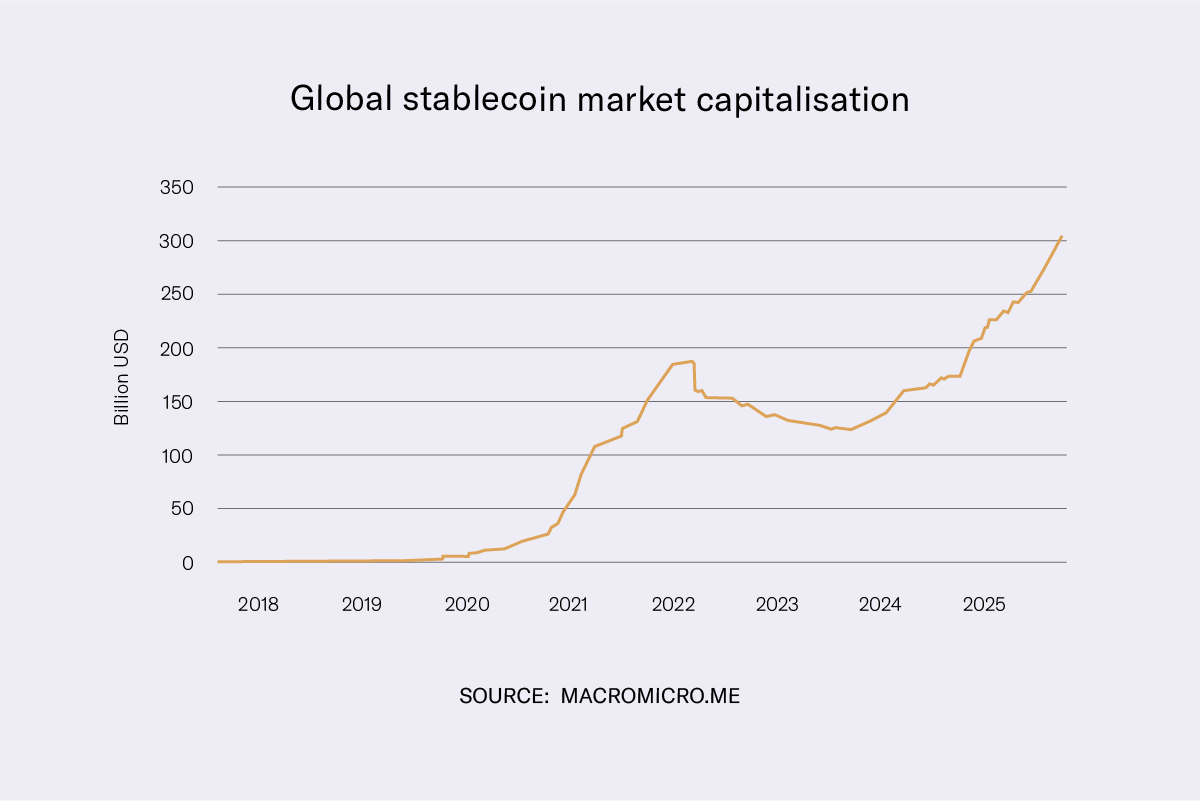
The popularity of stablecoins grew significantly between 2017 and 2022, reaching nearly US$200 billion in 2022, driven by factors including the bullish crypto market. Market capitalisation dipped slightly between 2023 and 2024 before resuming its growth.
KEY PLAYER
Paolo Ardoino
Paolo Ardoino is the CEO of Tether, the company behind USDT, the world’s largest stablecoin with a market capitalisation exceeding US$150 billion. USDT is the most traded digital asset globally, often surpassing even Bitcoin’s daily turnover. Originally a software engineer at Tether’s sister company Bitfinex, Ardoino was appointed Tether’s CTO in 2017 and subsequently its CEO.

HONOUREE TO KNOW
Alessio Quaglini
Alessio Quaglini is leading the institutional adoption of digital assets. In 2018, he co-founded Hex Trust, a digital asset financial institution specialising in custody, staking and market services. Under his leadership, it has become licensed across major financial hubs, including Hong Kong, Singapore, Dubai and Italy, and a partner for institutions seeking secure, strategic engagement with digital assets.

ONE FINAL THING

Stablecoins derive their value by pegging themselves to stable, physical assets, but their chaotic cousins, memecoins, peg themselves to... internet jokes.