When old is the new gold
A demographic shift that once spelled doom is now Asia’s trillion-dollar treasure trove. Let’s Deep Dive into how the significant and rapid ageing of older adults is fuelling the silver economy.
🧓 As Baby Boomers age, they are typically referred to as the silver generation. The silver economy refers to all economic activities, products and services for people aged 50 and over.
🪙 It is much more than just healthcare and pensions—it’s Asia’s newest economic powerhouse.
⚖️ Originally feared for its potential to bankrupt pension systems and strain healthcare resources, this ageing population has proven to be a catalyst for innovation, entrepreneurship and sustainable economic growth.
QUOTABLE
“Today, we are an aged society. Soon, we will be a ‘super-aged’ society. This has massive social and economic implications.”
— Lee Hsien Loong, senior minister of Singapore
BY THE NUMBERS

923 million The Asian Development Bank estimates that about 923 million people in Asia will be aged 65 and over by the middle of this century.
36.25 million In 2024, Japan’s population aged 65 and above hit an all time high of 36.25 million, making it one of the world’s fastest-ageing societies.
$4 trillion The projected value of Asia-Pacific’s silver economy is expected to surpass US$4 trillion in 2025.
QUIZ
What are the two primary reasons for Asia’s booming silver generation?
A. Increased migration to urban areas and better job opportunities
B. Government incentives for larger families and advancements in early childhood education
C. Sustained declines in fertility rates and significant increases in life expectancy
Scroll to the bottom for the answer.
TATLER FRONT & FEMALE AWARDS

DID YOU KNOW?

A 2022 study of China found that a growing elderly population significantly reduces public spending on education. For every 1 per cent rise in the proportion of older dependents, funding for local public education drops by 0.3 per cent.
THE EDIT
👵🏼 Silver startups. Entrepreneurs across Asia are building businesses inspired by the elderly.
💪 Work it. As people age more healthily, they can extend their working lives and enhance their productivity, which in turn strengthens the labour force.
🇰🇷 Being age-friendly. Despite South Korea being a “super-aged” society, a study by Stanford University found that it has not adapted as fast as the US in creating “age-friendly” jobs for its silver population.
📱 Gerontechnology. Also known as age-tech or gerotechnology, this field leverages innovation to support older adults and improve their quality of life.
WATCH

This video looks into how various societies in Asia—Singapore, China and Taiwan—have evolved with the increasing number of older adults—from the rise of longevity clinics to social and labour issues.
THE FULL PICTURE
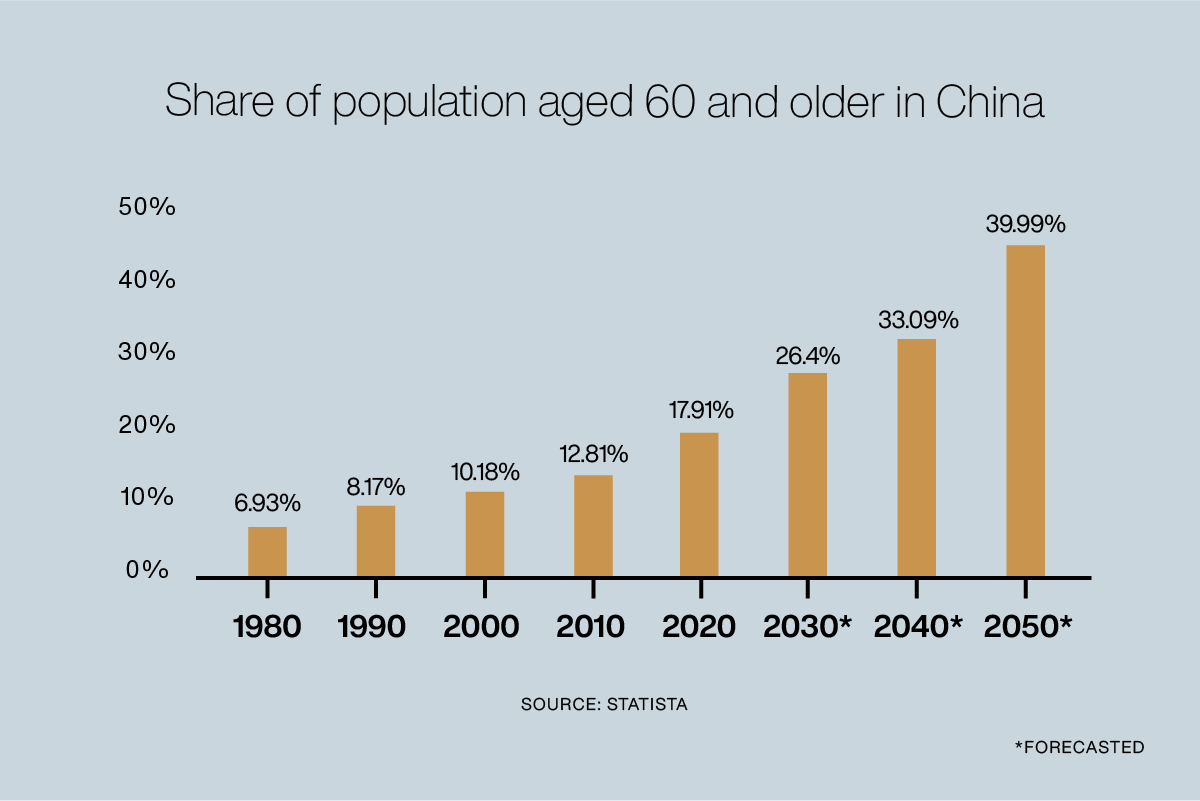
Between 2000 to 2020, China’s population aged 60 and over nearly doubled from 10.18 per cent to 17.91 per cent, reaching around 255 million people. This age group is expected to hit 40 per cent of the country’s total population by 2050.
KEY PLAYER
Élie Metchnikoff
Nobel prize winner and researcher Élie Metchnikoff coined the term “gerontology” in 1903. He also developed one of the first scientific theories on ageing and longevity, emphasising the critical roles of the immune system—specifically phagocytes—and the intestinal microbiome in degenerative ageing processes.
HONOUREE TO KNOW
Queenie Man
With The Project Futurus, Queenie Man is elevating the tone of the debate around ageing. The organisation promotes ageing innovation featuring state-of-the-art eldercare products from around the world, and through its Captain Softmeal campaign, advocates for senior-friendly dining and food preparation.

ONE FINAL THING

Age is but a number, and an 86-year-old grandfather from England has proven just that. Known as Britain’s “strongest grandpa”, he set a new world weightlifting record clearing 77.5kg in the British Drug-Free Powerlifting Association 2023 championship.
NEXT TIME
The answer to the quiz is C (Sustained declines in fertility rates and significant increases in life expectancy).





