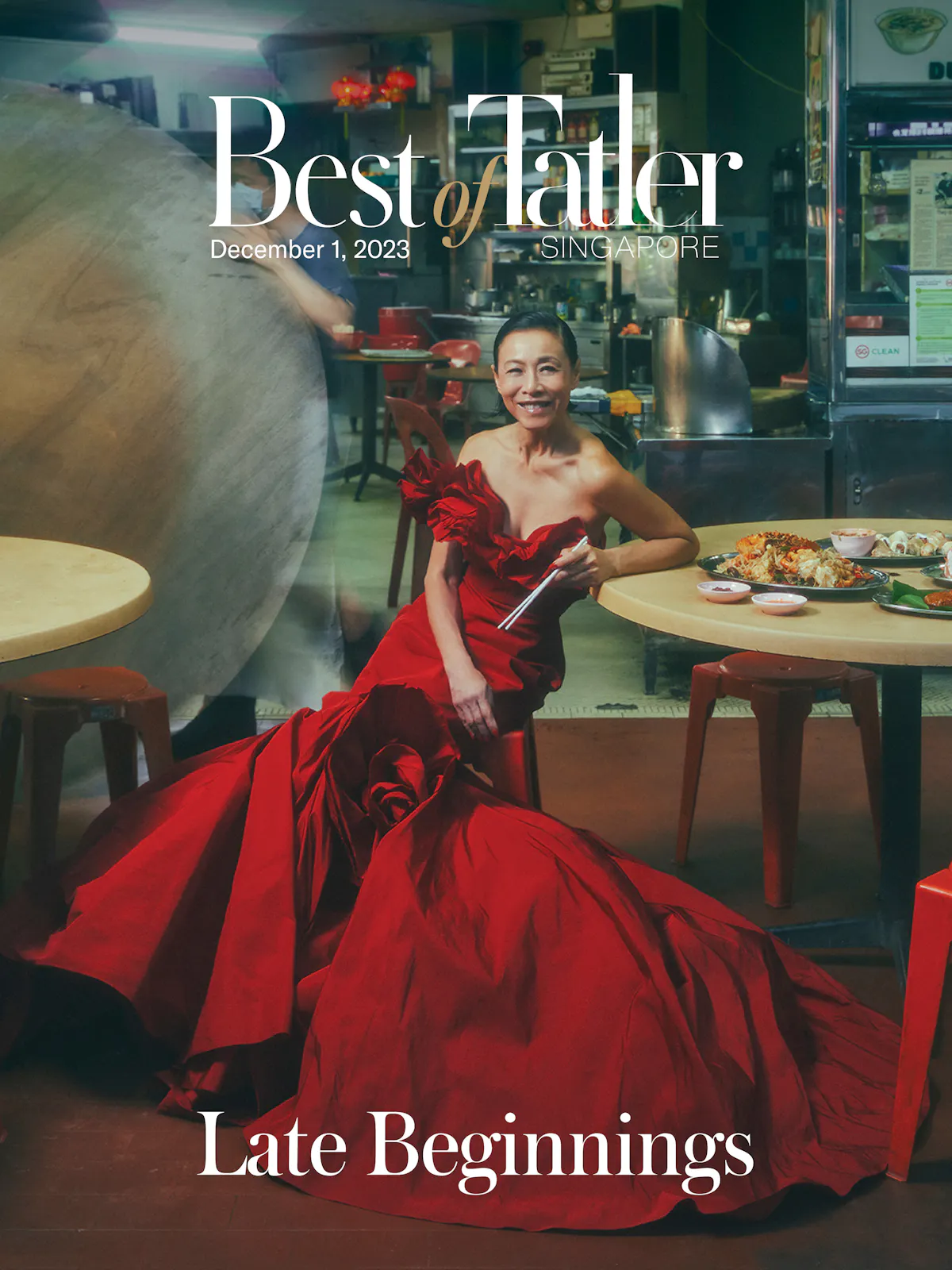
A Woman In Her Prime
In a floor‐sweeping strapless red gown and with her freshly cropped hair slicked back, Tan Kheng Hua is the picture of sophistication. The gritty setting of Sin Huat Eating House—a coffee shop in Geylang loved by culinary luminaries—is an antithesis to her glamour. Yet there she sits, elegant and nonchalantly at ease on an orange plastic stool and with chopsticks in hand.
On set, Tan is a photographer’s dream, effortlessly morphing into different characters, be it a cape‐clad diva striking a pose at National Kitchen by Violet Oon or a cheeky audience member heckling an empty stage at the hallowed Esplanade – Theatres on the Bay. A quick glance at the test shots is all she needs to work her magic.
Away from the cameras, Tan is disarmingly grounded, chatting about her fondness for wearing slippers everywhere and her routine morning strolls to the kopitiam (a colloquial term for coffee shop).
Over a video call in October, Tan revealed that she had been living a remote, off‐grid life for six months, on an island in British Columbia in a “dilapidated” cabin devoid of electricity and plumbing, and with a compost toilet. This desire to live remotely took root while she was filming in Vancouver. She has always been athletic—her school years saw her participating in gymnastics, marathons and canoeing—and the great outdoors appealed. The more time she spent in the Canadian province’s natural landscapes, the harder it was to resist the call of the wilderness.
Such rustic living may seem at odds with Tan’s glamorous public persona, but deliberate choices after careful consideration are also part of her personality.
This theme of deliberate pacing has been a recurrent one throughout her life, with her late entry into Hollywood being a recent example. “I only came to work in North America in my late 50s. I’m a real proponent of being a late developer. When you take things on at an older age, you tend to be more level‐headed,” she says. And far from the notion that society has long perpetuated about opportunities for women over 40, Tan’s career is nowhere near winding down. Her breakthrough in Hollywood is not her swan song, but an affirmation of her long‐held conviction: that there is untold grace in late blooming.
Beyond acting, Tan is also a distinguished television and stage producer, known for her work on the iconic live cabaret act the Dim Sum Dollies as well as Mediacorp’s television series 9 Lives and Do Not Disturb. On the international stage, she produced the theatre piece No 7 for Penang’s George Town Festival in 2011 and led the festival’s Sin‐Pen Colony showcase in 2014.
This year, Tan also lent her voice to projects by Singapore production company Robot Playground Media and streaming service Paramount Plus, such as the latter’s animated film The Tiger’s Apprentice, which is set to be released early next year and also features the voices of heavy hitters such as Michelle Yeoh, Henry Golding and Sherry Cola.
The months‐long writers’ and actors’ strikes had left Tan in what she describes as “a limbo state” for some time—which she shares was not necessarily a negative experience.
Tan strikes us as someone who has found a sense of liberation that comes with embracing one’s golden years. The anxieties she faced as a younger woman have faded into the background and her insatiable curiosity also keeps her energised. “I’m curious about a lot of things. I’m restless. I can’t sit still. When I want to do something, I’ll do it.”
With a slew of projects and an enthusiastic embracing of her maturity, we can only imagine that Tan will continue to grow her career with the same vigour and introspection that have always marked her journey.
Read story here.
DINING
Celebrity chef Daniel Boulud to open Maison Boulud at Marina Bay Sands Singapore
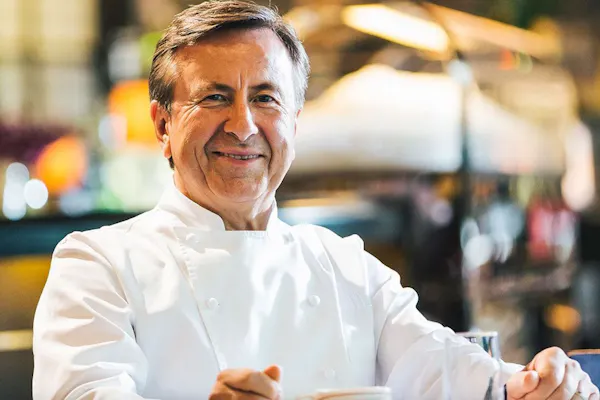
Celebrity chef Daniel Boulud
French celebrity chef Daniel Boulud is making his return to Singapore with Maison Boulud, a fine dining restaurant that opened to much praise and acclaim in Montreal in 2012. The two-storey restaurant, situated along Marina Bay Sands’s picturesque waterfront promenade, will open its doors in early 2024.
Diners familiar with Maison Boulud’s signature brand of elevated French gastronomy will spot some of his greatest dishes such as sole meunière and côte de bœuf, each one rendered with precision, yet retaining its simple, French soulfulness. Boulud’s other beloved concept, Db Bistro & Oyster Bar, will close after 13 years to make way for the new restaurant. But iconic dishes from the bistro will make a reappearance on Maison Boulud’s new menu, including its signature seafood platter.
Inspired by the simple beauty of the Mediterranean, award-winning Joyce Wang Studio has designed a restaurant dominated by neutral palettes and burnished with large, arched windows and coastal-inspired artwork reminiscent of the French Riviera. The result makes for a dining experience that is luxurious as it is rustic, from the airy main dining room to the stylish bar and lounge, and even outdoors by the Bay, where you can sip on cocktails from an innovative mixology programme before returning inside for an exquisite feast.
Read full story here.
POWER & PURPOSE
How a twist of fate led Killiney Kopitiam’s Woon Tien Yuan to take over his family business
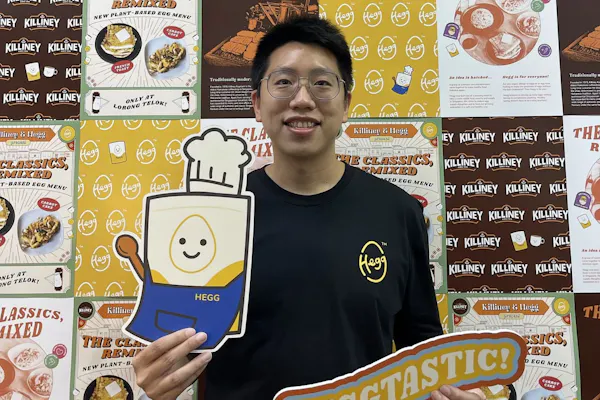
Killiney Kopitiam’s Woon Tien Yuan (Photo: Woon Tien Yuan)
When it comes to the quintessential Singaporean breakfast, one of the first things that comes to mind is a full local breakfast set that comprises kaya toast, soft-boiled eggs and a cup of Nanyang-style coffee. Even better if it is from Killiney Kopitiam—after all, it is the oldest Hainanese coffee shop in Singapore.
For many Singaporeans, this coffee shop needs no introduction. Previously known as Kheng Hoe Heng Coffeeshop, this joint was established in 1919 by a Hainanese immigrant before being bought over by Woon Tek Seng in 1992. Inspired by the coffee shop’s location along Killiney Road, the joint was renamed Killiney Kopitiam. Over the years, the local institution has expanded with over 40 outlets in Singapore and overseas.
Today, the heritage brand is led by second-generation business owner and director Woon Tien Yuan. While his family has been in the F&B business for years, the younger Woon never felt any pressure to join any of his family’s businesses.
Woon decided to join the family business after graduating from NUS Business School in 2012—however, not as the director of Killiney Kopitiam but managing Woon Brothers Foundation, a family foundation established with a mission to “advance art and education; promote art and culture; and assist the weak and needy”.
Moving to take over Killiney Kopitiam was due to a “twist of fate” in 2019. While catching up with Ow Yau Png, his childhood friend and co-founder of food-tech company Hoow Foods, Woon challenged Ow to create a better instant beverage product for Killiney. This led to a joint venture between Killiney Kopitiam and Hoow Foods, and the start of Woon’s journey as the director of Killiney Kopitiam.
Since joining in 2019, Woon has been constantly introducing new ideas to enhance and preserve the heritage brand. This year alone, the brand has initiated three new major projects: KillineyGO, Official Killiney Mart and The Killiney Experience. Fortunately for Woon, his family elders have been “very supportive of my proposed new plans and projects since day one”.
Woon enjoys working with his family—whether it be at Killiney Kopitiam or Woon Brothers Foundation. “Every day is a learning journey for me, especially when I seek advice from my family elders. These learning experiences are priceless and invaluable because they represent the entrepreneurial journey that the previous generation have gone through,” he says. What’s more, being able to work with his family has also resulted in having a strong family bond.
Read full story here.
HOMES
The return of maximalism: Why are bold, eclectic interiors suddenly popular again?
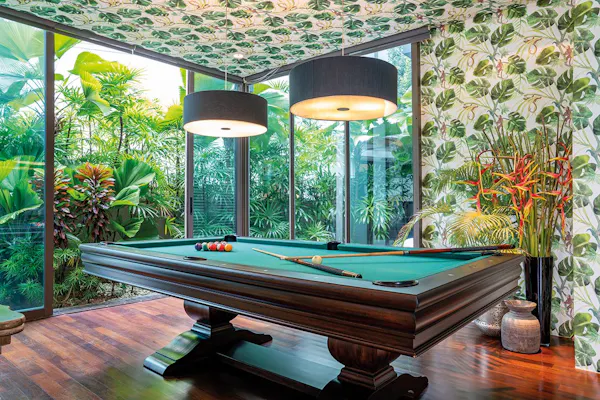
Palm motifs applied to an entertainment den that reference the garden’s verdant greenery (Photo: Design Intervention)
Even Marie Kondo has finally relented: in an interview earlier this year, she said that her home is messy but apt for her current stage in life. Unsurprisingly, trying to maintain an ultra-tidy house while raising three children and running a thriving business does not spark joy. The rest of us have also leaned into self-indulgent “goblin mode” to varying degrees, and there’s an acceptance that a layered, lived-in home is more comfortable, not to mention authentic.
This is a marked shift from the polished perfection that was the height of aspiration over the last decade. The dominance of Scandinavian minimalism perpetuated the myth that a pared-back look is best, but it seems that less is not always more. Today, there is a collective desire to inject more colour, pattern and texture into our interiors, and for our spaces to reflect our imperfect lives.
The pandemic may have had something to do with this. Nikki Hunt, founder of award-winning firm Design Intervention in Singapore, shares: “Post-Covid, health and well-being have become increasingly important. People are abandoning the pursuit of perfection and prioritising happiness. Eclectic design enables the creation of spaces that are personal and reflect the myriad interests and experiences of the people who inhabit them.”
Our new post-pandemic lifestyle is informing the desire for more characterful sanctuaries, but the fact is that minimalism was a stretch to achieve from the start.
The pendulum swing to maximalism is also a rejection of the decluttering movement that shamed anyone who owned more crockery than needed for a dinner party. Today, possessions are seen as a reflection of one’s life, just as they should be.
For homeowners who are toying with going in the same direction, the question remains: How do you create an eclectic interior you won’t tire of? A simple starting point would be to experiment with furniture and art.
That said, Hunt explains that there’s a need to create a cohesive element—a visual thread that runs through the space—as well as to strive for balance. For instance, energetic hues have to be paired with neutral tones to ensure harmony. The same goes for pattern and texture, which she says should also be offset with negative space so the eye can rest. One of Design Intervention’s best design devices is symmetry, which Hunt believes grounds a space. Most importantly, eclectic spaces need to have something personal to enhance their character.
Read full story here.
DISCOVER THESE ON TATLER ASIA
5 crazy smart insights on self-empowerment, self-love and outer space.

Festive Finery: An exclusive showcase of Valentino’s party-ready looks.

From legacy to new beginnings: Life-changing quotes from Pico Iyer and Juan Pablo Escobar.

Meet the winners of the Blue Water Heroes awards 2023, announced at a private ceremony in Singapore.

Grace Ann Chua on why she co-founded her social enterprise Friendzone.

A tech founder, creative entrepreneur and industrial designer share their stories of forging their own path.

Audemars Piguet introduces four 37mm Royal Oak Offshore Selfwinding Chronographs with gem-set bezels.

Fulfil all your festive gift desires with these fashion and beauty treats at Takashimaya.

Three-time world snooker champion, On-yee Ng, traces her Hong Kong roots.

Experience the vibrant flavours of South America with Tatler Dining Kitchen and Mastercard at Araya.





