
1 / 1
Founded in the ninth year of the Kaibao period in Northern Song dynasty (AD976), Yuelu Shuyuan was one of the oldest and most enduring independent academies in China. The academy’s history closely mirrors political trends and educational developments in China, from the first blossoming of independent academies in the Northern Song period, through intervals of inter-dynastic turmoil, to the final transition into a modern educational institution, in the guise of Hunan University, opened in 1927.
Already in the Song dynasty, Yuelu Shuyuan was hailed as one of four great academies in China – a position it was to maintain to the end of the dynastic period – and its destiny was closely interweaved with that of China itself, reflecting not only developments in education and philosophy, but the academy was ultimately to play an important role in national fate. For it was in the quiet, secluded environment of Yuelu Shuyuan, seemingly removed from all earthly quarrels, that Mao Zedong and his cohorts hatched their revolutionary plans, which were ultimately to change the face of China forever.
In its origin, Yuelu could not be further away from the reality of politics. Nestled in the sacred valley of Mount Yuelu, which had for long been home to Taoist hermits and Buddhist monks, the academy was in close vicinity to Gu Lushan Monastery, an ancient Buddhist temple founded in the Western Jin period (AD268). In fact, the academy was built on the site of a late Tang dynasty Buddhist school, which attests to the influence of Buddhist institutions on early independent schools in China. It has often been said that Buddhist monastic communities with their strong tradition in scholastic learning and meditation had been a main source of inspiration for shuyuan. In that connection, Yuelu Academy may be regarded a classic example.
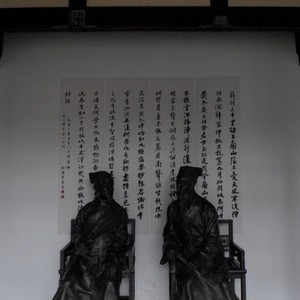
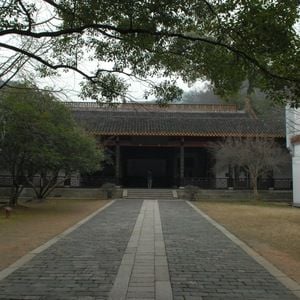
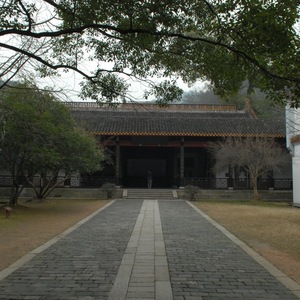
As one of the first great independent academies in China, for generations Yuelu was presided over by philosopher-hermits, who shunned the temptations of officialdom and wealth to pursue a path of self-realization, within an independent, self-sufficient academic community. In the Southern Song dynasty, in particular, academies flourished throughout China, and the spiritual leaders of this movement – the philosophers Zhu Xi and Zhang Shi, both of whom lectured at Yuelu – encouraged students to study for the sole purpose of self-knowledge and wisdom, rather than to advance their careers through public examinations. During this period, academies were the very centre of philosophy and free inquiry, with Yuelu being the site of two famous debates between Zhang Shi and Zhu Xi concerning interpretation of Confucian tenets in moral philosophy. And for anyone with a good sense of history and imagination, it is inspiring to walk through the entrance leading to the main lecture hall, where some of the greatest minds in China lectured on diverse subjects from astronomy, moral and political philosophy, and epistemology to a congregation of aspiring scholars.
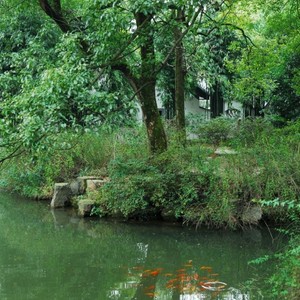
Walking through the largely reconstructed academy today, the hermitic spirit continues to manifest in certain parts of the shuyuan, in particular, in the unkempt garden enveloping Bai Quan Lodge in the western wing of the academy, which extends longingly towards the wilderness of the mountain beyond the walls.
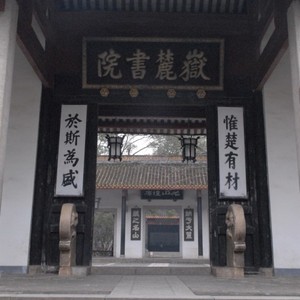
It is an irony of history that every successful institution becomes a victim of its own success. In the Qing dynasty, reversing China’s long-held custom of ‘ruling the barbarians with barbarians’, the talented Manchu emperor Kangxi began a series of far-reaching Confucian reform, in a bid to exert political authority over the Chinese population through ideological control. One of them was through incorporating centres of education into the official system, and turning them from isolated cloisters of independent thinking into closely monitored schools servicing the state examination.
In the dialectic between wild garden and architectural order, historic root to ascetic philosophy and contemporary connection to Hunan University, which is manifest in Yuelu Shuyuan, we find a deep-rooted tension between orthodoxy and independence, dogma and free inquiry, which perhaps sums up the ongoing dilemma in Chinese education continuing into the present day.





