1 / 1
No one does it quite like Waldorf Astoria Hotels & Resorts—which has reopened its legendary New York property. We look into its enduring legacy, and how the luxury brand is taking that spirit of hospitality to new destinations from Osaka to London
It’s a funny thing to reminisce about an era you never lived in. And yet, many find themselves romanticising the bygone glamour of travel—where hotel lobbies pulsed with energy, royalty and rock stars rubbed shoulders, dining was a spectacle and timeless, elegant design left one thinking, “ah yes, this must be the place.”
Few hotels embody this era quite like Waldorf Astoria New York, which has opened following a meticulous restoration. More than just an opening, it’s the return of an icon, and to bring a property so culturally and historically significant into the now is no easy feat. So Waldorf Astoria, Hilton’s luxury brand of iconic hotels, enlisted some of the best in the business to take on this coveted project.
The restoration is led by Skidmore, Owings & Merrill for architecture, and French designer Pierre-Yves Rochon—who is also behind Waldorf Astoria Beverly Hills—for interiors. While retaining the original art deco grandeur, the hotel features updated technology and contemporary comforts, while guest rooms have been significantly reduced from 1,400 to 375, allowing for larger, more luxurious stays. After all, an unparalleled guest experience has always been at the heart of this hotel’s legacy.


Above The newly reopened Waldorf Astoria New York has retained much of the charm of the original
The newly reopened Waldorf Astoria New York has retained much of the charm of the original
1 / 1
When it first opened in 1931, Waldorf Astoria New York was the tallest and largest hotel in the world—a marvel of art deco architecture by Schultze & Weaver, who envisioned grand spaces with intricate details. The hotel had such grandeur that Hilton founder Conrad Hilton declared the property “The Greatest of Them All.” But its design is just one of many ways the now legendary hotel was ahead of its time.
Waldorf Astoria New York modernised room service, and was the first hotel in the world to offer it 24-7; in 1948, it hosted the first ever Met Gala—the invitation was titled “The Party of the Year”; and it was the first major hotel to hire a female cooks, in the early 1930s.
It also had a star-studded history of famous guests, from Queen Elizabeth II to Elizabeth Taylor. It’s alleged that every US president from Herbert Hoover to Barack Obama has spent a night in its presidential suite; rock band The Who infamously earned a lifetime ban following a rowdy 1968 visit; and some celebrities even called it home—including Frank Sinatra, Cole Porter, Marilyn Monroe and Paris Hilton, who lived there throughout her childhood in the ’80s and ’90s.
The world was intrigued, and in the early 2000s, Waldorf Astoria brought its timeless elegance to some of the world's most coveted destinations. From Versailles in Paris to the canals of Amsterdam, the Bund in glittering Shanghai to bustling Bangkok.

Above The iconic Waldorf Astoria New York facade on Park Avenue
The iconic Waldorf Astoria New York facade on Park Avenue
1 / 1
In April, we were one of the first guests to check into the brand’s newest hotel, Waldorf Astoria Osaka—its debut property in Japan.
“The debut of Waldorf Astoria in Japan marks a defining moment for Hilton’s luxury portfolio in Asia Pacific,” said Candice D’Cruz, vice president, Hilton Luxury Brands, Asia Pacific. “From the legendary Waldorf Astoria New York—an enduring symbol of luxury and sophistication—to this exceptional new address in Osaka, we are expanding a legacy built on timelessness, innovation and intuitive service. We look forward to delivering truly effortless stays and unforgettable experiences that reflect both the rich cultural heritage of Osaka and the brand’s sincerely elegant service.”
The hotel was designed by internationally acclaimed architect Andre Fu, who took inspiration from the original New York hotel.
“Much of the design echoes the art deco heritage that Waldorf Astoria embraces,” he says. “We juxtaposed art deco grandeur with Japanese craftsmanship. That was very much the soul and spirit of the integrity of the concept.”

Above Waldorf Astoria Osaka opened this April
Waldorf Astoria Osaka opened this April
1 / 1
This is especially prominent in Peacock Alley, the iconic bar and lounge at the heart of the Waldorf Astoria experience. The Osaka rendition is an elegant day-to-night social space with soaring triple-height ceilings, mesmerising views and a statement clock—an art deco pièce de résistance that anchors the room, fashioned from a 144-year-old timepiece by legendary Japanese manufacturer, Seiko.
Here, champagne flows and too-pretty-to-eat high tea towers are whisked from the kitchen to tables. Even the uniforms worn by staff in Peacock Alley fuse art deco flair with Japanese craftsmanship—like the box pleated skirts worn by waitresses, made from a beautiful fabric that echoes those used to craft kimono.
In the guest rooms, sculptural lamps bookend ornate wooden headboards built using the Japanese technique of Kumiko, where thin wooden pieces are precisely grooved, punched, and mortised before fitted together without the use of nails or glue.
Speaking of guest rooms, the 252 at Waldorf Astoria Osaka are some of the largest in the city, the most luxurious of which are two 1,570 sq ft penthouse suites and a more than 2,000 sq ft Presidential Suite. All rooms boast views that sweep across the city, from a sea of skyscrapers to Osaka Bay to the mountains of Hyogo.
I really wanted to have his work in the project because it has a bold pop of colour, that, to me, is what differentiates Osaka from other Japanese cities. It’s edgy, and it has grit.
Ahead of designing the hotel, Fu took multiple trips to Osaka to familiarise himself with the city’s rhythms, nuances and quirks, and to find inspiration in its architecture. “I visited art deco buildings that were built in the 1920s and 1930s,” says Fu, adding that a visit to Frank Lloyd Wright’s Yodoko Guest House in Ashiya, 45 minutes’ drive from Osaka, inspired the trapezium lamps throughout the hotel.
Osaka is, indeed, full of surprises, and Fu wanted to make sure the hotel reflected this.
“A lot of people associate high end luxury hotels with tranquillity, but in the curation of art [for Waldorf Astoria Osaka] I focused a lot on colour. “We’ve got strong pops of indigo blue, caramel yellow and sage green,” says Fu.
One of the most prominent pieces is a sculpture in the lobby by late Japanese artist Jun Kaneko, a large ceramic orb adorned with pops of bright yellow and coral pink, with black polka dots - a contemporary holler amidst the space’s quieter, more traditional Japanese pavilion look with oak posts and bronze screens.
“I really wanted to have his work in the project because it has a bold pop of colour, that, to me, is what differentiates Osaka from other Japanese cities. It’s edgy, and it has grit,” says Fu.
Tatler tip: A personal favourite design element is the glass-encased courtyards scattered throughout the hotel’s public spaces, from the reception to its airy French brasserie, Jolie. These serve as living galleries that will transform with Japan’s seasons - Sakura in the spring, vibrant flowers in the summer, fiery hues of autumn and the tranquil, snowy white of winter.

Above Guest rooms and suites at Waldorf Astoria Osaka boast sweeping city views
Guest rooms and suites at Waldorf Astoria Osaka boast sweeping city views
1 / 1
Innovative dining is core to the Waldorf Astoria—after all, it was Waldorf Astoria New York that invented the Waldorf Salad and popularised the eggs benedict.
At Waldorf Astoria Osaka, its signature restaurant Tsukimi showcases the innovative nature of Japanese cuisine: from exquisite Kobe beef sourced from a farm that sells exclusively to Tsukimi; buckwheat soba handmade the traditional way by the chef, who spent months with a soba master honing his skills; and warabi mochi made in front of you, as a chef skilfully stirs and mixes the bracken starch to a perfect consistency. And none of it feels performative—it’s intentional, authentic and rooted in respect.
For a nightcap, Canes and Tales is the hotel’s speakeasy. “The bar is kind of a crescendo, a speakeasy that’s tucked away. When conceptualising the bar, I imagined… if the founder of the Waldorf Astoria came to Osaka and wanted to create a bar that tells the story of the brand, what would that look and feel like?” says Fu of the seductive space, which features cascading art deco style lighting, a long bar and lush velvet seating. Be sure to check out the tiles at the back of the bar, which are fashioned from an old map of Osaka during Japan’s Edo Period (1603-1868).
“I think what differentiates a good hotel from a great hotel is when you walk in and you know that there is a story to be told,” says Fu. “You know that there is a meaningful narrative. In this case, it’s that you’re seeing Osaka through the lens of Waldorf Astoria.”

Above Waldorf Astoria Osaka's speakeasy-style bar, Canes and Tales
Waldorf Astoria Osaka's speakeasy-style bar, Canes and Tales
1 / 1
The brand will continue to grow in Japan, with its next outpost in Tokyo’s vibrant Nihonbashi district —one of multiple properties currently under development as part of Hilton’s plan to double the 34-strong Waldorf Astoria brand.
Later this year, Waldorf Astoria Shanghai Qiantan will open in Shanghai's New Bund area, giving guests a front-row seat to the city’s electric energy with panoramic views of the Huangpu River. The hotel's interior design draws inspiration from ornate Chinese cultural elements and an art deco style that echoes the energetic elegance of Shanghai in the roaring 1920s.
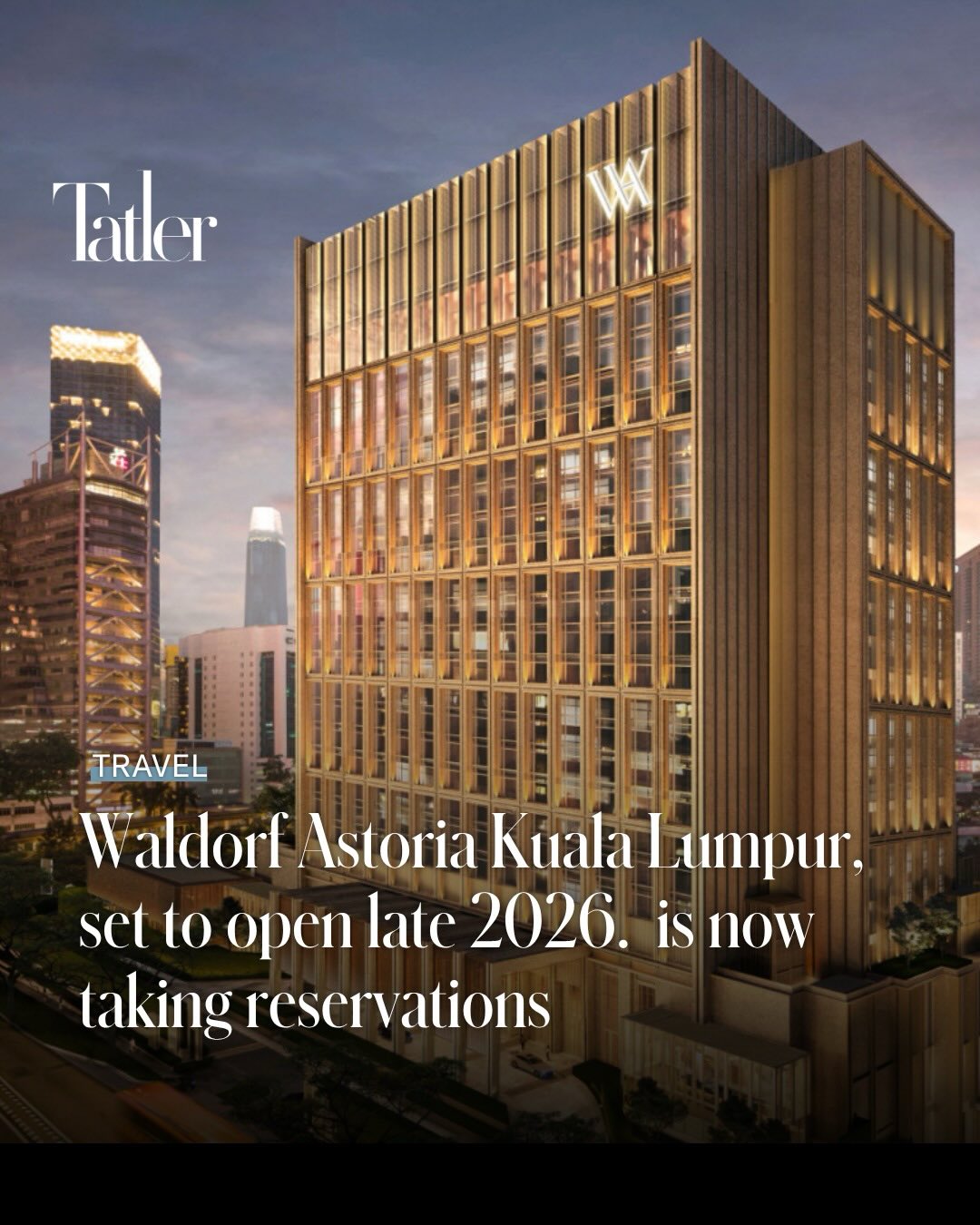
Next year is equally exciting, with the opening of Waldorf Astoria Kuala Lumpur marking the brand’s debut in Malaysia. Set to redefine luxury in the heart of the city’s prestigious Golden Triangle, the hotel is a stone’s throw from landmarks such as KLCC, Pavilion Mall and the vibrant pocket of Bukit Bintang.
In addition to upcoming debuts in Sydney, Hanoi, Jaipur, Waldorf Astoria will also make its long-awaited entry into London at Admiralty Arch, one of the city’s most iconic historical landmarks. Hilton is revitalising the landmark property in partnership with owners Reuben Brothers, with design led by architects Aros to envision the 100-key hotel. We hear the Presidential Suite is going to be spectacular—with sweeping views of Buckingham Palace and Trafalgar Square.
“Waldorf Astoria has all the right ingredients to reimagine old world elegance and heritage in a thoughtful way.,” says D’Cruz. “After all, each and every Waldorf Astoria across the globe is influenced by the original—the legendary Waldorf Astoria New York—‘The Greatest of Them All’.”

Coco Marett is a writer and editor who grew up between Hong Kong and Melbourne. She currently heads the travel section for Tatler Asia, and manages the Tatler Travel account on Instagram. She is known for her features on unique, under-the-radar properties and destinations. She's also known for her in-depth interviews that paint a refreshingly candid portrait of influential figures across various industries —from artists to political figures, CEOs to celebrity chefs. Follow her on Instagram @cocomarett
Curated for you
The stories, profiles, and cultural moments featured on our Instagram feed