

Cover Diocese of Antipolo’s bishop emeritus Most Reverend Francisco de Leon, DD, (right) beside the miraculous image of the Our Lady of Peace and Good Voyage during the solemn declaration of the Antipolo Cathedral as an international shrine (Photo: Facebook/The Antipolo Cathedral)
Diocese of Antipolo’s bishop emeritus Most Reverend Francisco de Leon, DD, (right) beside the miraculous image of the Our Lady of Peace and Good Voyage during the solemn declaration of the Antipolo Cathedral as an international shrine (Photo: Facebook/The Antipolo Cathedral)
1 / 1
The National Shrine of the Our Lady of Peace and Good Voyage, which serves as the diocesan cathedral of Antipolo, has been hailed as the first international shrine of the Philippines and the first Marian shrine of such status throughout Asia
Widely known as the Antipolo Cathedral, this national shrine dedicated to the Our Lady of Peace and Good Voyage, has been recently elevated to the status of Marian “International Shrine”. The symbolic coronation and rite of solemn declaration was presided by Most Reverend Charles Brown, DD, the Apostolic Nuncio to the Philippines, last Friday, January 26.
In his message, Brown reflected on the role of the “Our Lady of Antipolo” in the history of the country and the Catholic Church.
“The phenomenon of popular piety, the religiosity of the masses… is so evident [here] in the Philippines. Indeed, it was only last month that all were gathered for the ‘Simbang Gabi’ masses in anticipation of Christmas, a beautiful example of the Philippine popular piety,” he said.


Above Marian devotees from Antipolo Cathedral join a solemn procession in 2022 for the first time since the start of the pandemic two years back. The Antipolo Cathedral is a Roman Catholic cathedral that enshrines the Marian image of Our Lady of Peace and Good Voyage. (Photo: SOPA Images / Getty Images)
Marian devotees from Antipolo Cathedral join a solemn procession in 2022 for the first time since the start of the pandemic two years back. The Antipolo Cathedral is a Roman Catholic cathedral that enshrines the Marian image of Our Lady of Peace and Good Voyage. (Photo: SOPA Images / Getty Images)
1 / 1
The historic National Shrine of Our Lady of Peace and Voyage has been deemed by the Vatican as an international shrine, as first announced by Most Reverend Francisco de Leon, DD, now the bishop emeritus of Antipolo, during his homily at the celebration of the diocese’s 39th founding anniversary last 2022.
“We received a letter from Rome saying that, on June 18, our national shrine will be recognised as an international shrine,” De Leon said in his 2022 homily.
The renowned Antipolo Shrine is now known to be the 11th international shrine in Asia and the first Marian shrine to be of such status in the continent. As the sixth Marian international shrine in the world, it becomes at par with historical sites with approved Marian apparitions such as Lourdes and Fatima, to name a few.
In case you missed it: Tatler Deep Dive: A Glimpse Into Marian Devotion in the Philippines
The Catholic Bishops Conference of the Philippines (CBCP) endorsed the petition in 2021 for the said cathedral's premier status of being frequented by many devotees worldwide. Most significantly, the cathedral has been noted for its vital role in the religious and spiritual lives of seafarers and overseas workers, among others from the Philippines. Indeed, the cathedral is filled with stories from devotees who have experienced firsthand the special presence of the Blessed Mother, as stated in a letter written by CBCP President Davao Archbishop Romulo Valles and addressed to Archbishop Salvatore Fisichella, president of the Pontifical Council for Promoting the New Evangelization.

Above The National Shrine of Our Lady of Peace and Good Voyage / Wikimedia Commons
The National Shrine of Our Lady of Peace and Good Voyage / Wikimedia Commons
1 / 1
During the Spanish colonisation period, the Society of Jesus (also called Jesuits) under Reverend Juan de Salazar built the first church in the area that would later be known as Antipolo City. The Jesuits administered the said church from 1591 to 1768, which was supposed to house in 1632 the image of Nuestra Señora de la Paz y Buen Viaje (Our Lady of Peace and Good Voyage). However, the Chinese uprising in 1639 severely damaged the church’s structure with fire. It was restored afterwards but was continuously damaged by earthquakes in 1645, 1824, and 1863. Nevertheless, the church continued to be flocked by devotees (including the country’s esteemed national hero, Jose Rizal and his father, Francisco Mercado) paying reverence to the Blessed Mother.
Reports of the wooden image of Our Lady of Peace and Good Voyage mysteriously vanishing kept on repeating, making the people think that the Blessed Mother wanted the church to be built in a different location. Every time it was lost, it would be found at the top of a Tipolo tree at the present location of the cathedral.
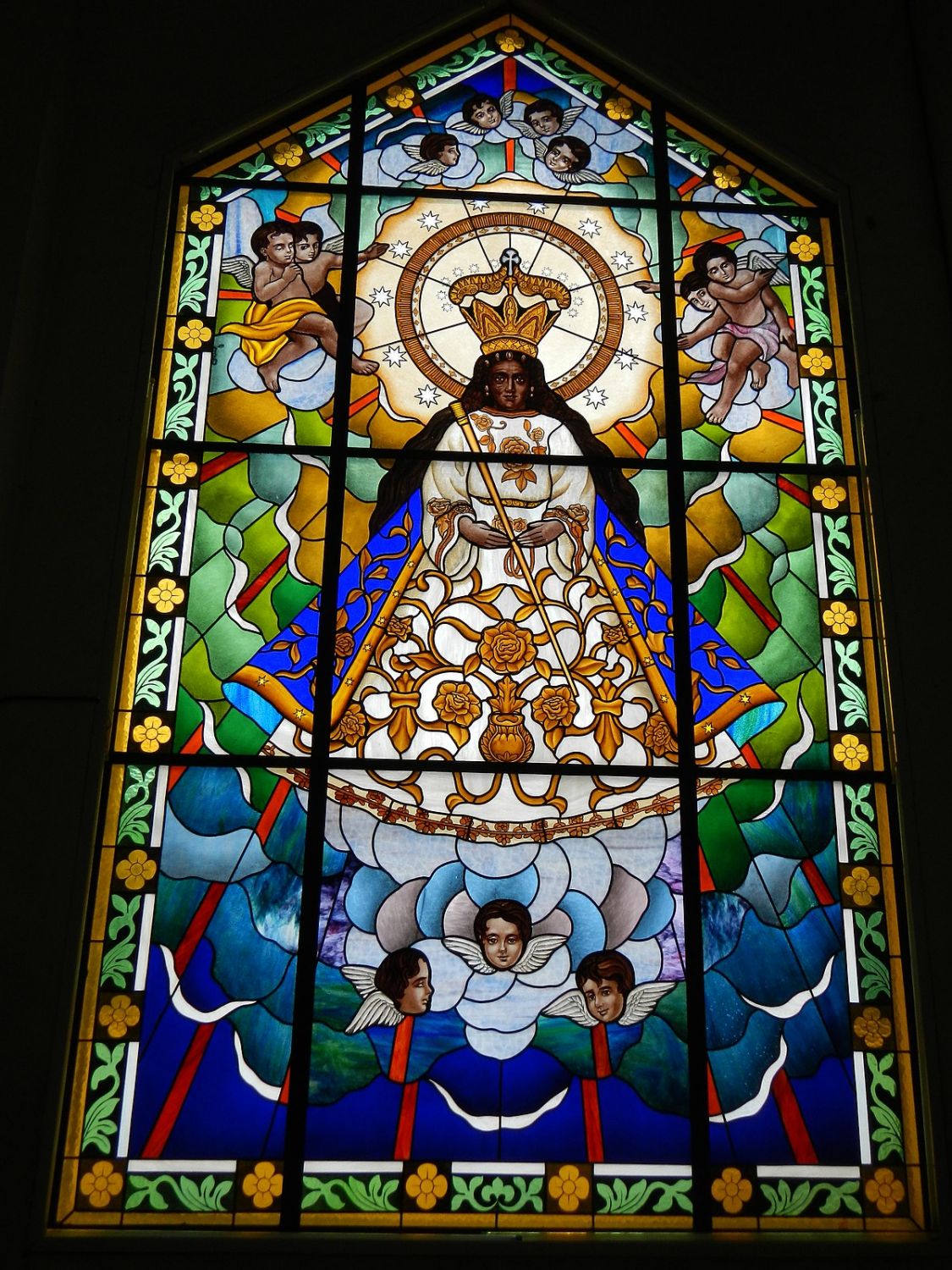
Above Stained glass image of the Our Lady of Peace and Good Voyage
Stained glass image of the Our Lady of Peace and Good Voyage
1 / 1
During the Second World War, the Antipolo church was destroyed by Allied Forces. Former First Lady Aurora Quezon and parish priest of the said church, Francisco Avendaño, spearheaded the fundraising committee to rebuild it after the war. They commissioned Architect Jose L De Ocampo to design the new shrine, which was completed in 1954.
The CBCP also declared it the National Shrine to Our Lady of Peace and Good Voyage upon its completion. Eventually, it was elevated to cathedral status on June 25, 1983, becoming the centre of the Diocese of Antipolo.
Read also: Tatler Review: Quezon's Game (2019)
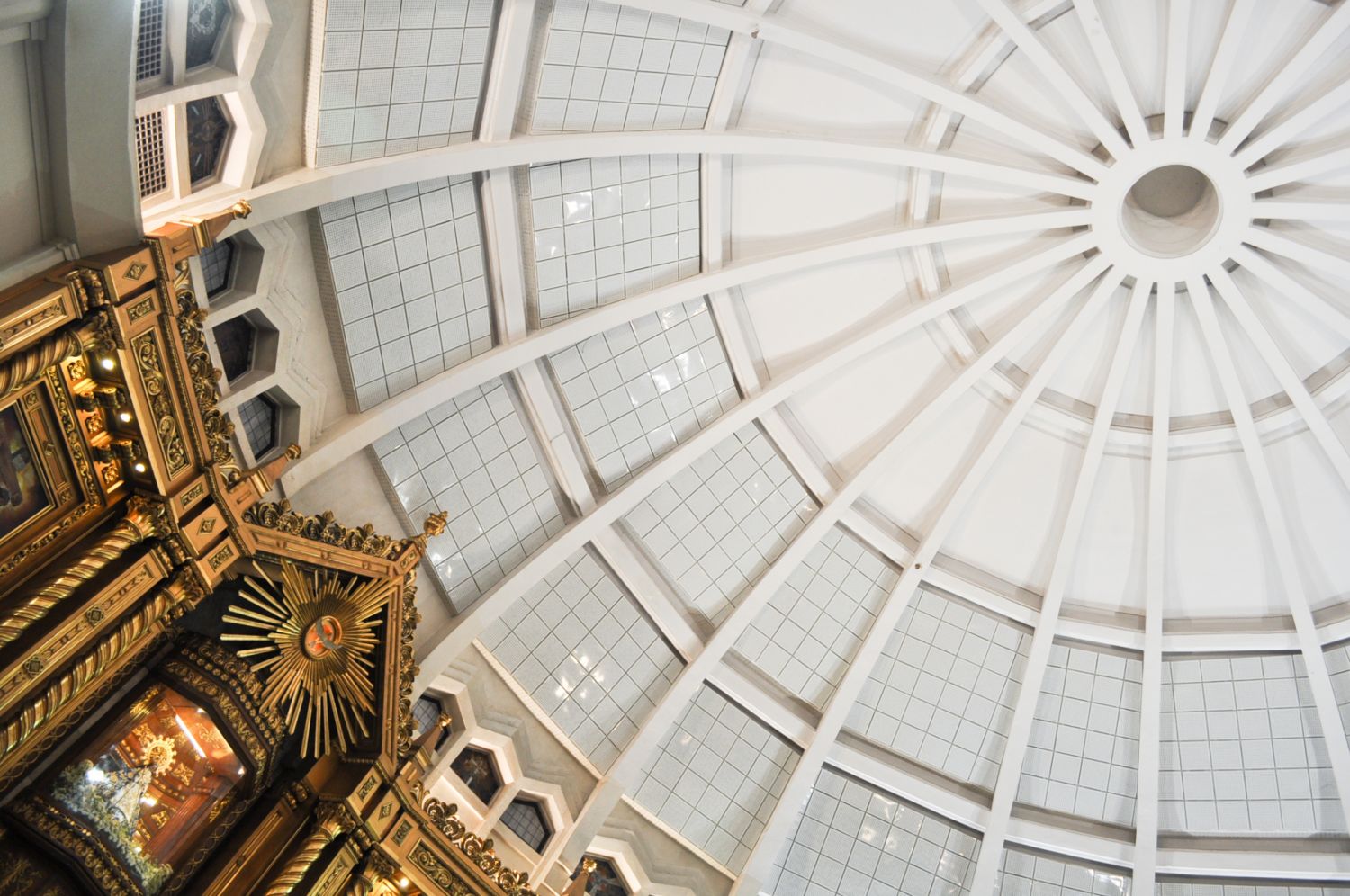
Above The Antipolo Cathedral’s dome (Photo: Wikimedia Commons)

Above The Antipolo Cathedral’s altar (Photo: Wikimedia Commons)
The Antipolo Cathedral’s dome (Photo: Wikimedia Commons)
1 / 2
The pilgrimage season for the cathedral is initiated yearly by the “Pagdalaw ng Ina sa Anak” (Visit of the Mother to her Son), a motorcade bearing the image of Our Lady of Peace and Good Voyage from Antipolo Cathedral to Quiapo Church, where the Black Nazarene is enshrined. A welcome Mass is held in Quiapo Church at 9am. At 6pm, the farewell Mass is officiated, after which the Penitential Walk from Quiapo Church to Antipolo Cathedral commences, a distance close to 33 kilometres.
On the 1st of May of each year, the arrival of the image of Our Lady of Peace and Good Voyage at the Cathedral is celebrated by a Mass at 5am. Every 1st Tuesday of May, a procession starts at 7am from the cathedral to Pinagmisahan Hill, where a Mass is held.
On May 3, 1947, on the Feast of the Holy Cross, a wooden cross was blessed and erected. From 1947 to the present, a commemorative Thanksgiving Mass is said every First Tuesday of May, the start of the Pilgrimage Season ending on the First Tuesday of July.
NOW READ
The Catholic Church and Social Media During the Lenten Season and COVID-19 Pandemic
Hispanic Catholic Churches in the Philippines: Haven of Faith and Repository of Art
10 Critical Films That Tackle Crises on Faith and the Catholic Church

Franz writes about the local cultural scene and rediscovering the country’s storied past and rich heritage. He earned his bachelor’s degree in Journalism from the University of Santo Tomas and is currently pursuing a master's degree in Art Studies at the University of the Philippines Diliman. Besides working on this luxury lifestyle magazine, Franz is an avid book reader, local traveller, museum-goer, chorister, and community theatre playwright. But above all this, this Aether main spends more time in Teyvat than anywhere else.





