
1 / 1
Andre Lam heads to Germany to drive the latest Porsche 911 Turbo and GT3 to find if they still deserve the giant-slaying reputation
In all its history Porsche never planned for anything more than a flat six-cylinder engine in the back of its 911 coupe. While that was its guiding principle, it was obviously not shared by the likes of Ferrari or Lamborghini. This voluntary “handicap” was instrumental in forcing Porsche to seek alternative solutions to compete on a more equal footing.
This led it to turbocharging, which allowed its flat six-cylinder engine to punch way above its weight to keep pace with the V12s and V8s of the exotics. At the same time Porsche also exercised some lateral thinking and worked on making a street-legal race car that would also allow its 911 to be faster over a circuit, not necessarily in a straight line. This led to the introduction of another model called the 911 GT3, addressing the competition from another direction without the aid of turbocharging.
The 911 Turbo began life in 1974 with a 260bhp 3.0L turbocharged flat-six cylinder engine offering the ability to sprint to 100km/h in just 5.4sec. This was soon uprated in 1977 to 300bhp and sales literally took off, garnering a cult following that has not abated till this day. This latest 911 Turbo doubles the original power ratings with a 520bhp 3.8L engine and the higher specification 911 Turbo S version has 560bhp.
Though Porsche has long been interested in racing, the 911 GT3 was a more recent development. Its inspiration can be traced back to the famous 1973 Porsche 911 Carrera 2.7 RS. It may not possess the 911 Turbo’s prodigious power, but more than makes up for it by harnessing the agility provided by its lightweight body and race-tuned suspension. The 911 GT3 badge only appeared in 1999 with the introduction of the water-cooled 911 to continue in the spirit of the legendary 911 RS models. The 911 GT3 is now only in its fifth generation, while the 911 Turbo enters its ninth. Porsche intends for this dynamic duo to capture the lion’s share of ultra-high performance car sales early in its product life cycle.

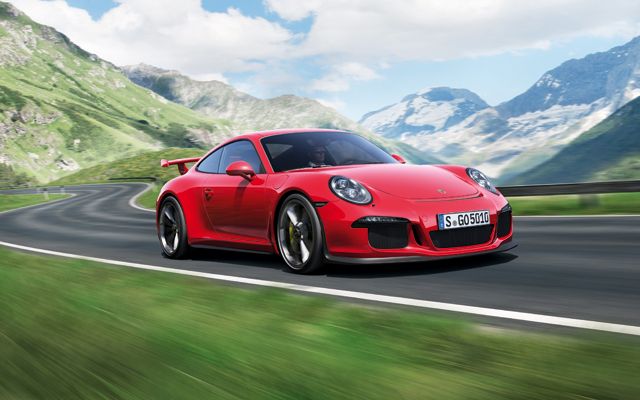
The new 911 GT3 is a manageable sportscar that feels at home on the racetrack, yet can be taken to new sporty destinations
To the casual observer, these Porsches look similar, but for the cognisant, there are tantalising differences. The 911 Turbo is more like a powered-up version of the basic 911 Carrera, but that is over simplifying the massive engineering effort needed for the 911 Turbo to safely reach 315km/h. During the course of 60 years, Porsche has learnt that it is best to start with the most robust and properly designed body rather than to attempt to alter or add hardware when making different models. However, the 911 Turbo has always enjoyed a slightly different shape than the rest, with the widest body in the entire range. Admittedly, it is as much for appearance as it is for better handling, but there is no denying its unique wide body is one of the most coveted features for buyers of the 911.
While the 911 GT3 also reaches 315km/h, it is a different animal altogether. Designed by the Porsche Motorsport Department, it is marked by luxury and comfort, but now these occupy lower priorities. Handling and agility are highest on the list. To that end, Porsche has made the experience as extreme as possible. There is no turbocharger to help with power, so it is dependent on the precise extraction of every drop of power from just atmospheric aspiration alone. Designing this engine to extract 475bhp is more difficult than boosting it to produce 520bhp. The Motorsport Department maintains that due to the 45bhp deficit, not one bit of the 475bhp is squandered as it reaches an identical top speed as the 911 Turbo. However, lest we forget, the 560bhp 911 Turbo S is there to remind us of the correct pecking order with its top speed of 318km/h.
Recognising the 911 GT3 is a lot easier as it is not shy to display its racy looks where the 911 Turbo tries to hide its aerodynamic bodywork, only deploying it at high speed. Taking its styling cues from the current 911 GT3 Cup race car, the 911 GT3 has fixed aerodynamic spoilers in the front and rear, looking very much like a racing car. These aerodynamic features are not merely for show as it creates a more stable high speed driving environment with as much as 122kg of downforce to aid overall traction and stability at 300km/h. The 911 Turbo is a little more discreet as it uses a complex mechanised system to deploy the aerodynamic spoilers only when required. Upon reaching 120km/h, the spoilers are extended halfway and over 180km/h will bring about the full extension, delivering 132kg of downforce and even more high speed stability.

A typical feature of the 911 Turbo is the rear wing, which forms the Porsche Active Aerodynamics system together with the adaptive spoiler at the front
In case you are wondering why Porsche uses fixed spoilers when it can simply hide them, the answer lies in the weight of the cars. The Motorsport engineers expend considerable effort to reduce weight in their 911 GT3 as they consider weight one of their greatest enemies—and the complex active system adds weight. Indeed they wish they could have even more weight reduction, but it gets very costly as a lot of carbon fibre parts have to be used to replace the metal ones.
The 911 GT3 needs to be priced at a level just below the 911 Turbo, but they have managed to control its weight to just 1,430kg, about 250kg less than the 911 Turbo.
This is the equivalent of carrying three fewer passengers in one’s car and this confers the 911 GT3 not just with greater agility to change direction but the ability to stop faster and accelerate nearly as quickly as the heavier but more powerful 911 Turbo. The 911 GT3 gets to 100km/h in a stunning 3.5sec but the 911Turbo gets the bragging rights by being three-tenths of a second faster. Certainly this lightweight approach can be applied to the 911 Turbo but as enthusiasts will know, that is reserved for a very special (and expensive) model line called the 911 GT2. Using this approach, Porsche creates two very different driving experiences, catering to different customer groups.
The 911 GT3 has always appealed to the hardcore enthusiast who spends considerable time at trackdays, enjoying the mechanical feel of the GT3 models and revelling in the additional effort needed to shift the manual gearbox and tame the beast on the track. However, that has changed for the new 911 GT3 as Porsche has stopped producing the manual for the GT3 and has fitted the PDK double-clutch automated sequential gearbox that is shared with the rest of the 911 range. It is, however, quite different internally as the gears have been configured to deliver maximum engine performance in all the seven forward gears as opposed to the rather long-legged gear ratios of the 911 Turbo. This gives the 911 GT3 a rather frenzied drive experience compared to the relaxed drive of the 911 Turbo but Motorsport engineers have added a special “paddle-neutral” feature that allows the GT3 to be driven with wild oversteer.

Controls are conveniently positioned in the 911 GT3. The ascending centre console with the gear selector is within direct reach of the steering wheel and so are the gearshift paddles on the steering wheel
In previous generations, the philosophies of these two were far more divergent—the 911 Turbo pandering to the well-heeled enthusiast who merely wanted the most potent intercity sportscar that would allow the occupants to arrive totally unflustered and composed, whereas the 911 GT3’s occupants would have been through a real workout. Today’s 911 GT3 gains more than a modicum of refinement thanks to the PDK gearbox along with fine tuning of the sports suspension and the 911Turbo gains a lot more agility. Remarkably, both the 911 GT3 and the 911 Turbo S are now just a second apart over a gruelling 20.5km lap of the world’s toughest track, the Nürburgring Nordschleife (North Loop). This was not always the case as the Motorsport Department prided themselves as the experts of Nordschleife, their 911 GT3 models staying ahead of the more powerful 911 Turbos.
Porsche told us their “secret” ingredient is active rear-wheel steering, new for Porsche though others have long used various forms of this technology. Porsche has resisted using this as they felt it artificially enhances the drive experience. They worked hard at developing one that would not be detectable at all when it is in function and it is claimed that this technology alone was worth over two seconds a lap. Moreover, it brings a practical side as it can also be programmed to reduce the turning circle, making life a bit easier in our impossibly tight car parks.
There are small differences as to how this active rear-wheel steering is programmed in the 911 GT3 and 911 Turbo models, with the engineers at the Motorsport Department maintaining that its function is purely a performance aid, whereas the mainstream engineers who developed the 911 Turbo used it more like a driver’s aid. What is the difference you say? Well, in the 911 GT3, it does make the car handle better in the high-speed turns but the driver still has to use his skill to harness all that potential.

The chassis of the 911 Turbo enables smooth high-speed manoeuvres
In the 911 Turbo, it is programmed to flatter the driver, making the car deliver more for the same input. This puts more of the 911 Turbo’s potential into the hands of a normal driver, while the 911 GT3 driver will find satisfaction as it involves the driver more, rewarding the additional skill and effort. In fact, at the race track we witnessed first hand how the 911 Turbo’s program saved an oversteering car without the driver doing too much to help correct the mistake, but do not expect such mollycoddling from the 911 GT3.
The purists will frown on this driver’s aid but there is no denying that this feature alone would help garner a whole lot more sales for the 911 Turbo. On the other hand the 911 GT3 will attract a lot more buyers solely because it has an automatic PDK gearbox. The ability to have the option of both manual and automatic shifting is a boon for quick lap times as well as user-friendliness. Over the generations the 911 Turbo has always outsold the 911 GT3 by ten to one but that is about to change as both the 911 GT3 and 911 Turbo are rapidly converging on the same group of customers.
Porsche 911 Turbo/911 GT3
Body Two-door sports coupe, steel monocoque construction
Engine 3.8L Petrol Injection Flat Six, Twin Turbo / Atmospheric Aspiration
Max Power 520bhp at 6,000-6,500rpm / 475bhp at 8,250rpm
Max Torque 660Nm at 1,950-5,000rpm / 440Nm at 6,250rpm
Transmission Seven-Speed Automatic with manual mode
Acceleration 0-100km/h in 3.2sec / 3.5sec
Top Speed 315km/h
Fuel Consumption 9.7L/100km / 12.4L/100km
Prices (before COE) $716,288 / $633,688
Agent Stuttgart Auto Pte Ltd. 29 Leng Kee Road. Tel 6472 4433





