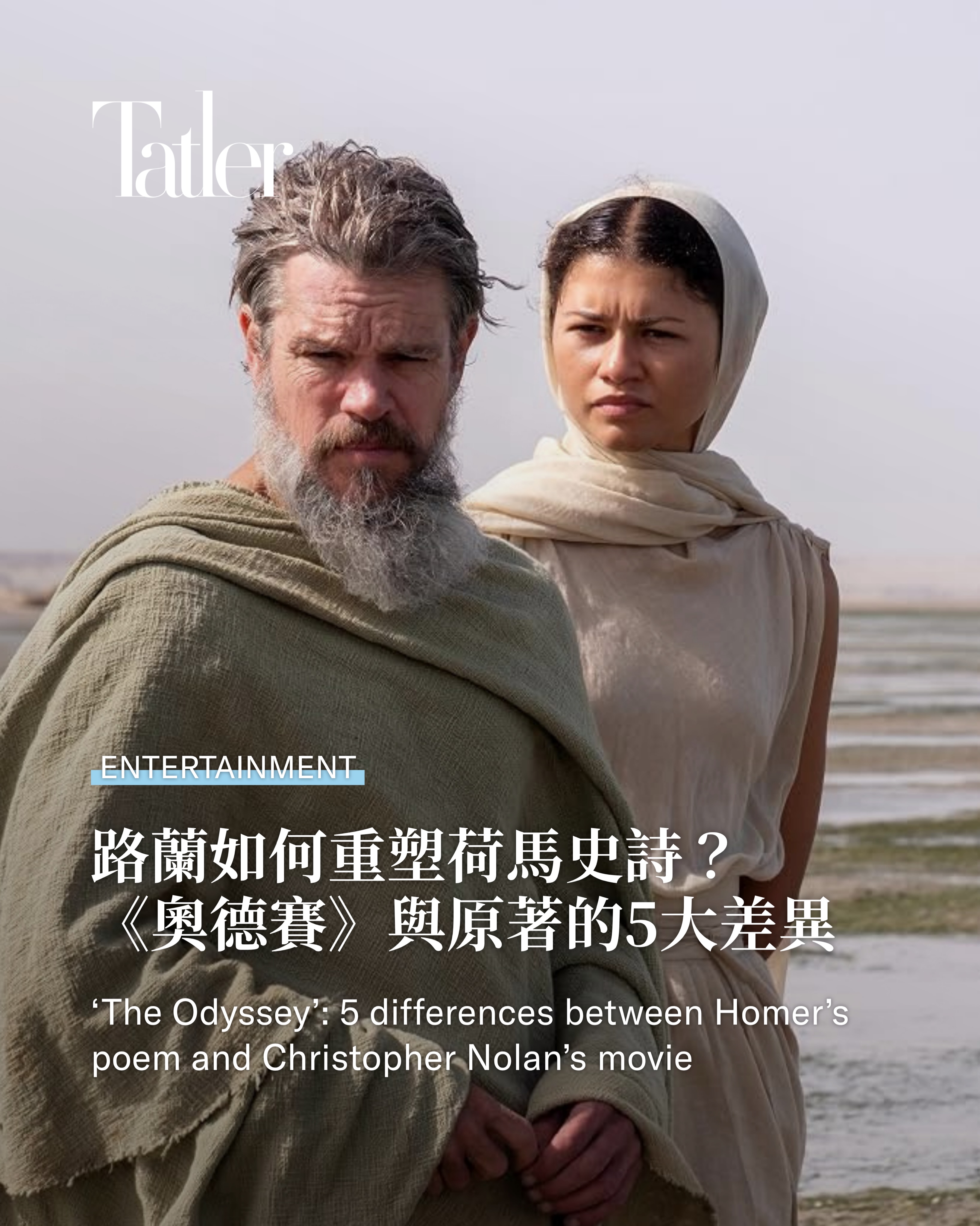
Cover From left: Matt Damon as Odysseus and Zendaya as Athena in Christopher Nolan’s ‘The Odyssey’ (Image: IMDB)
From left: Matt Damon as Odysseus and Zendaya as Athena in Christopher Nolan’s ‘The Odyssey’ (Image: IMDB)
1 / 1
There are no gods or heroes in Christopher Nolan’s ‘The Odyssey’—and the director’s bold decision to rewrite the original epic as a tale about the human condition makes him worthy of a modern Homer
Those expecting Christopher Nolan’s signature mind-blowing collision of dimensions and time in his storytelling—think Inception, where dreams overlap, or Interstellar, where the understanding of space dissolves—may find his latest feature offers a departure from his usual reality-bending tropes. The nearly three-hour film adaptation of Homer’s epic The Odyssey, which charts the Greek hero Odysseus’s treacherous journey home after his victory at the Trojan War, contains no multiverses. Yet, even without the surreal visuals of the extraterrestrial realm or the massive explosions of Oppenheimer, The Odyssey proves why the British director remains a master of storytelling.
That is not to say The Odyssey is not visually spectacular. The film, budgeted at an estimated US$250 million and Nolan’s most expensive feature to date, was shot entirely with 70mm Imax cameras. This technical choice delivers a grand cinema experience where every single frame envelopes the audience in an immersive voyage. From the towering cyclops lurking in the shadows of the cave and the tall gate of Troy opening to reveal a menacing Agamemnon—whose vertebrae-adorned helmet sends chills down the spine—to the raging tempest of the sea and the massive wooden horse dragged across the beach, Nolan’s choice to film in this large-scale format from start to finish is worth every penny.
Read more: ‘Squid Game’ director Hwang Dong-hyuk on his next—even more violent—production


Above The scene of the wooden horse being dragged from the beach to the city of Troy in Christopher Nolan’s ‘The Odyssey’ (Image: IMDB)
The scene of the wooden horse being dragged from the beach to the city of Troy in Christopher Nolan’s ‘The Odyssey’ (Image: IMDB)
1 / 1
The most impressive aspect of the film is its structural narrative. Homer’s original text consists of 24 books spanning up to 500 pages; condensing this into 172 minutes is a daunting task. However, Nolan’s version is not a literal adaptation. In the original epic, the characters’ actions, such as Odysseus’s conception of the wooden horse trick or his son Telemachus’s decision to search for his missing father, are dictated by divine intervention. The gods appear as signs or visions, planting ideas in mortal minds to drive the plot forward—such as Athena asking Zeus to free Odysseus from Calypso’s island, or disguising herself as a trusted friend to advise Telemachus.
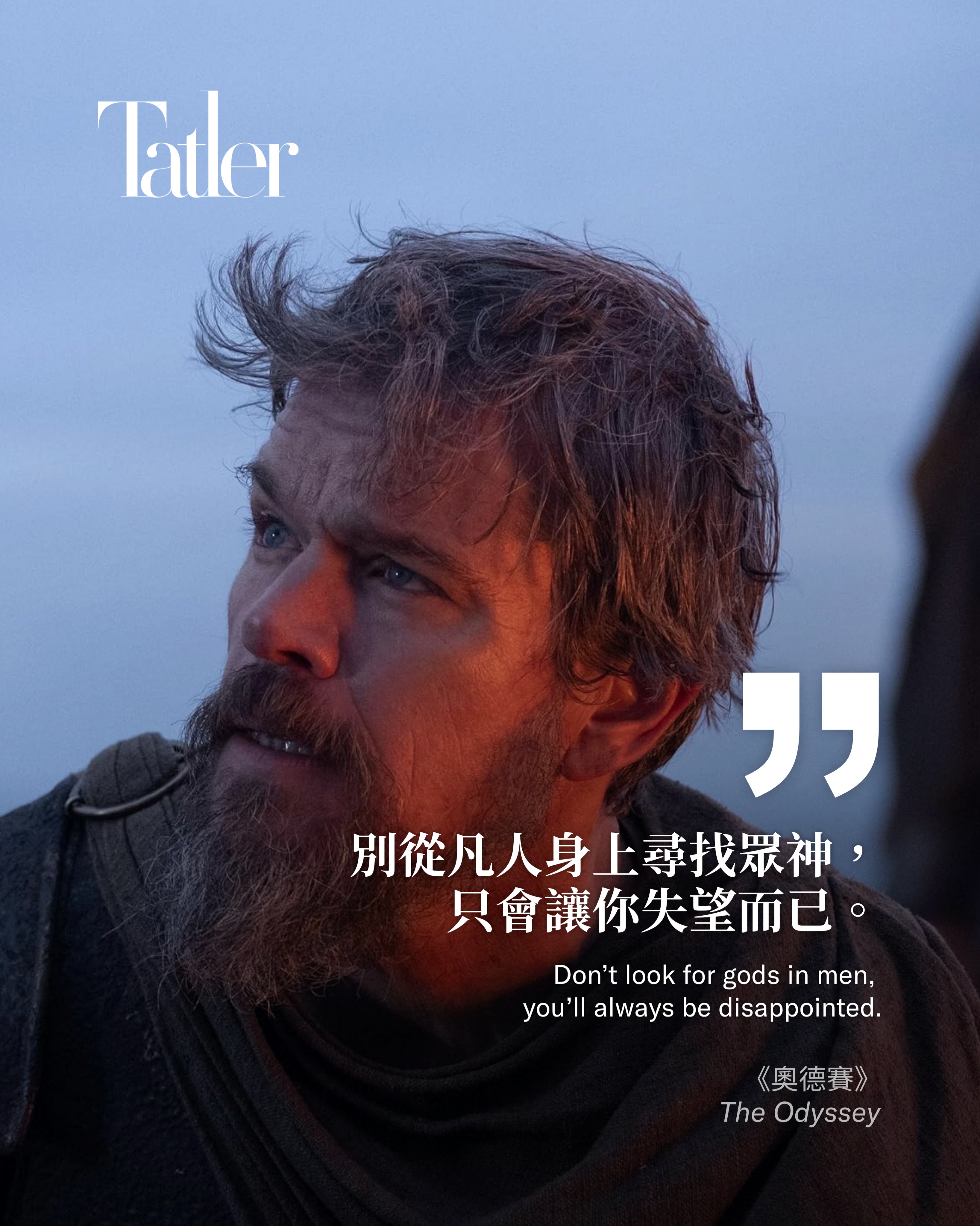
In Nolan’s version, this divine interference is heavily toned down, placing the burden of decision-making and plot progression squarely on human shoulders. Athena, played by Zendaya, appears occasionally as a fleeting vision to Odysseus, but her influence on the sceptical protagonist is minimal; she serves more as Odysseus’s Jiminy Cricket than an all-powerful goddess. The three great Greek gods—Zeus, Poseidon, and Hades—do not physically appear. While Poseidon is occasionally prayed to, Hades is mentioned, and the desperate crew blames Odysseus for offending the god of the sea, the film never shows the deities directly responding. On multiple occasions, faith is dismissed as mere coincidence, and Odysseus actively defies divine will in a desperate attempt to save his doomed crew.
In case you missed it: 7 Chinese movies about family history and dynamics that you shouldn’t miss: ‘Dear You’, ‘Raise the Red Lantern’ and more

Above From left: Anne Hathaway as Penelope and Tom Holland as Telemachus in Christopher Nolan’s ‘The Odyssey’ (Image: IMDB)
From left: Anne Hathaway as Penelope and Tom Holland as Telemachus in Christopher Nolan’s ‘The Odyssey’ (Image: IMDB)
1 / 1
If Homer wrote The Odyssey to warn against the consequences of hubris, Nolan reinterprets the text to caution against the flaws of human nature. Instead of a fantastical adventure of defeating mythical monsters, this odyssey is about a man navigating the universal trials of life: the pain of leaving loved ones, the burden of leadership, the torment of making impossible decisions, and the fading hope for survival. Nolan’s Odysseus is no flawless hero. The film depicts his victory at the Trojan War, but instead of a king basking in glory, audiences are presented with a war veteran consumed by regret over the slaughter of innocent Trojans. Parallel to his son’s coming-of-age journey to assume the throne, Odysseus undergoes his own moral evolution, gradually learning how bloodlust, greed, pride and hypocrisy—rather than divine anger—ultimately ruin a man.
This message is crystallised in the scene featuring the sorceress Circe. After turning Odysseus’s men into pigs for disrespecting her home, she returns them to human form with a spell commanding them to turn “back into your disguises”. To Circe (and Nolan), humanity’s primal gluttony and true animalistic nature are merely concealed by the veneer of civilisation, and divine power in this film serves only to expose, rather than interfere with, these traits.

Above Samantha Morton as Circe in Christopher Nolan’s ‘The Odyssey’ (Image: IMDB)
Samantha Morton as Circe in Christopher Nolan’s ‘The Odyssey’ (Image: IMDB)
1 / 1
For critics who dismiss Nolan’s The Odyssey as an inaccurate portrayal of the source material—some even suggesting that the director, who holds an English degree from University College London, has not read Homer’s work—they completely miss the contemporary resonance of this retelling.
Admittedly, the film has minor flaws. Penelope’s characterisation suffers from a sudden, agitated outburst regarding male rule, which feels somewhat disconnected from the overarching narrative. While gender equality is an important theme, the scene feels abrupt for a character who has demonstrated unwavering loyalty to her king and shows no personal interest in claiming the throne. Similarly, Helen’s apology for the destruction of Troy that ruined Ithaca feels misplaced. This is not a film about the Trojan War itself, but rather how the characters cope with its aftermath, making the face that launched a thousand ships feel somewhat irrelevant to the immediate plot.

Above Christopher Nolan on set with Matt Damon, who plays Odysseus, and Zendaya, who plays Athena, in ‘The Odyssey’ (Image: IMDB)
Christopher Nolan on set with Matt Damon, who plays Odysseus, and Zendaya, who plays Athena, in ‘The Odyssey’ (Image: IMDB)
1 / 1
These minor issues notwithstanding, The Odyssey is a meticulously crafted, visually arresting film that keeps viewers engaged throughout its runtime. Nolan’s film is a grand epic about Odysseus, but it is equally a reflection on the shared human condition of those watching from the theatre seats.

Zabrina is the Senior Editor, Arts and Culture of Tatler Hong Kong. She specialises in performing arts, visual art and film. Her wanderlust was first fuelled by the Mighty Rovers Antarctica Expedition 2010. Over the years, she has interviewed A-list artists and filmmakers, including Oscar winners Chlóe Zhao and Tim Yip, Golden Horse winner Sylvia Chang, In the Mood for Love cinematographer Christopher Doyle, Pachinko author Min Jin Lee, and Coachella’s first Chinese solo singer Jackson Wang. She won gold at the WAN-IFRA Asian Media Awards for her 2021 feature on the waves of hate crimes targeting Asian Americans.
Curated for you
The stories, profiles, and cultural moments featured on our Instagram feed