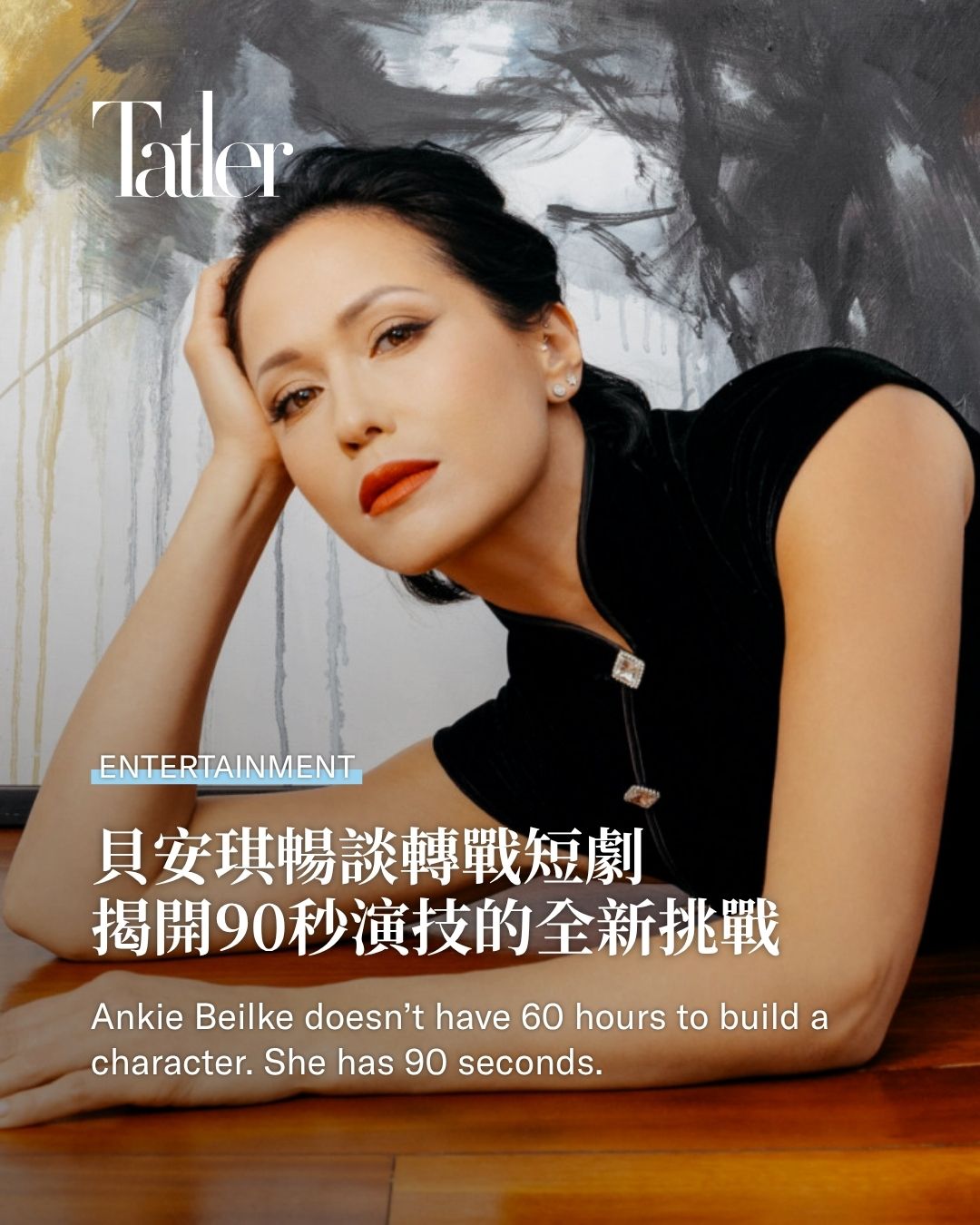
Cover Ankie Beilke talks about swapping a TVB shooting schedule for a vertical drama's breakneck pace (Photo: Lamma)
Ankie Beilke talks about swapping a TVB shooting schedule for a vertical drama's breakneck pace (Photo: Lamma)
1 / 1
German-Chinese actress Ankie Beilke built a career on prestige TVB dramas and feature films alongside heavyweights like Tony Leung. Now, with four short-form vertical dramas already under her belt, she's betting on the format reshaping how China—and the world—watches television
Ankie Beilke has spent decades moving between worlds. Born in Düsseldorf to German art director Michael Beilke and Hong Kong actor-director Ankie Lau, she trained at the Lee Strasberg Theatre and Film Institute in New York before building a screen career that spans German blockbusters, TVB primetime dramas like Big Wheel and Line Walker, and Hong Kong feature films alongside stars like Tony Leung and Aaron Kwok.
These days, she’s chasing a different kind of role entirely: the vertical drama, China’s mobile-first, minute-by-minute format that has exploded into a multibillion-dollar industry in just a few years, and is now reportedly outpacing the country’s traditional box office. Beilke has already filmed four of them.
Sitting down in Hong Kong, she talks about swapping a TVB shooting schedule for a vertical drama’s breakneck pace, why a 90-second episode demands a completely different kind of acting instinct, and what it’s like building a career at the centre of an industry being rewritten in real time.
See also: Ivana Wong on composing for ink art: A dialogue between dance, music and Wu Guanzhong


Above Ankie Beilke (Photo: Lamma)
Ankie Beilke (Photo: Lamma)
1 / 1
Ankie, you’ve gone from TVB dramas and feature films like Confession of Pain to four vertical dramas in quick succession—what made you say yes to this format, and how does it compare to the pace of a TVB production?
For me it wasn’t about switching genres, it was about learning a different rhythm. Vertical dramas are built for immediacy—short-format storytelling where every beat has to land fast.
When I said yes, I was excited by the challenge: can you still create something emotionally real when the audience is only giving you a few minutes per episode? In pace, it’s a totally different engine. TVB has its own cadence—more room to breathe in scenes, more processing time. Vertical dramas are more like a relay race: constant forward motion, scene after scene, designed to keep momentum.
And coming from cinematic work—I’ve shot many blockbusters like Vickie The Viking, Connected and Bon Bini: Bangkok Nights—the filmmaking approach is even more different. In film, you often get to build atmosphere and character texture through longer takes, deeper rehearsal and camera decisions that let moments unfold naturally. With that kind of background, vertical dramas are a fresh test: can I keep the same emotional depth, but deliver it at speed, with fewer chances to breathe between shots?
See also: A world of pure imagination: Why ‘Charlie and the Chocolate Factory’ is Hong Kong’s Golden Ticket

Above Ankie Beilke (Photo: Lamma)
Ankie Beilke (Photo: Lamma)
1 / 1
Vertical dramas run 60 to 100 episodes, but each episode only lasts between one and three minutes, built around constant cliffhangers. As a Lee Strasberg-trained actor, used to building a character over a full script, how do you adapt your process to that compressed, hook-driven structure?
The biggest adaptation is this: you can’t wait for the full picture to make the character real. You have to front-load intentions. Lee Strasberg trained me to chase what’s truthful inside the moment. In vertical dramas, you still do that, but you work in smaller units. Instead of thinking about your character across 60 hours, you think about your character in this hook, in this turn.
Practically, I build a clear internal through-line (who she is, what she wants, what she fears) and it gives me continuity discipline, because I’m shooting so much material so quickly, that I become obsessive about emotional continuity and physical continuity—so the character doesn’t reset every day.
Does your multicultural background give you an edge now that Chinese verticals are being localised and exported to Western audiences?
Yes—because it taught me early that storytelling isn’t only language, it’s behaviour. Different cultures read facial nuance, timing, restraint and emphasis differently. Hong Kong taught me the intensity and efficiency of performance; Germany [and the cultural training around it] taught me precision and structure.
I’m fluent in Cantonese, German and English, so I’m not performing “foreignness” as a stereotype. That matters for localisation, because western audiences often latch onto emotional honesty more than accents—they just need the character’s humanity to be specific and consistent. So when vertical dramas get localised for western audiences, I’m not just acting the words, I’m acting the way a character decides, hesitates, protects herself—and those things travel.

Above Ankie Beilke (Photo: Lamma)
Ankie Beilke (Photo: Lamma)
1 / 1
There’s a lot of buzz right now about AI actors and AI-generated short dramas in China—some platforms are even creating AI doubles of real performers. As a working actor in this exact space, what are your views?
I understand the appeal—cost, speed, scale. Vertical dramas already teach everyone that audiences want more and faster. AI is basically trying to meet that demand with production efficiency.
But I also think there’s a fundamental difference between content and craft. Performance is not just output—it’s intent, experience, vulnerability, risk and the human specificity that audiences sense even when they can’t name it. If platforms use AI to assist [editing, pre-visualisation, translation, dubbing workflows], that’s one conversation. If they use AI to replace living performers, that’s a different conversation—one that touches on consent, labour, identity and artistry. Personally, I’m protective of the human truth of acting. I’m not interested in shrinking the role of performers; I’m interested in how new formats can still honour real performance.
You’ve built a brand around yoga and a steady, disciplined lifestyle for almost two decades now—does that grounding help you survive the breakneck production schedule of vertical drama?
Absolutely. Yoga gave me a way to regulate my nervous system, not just my body. In vertical dramas, the adrenaline is constant—short cycles of build, shoot, move, repeat. That can make you emotionally float instead of staying centred. My practice helps me come back to a stable baseline so I can work with intensity without losing myself.
It also helps recovery: when you shoot quickly, your body becomes your schedule’s first casualty—so discipline isn’t aesthetic for me, it’s survival. The grounding is part of my professionalism. It’s how I keep performance sharp and keep my life intact while the production machine runs.
Topics

As Content Director at Tatler Hong Kong, Tara shapes the brand's editorial vision across social, digital and print. She also drives the planning and execution of Tatler's flagship IPs. In her dual role as Head of VIP, she reports on Asia's most influential figures — from CEOs and leaders across business, style and the arts — curates star-studded events, and builds the relationships and communities that define the brand. Born and raised in the Middle East, she honed her craft in Dubai, crafting communication strategies for luxury brands across the Gulf. Follow her on Instagram @tarasobti.


Curated for you
The stories, profiles, and cultural moments featured on our Instagram feed