

Cover George Orwell (Photo by ullstein bild/ullstein bild via Getty Images)
George Orwell (Photo by ullstein bild/ullstein bild via Getty Images)
1 / 1
Published in 1949, George Orwell's dystopian bestseller is as relatable to Filipinos as ever before
There's a lot to unpack in1984. Since it was first published in 1949—less than a decade since the end of the Second World War—George Orwell's incredible novel has been burnt, banned, and blacklisted. Yet it remains one of the author's most prolific reads, and maintains an important discourse in both politics and philosophy. Though it takes place in a fictitious land called Oceania, the events it narrates contain important principles that are relevant to Philippine society today.
Read more: National Heritage Month: Filipino Books That Shaped Our History
Perhaps the most striking theme in the book is historical negationism. Much of what the protagonist, Winston, suffers for is due to this very idea, which means to deny, falsify, or distort historical data. Alongside this is 'doublethink', a term first used in the novel, which is now minted in the English dictionary. Merriam Webster defines this concept as a "simultaneous belief in two contradictory ideas".


Above 29th June 1965: A poster with the famous words 'Big Brother is Watching You' from a BBC TV production of George Orwell's classic novel '1984'. (Photo by Larry Ellis/Express/Getty Images)
29th June 1965: A poster with the famous words 'Big Brother is Watching You' from a BBC TV production of George Orwell's classic novel '1984'. (Photo by Larry Ellis/Express/Getty Images)
1 / 1
But how does Orwell's explanation of historical negationism and doublethink play about in our own community? The Philippines is currently not subject to totalitarianism in its literal sense. In fact, we enjoy a democracy alongside our personal privacy, something citizens in Oceania are not privy to, thanks to the infamous Big Brother, who is an omnipresent persona that the Party uses to control its citizens. But the way in which the Party achieves subservience is eerie because it banks not just on brute force, but on nonviolent tactics such as historical negationism and doublethink.
How Can We Hold On to History?
Though Winston, the novel's main character, detests the Party, he contributes to its strength by constantly rewriting the past to make the Party seem perfect and therefore infallible. One day, he sees a photo of three men accused of subversion: Jones, Aaronson, and Rutherford. The photo shows them in New York on the day they were accused of conspiring against the Party—at that moment, Winston held proof of their innocence in his hands. Unsure of what to do, Winston destroys the photo, and, therefore, evidence of the Party's unjust persecution. Throughout the years, the memory of the photograph haunts our protagonist. It prompts an agonising question for him: can we hold on to history?
In 2022, this very question has become a controversial topic. The lines between opinions and facts have been blurred. Recently, a young actress by the name of Ella Cruz aligned history to gossip saying that history is like "chismis". It was quick to draw flak from historians and journalists alike, both of whom are tasked to safeguard the integrity of facts and narratives. So is history like gossip? In the world of 1984, Cruz's statement would stand as true: history in Oceania is filtered, it is full of bias, it is controlled by the Party. But as Winston knows, there is only one version of the past. Orwell writes: "The past, though of its nature alterable, never had been altered. Whatever was true now was true from everlasting to everlasting. It was quite simple. All that was needed was an unending series of victories over your own memory."
Is Sanity Statistical?
Another question 1984 posits: is sanity statistical? If everyone around you believes in lies, would believing in the truth make one mad? This question is never fully answered in the book as Winston's experiences unfold in the plot, but this particular question can be applied to our current experiences. With the rise of fake news and its proliferation on social media, it becomes easy to piggyback off of misinformation. If everyone believes in a false idea, misinformation gains momentum until it becomes difficult to dispel. An important equation posits itself in 1984 and claims that 2+2=5. We know by fact that 2+2 makes 4, but if it becomes widely accepted that 2+2=5, at what point in this consensus will someone stop to question that perhaps 2+2 does not equal 5?
Read more: 6 New Filipino Books You Should Add to Your Collection
Let's try to digest this concept in the context of the troll farms that are prevalent in the Philippines. Troll farms are used to amplify a certain belief or opinion; they often post inflammatory content that angers their audience—sometimes, however, the news that they share may not be entirely true either. Yet people's judgments are easily swayed by them, as evident in a recent survey that showed that more than half of respondents find it difficult to spot fake news. In this context, it's easy to imagine that people's beliefs are easy to manipulate. Orwell, on the contrary, highlighted the importance of freedom of thought and access to information when he wrote: "Freedom is the freedom to say that two plus two make four. If that is granted, all else follows."
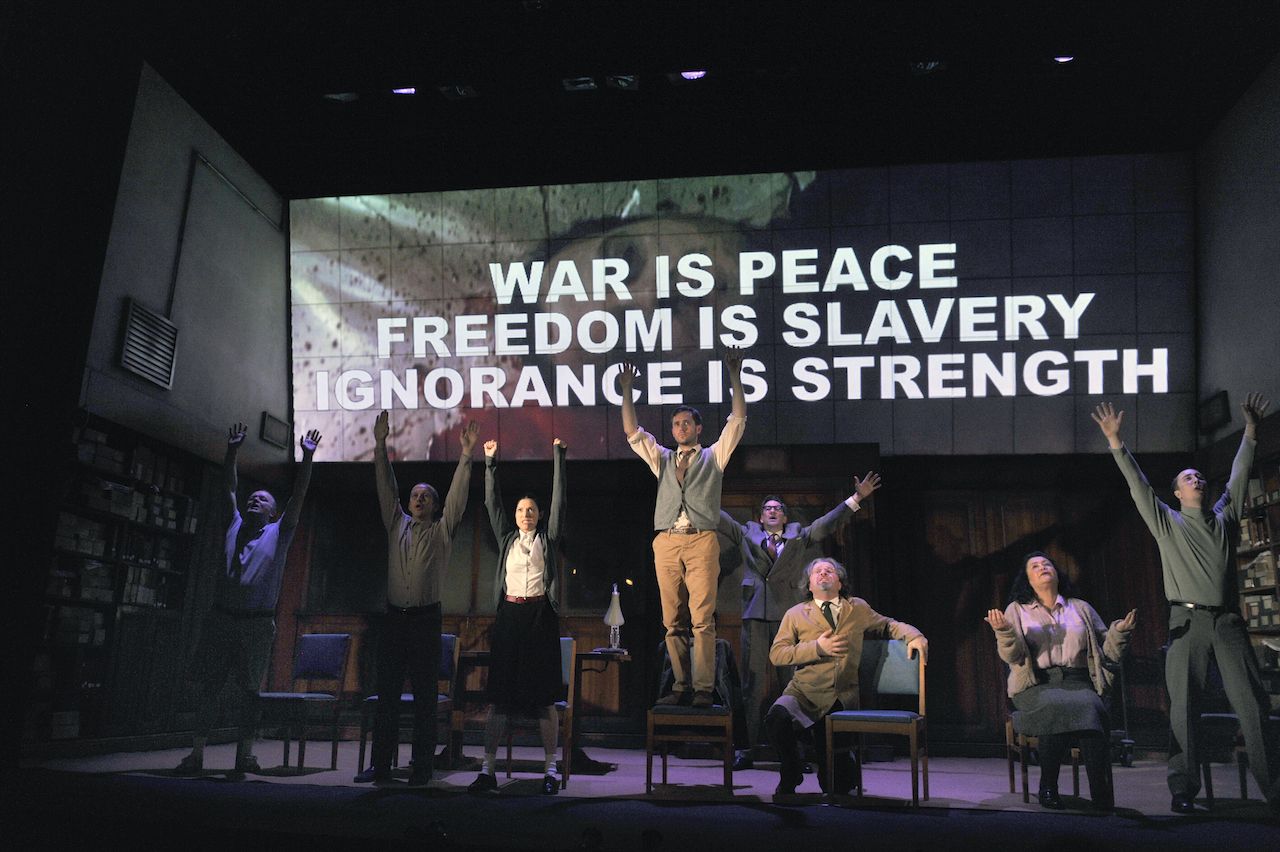
Above Artists of the company in Robert Icke and Duncan Macmillan's adaptation of George Orwell's 1884 directed by Robert Icke and Duncan Macmillan at the Playhouse Theatre in London.
Artists of the company in Robert Icke and Duncan Macmillan's adaptation of George Orwell's 1884 directed by Robert Icke and Duncan Macmillan at the Playhouse Theatre in London.
1 / 1
Standards of Doublethink
The human psyche is riddled with inconsistencies. One of the most important kinds highlighted in 1984 is doublethink, a concept that allows people to hold two contradictory ideas at one time. But don't believe that this kind of phenomenon is only to be found in Oceania.
A notable example is how some people believe that a corrupt leader can be a good leader. These two thoughts seem inconsistent: How can a corrupt leader govern well? And yet the majority vote for those with criminal records into power, arguing that despite past mistakes, these people are capable of leading their communities. Having these two thoughts coexisting in one belief system denotes the need to use logic against logic, or to suspend disbelief to accommodate the contradiction. It's a fascinating construct that Orwell defined in 1984 and is recognisable in today's era.
An Advantage
The society that people live in in 1984 is almost unimaginable—yet many of its distinctive characteristics are present in our communities. Our biggest advantage? That the world of 1984 is fictional. In the book, it is apparent that the Party has the power to read people's minds, and so no one's individuality or free thought is safe. Ultimately, this is how the Party manages to turn everyone—including Winston—into a subservient follower. In the real world, no one has that power. We are all capable of thinking for ourselves, and deciding which ideas or beliefs we should subscribe to. And that perhaps is the greatest advantage we have over a fictional Oceania: that while we can think for ourselves, we have the power to remember history and to recognise not a consensual truth, but an objective one.
NOW READ
Pulitzer Prize 2022: All the Winners For Books, Drama and Music
10 Books Featured in Korean Dramas That You Should Read
10 Interesting Filipino Coffee Table Books: Betsy Westendorp, Old Manila, And More





