
1 / 1
Asia Tatler chats with Indonesian artist Heri Dono about his childhood, the ideas that drive his art, and what mythological character he would like to be

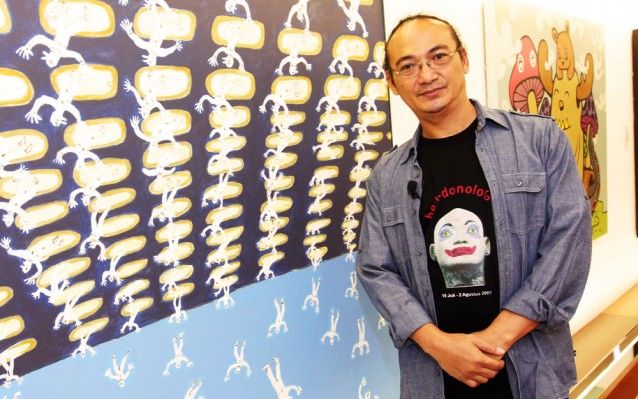
Heri Dono with his piece, '40,000 Souls Falling'
Indonesian contemporary artist, Heri Dono, is known for his works that comment on change and the socio-political landscape of his homeland, using elements of satire, parody, and fantasy to keep things from getting too serious. With someone whose themes are so deeply entrenched in the tribulations of modern society, we were inclined to expect a brasher personality than the mild-mannered Dono we would finally meet in person.
Recently in town for the opening of the Fantasy Islands exhibition at Espace Louis Vuitton Singapore, which features the artworks of seven contemporary Indonesian artists (himself included) that touch on the theme of Indonesian mythology, Dono hosted an art talk to share the inspirations and ideas behind some of his key pieces, including Flying in a Cocoon, Angels Face to the Future, and 40,000 Souls Falling. The latter two are currently showcased at the exhibition.

Heri Dono
Dono has exhibited extensively and participated in many artist residencies and workshops around the world, and is best known for his mixed-media installations that take influence from wayang kulit, the Javanese shadow-puppet folk theatre.
“I wanted to be a painter when I was in primary school, and my teacher was confused as to why, because most of the other children wanted to be pilots, doctors, or engineers. There was no money in being a painter,” says the Yogyakarta-born artist with a chuckle. “My parents would bring me to see exhibitions, so I have a reference to art from my childhood. They liked art but they didn’t buy art, because we were poor. There were seven of us children – we slept like sardines.”
Thus passion was born from an unadulterated early appreciation of art, and Dono’s ambitions as an artist remain modest today. “Art can give consciousness to people; to make them aware and from there, make their own decisions,” referring to his work throwing light on social issues to inspire change.
And does he feel that his art is best approached with a prior understanding of Indonesian politics? “When people see the work, they don’t need to know the politics. For example, with Guernica by Picasso, people didn’t need to understand about the Fascists, but aesthetically, they see it as a masterpiece. In my work, sometimes I don’t care if people don’t understand the story behind it, because they can also perceive it aesthetically.”
Dono describes his three-step artistic process as such: “Contemplation; research; and creation. If you just work, you lose your philosophy. But when you have contemplation, you have many questions about what you want to make and then you research the objective data. Sometimes perception can be wrong, so objective data is important. Perspective comes after that; and then we have the emotion of expression.” It is a collected and almost methodical way of working that seems to demonstrate a penchant for deep philosophising.

Angels Face to the Future
Dono’s depictions often feature angels, a symbol of freedom, and wings, an enabler of true introspection. “Flying to me is being able to go someplace where I can get a clearer view. It’s about the ego and super-ego,” says Dono, in reference to Sigmund Freud’s theoretical structure of the human psyche, “If there is just the ego, we don’t know who we are because we have no distance – that’s why I’ve given them wings.”
Of late, the buzz in the Indonesian art scene has grown noticeably, and Dono sees the evolution as such: “Many years ago, art was like a kingdom – if you wanted to be a good artist you had to follow your master. But we would not have masters anymore, just followers. Now there is a movement from the young artists where they don’t need to follow the senior artists. Today in Yogyakarta, we have more than 700 visual artists, and [there are also many] in cities like Bandung, Bali, and Jakarta. The art scene is very vivid and there are many art galleries and collectors.”
Seeing as Dono’s work features a rich variety of fantastical characters, we offer him the liberty of choosing a superpower in a hypothetical situation. Without missing a beat, he says, “I want to be a semar.” A semar, we learn, is a character in Javanese folk mythology, not unlike a court jester. “The semar is only like a trigger to make people change their lives, so he almost doesn’t really do anything except to make people aware, with jokes and humour,” he says with a smile.
Fantasy Islands is on until June 1, 2012, at the Louis Vuitton Island Maison, B2-36 Marina Bay Sands
Photos: Louis Vuitton; Annabelle Teo





