Cover These endangered crafts are on the verge of disappearing (Photos: Creative Commons; stylized by Angela Nicole Guiral)
These endangered crafts are on the verge of disappearing (Photos: Creative Commons; stylized by Angela Nicole Guiral)
1 / 1
Discover the rich cultural heritage of Asia through these five endangered crafts and traditions
It’s not only animal species like the Philippine Eagle or the Giant Panda facing threats of extinction; our cultural heritage, especially the traditional crafts maintained by our indigenous communities over generations is also in peril.
To keep track, the United Kingdom has the Red List that identifies and monitors these endangered crafts. Issued by the Heritage Crafts Association, the list uses a system of four categories of risk to assess their viability. As of writing, it has declared hand-stitched cricket ball-making, gold beating, and lacrosse stick-making, among many others, extinct.
Similar scenes are happening in Asia, and various efforts are underway to preserve endangered crafts. Countries like Japan have established systems to designate and support Living National Treasures, individuals, or groups recognised for their expertise in the subject matter. Similarly, in the Philippines, the National Commission for Culture and the Arts (NCCA) works to protect and promote the diverse cultural heritage of the nation’s indigenous peoples.
These initiatives aim to ensure that the knowledge and skills of traditional craftsmanship are passed down to future generations, safeguarding these cultural treasures from the risk of extinction. We take a look at some of these endangered crafts in this article.
More from Tatler: After graduating from college, this indigenous Aeta from Pampanga continues to hope for the future of his tribe
Philippines: Mabal Tabih weaving


Above President Rodrigo Roa Duterte receives a token from Gawad sa Manlilikha ng Bayan Awardee for Master of Mabal Tabih Yabing Masalon Dulo during the awarding ceremony at the Malacañan Palace on October 24, 2018 (Photo: Ace Morandante/Creative Commons)
President Rodrigo Roa Duterte receives a token from Gawad sa Manlilikha ng Bayan Awardee for Master of Mabal Tabih Yabing Masalon Dulo during the awarding ceremony at the Malacañan Palace on October 24, 2018 (Photo: Ace Morandante/Creative Commons)
1 / 1
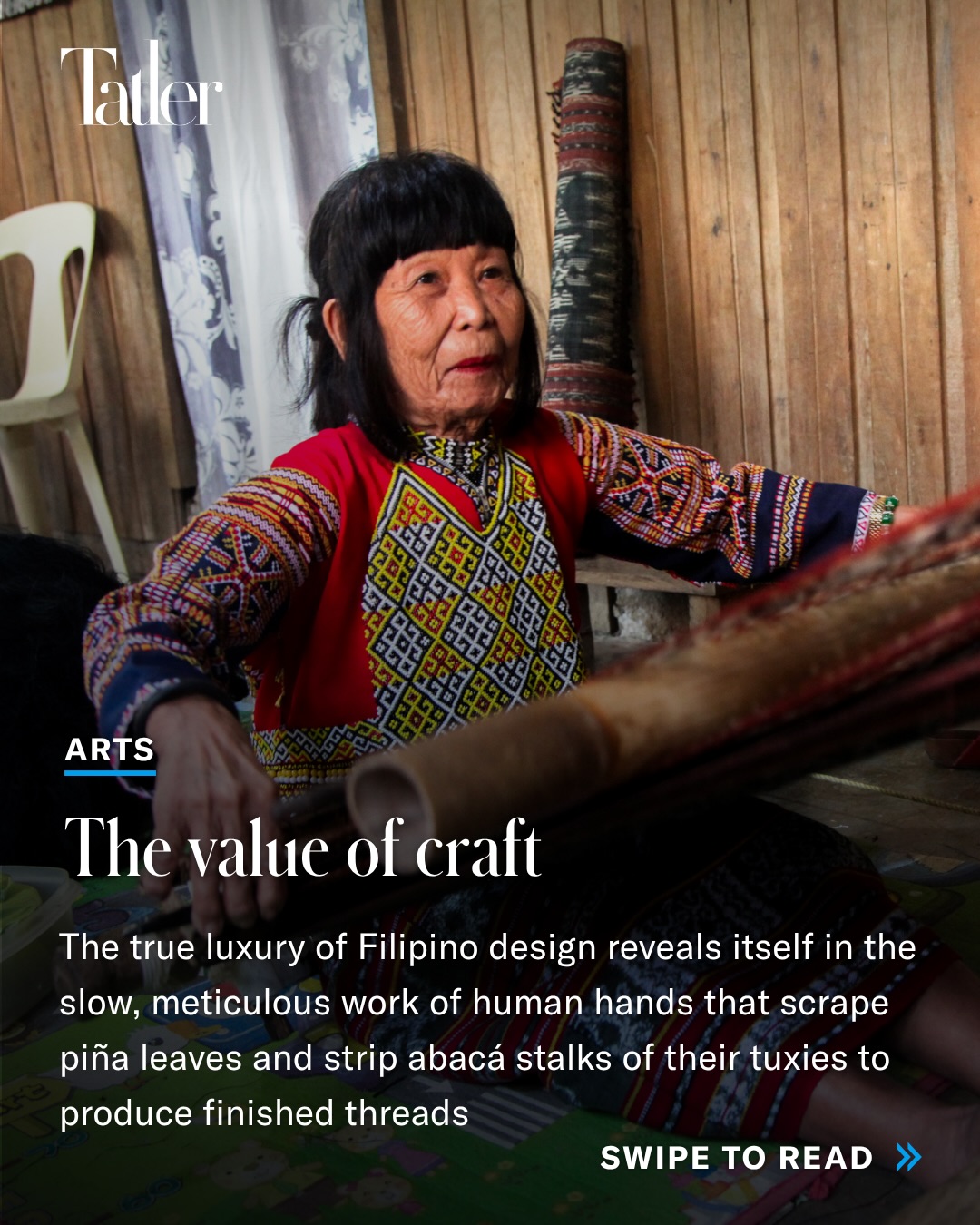
In South Cotabato, the Blaan tribe’s Mabal Tabih is deeply rooted in spiritual traditions, regarded as the miraculous gift of Furalo, the goddess of weaving. This endangered craft is an intricate art form that utilises abaca fibre, and the Blaan weavers employ a unique method: instead of spinning wheels, they meticulously join strands of abaca fibre by hand.
The fibres are dyed using the warp tie-dye resist ikat technique and natural dyes from native plants. The designs typically depict crocodiles and tiny curls.
At the time of her death in 2021, Fu Yabing Dulo was one of the last two surviving master designers of the Mabal Tabih art of ikat weaving. Her contributions have been instrumental in preserving this cultural heritage, which embodies the Blaan tribe’s spiritual and artistic legacy.
Read more: Weaving Patterns in the Philippines: Heritage, Design, and Their Meanings
Japan: Traditional brass bell crafting
Japan is renowned for its history of metal production and craftsmanship, useful for its religious practices that rely on bells. One notable example is the ‘standing bells’, ancient relics used for meditation. The tradition of crafting these bells spans over 400 years.

Above Brass bell and carved wooden seal near Ainokura Folklore Museum 相倉民俗館 Nanto, Toyama, Japan (Photo: Savannah Rivka/Creative Commons)
Brass bell and carved wooden seal near Ainokura Folklore Museum 相倉民俗館 Nanto, Toyama, Japan (Photo: Savannah Rivka/Creative Commons)
1 / 1
The intricate skills and techniques involved in traditional brass bell crafting are typically passed down through generations. Unfortunately, fewer young people are interested in or able to pursue this demanding craft. The generational gap, coupled with economic pressures and the influence of modern technology, threatens the survival of this ancient art form.
Malaysia: Wayang kulit puppetmaking

Above Wayang kulit is an ancient Southeast Asian art form (Photo: Ivuvisual/Creative Commons)
Wayang kulit is an ancient Southeast Asian art form (Photo: Ivuvisual/Creative Commons)
1 / 1
Wayang kulit is an ancient Southeast Asian puppet theatre where vibrantly coloured characters made from goat skin cast shadows on a screen. Accompanied by a gamelan orchestra of percussion instruments, this art form immerses audiences in rich narratives that can last for a while. Despite its declining popularity and a lack of interest from younger generations, masters like Mohd Jufry are dedicated to its preservation.

Above Fusion of wayang kulit puppets (Photo: Fusionwayangkulit/Creative Commons)
Fusion of wayang kulit puppets (Photo: Fusionwayangkulit/Creative Commons)
1 / 1
Malaysian artists Tintoy Chuo and Take Huat are also committed to reconnecting Southeast Asian youth with wayang kulit. In 2013, they both developed a 20-minute wayang kulit adaptation of George Lucas’ film Star Wars: A New Hope called Peperangan Bintang—born out of a shared interest in American science fiction and traditional Southeast Asian art.
Thailand: Rua Hua Tong boatbuilding
Ban Khlong Rua is a vital hub for rua hua tong boatbuilding—a craft integral to the Andaman Sea’s fishing industry. In a Bangkok Post article, Supad Chuatalay (a third-generation boatbuilder from the village) highlights its significance: nearly all small-scale fishing boats in the Andaman Sea are crafted at the place. These traditional boats are uniquely suited to withstand the region’s challenging waters.
Beyond serving fishermen, the boatbuilders cater to tourism needs, constructing larger vessels for sightseeing. Despite economic pressures elsewhere, this artisanal trade remains prosperous, bolstered by local demand and annual events promoting rua hua tong. However, looming threats such as nearby coal transportation projects pose environmental and economic uncertainties.
As younger generations show waning interest, concerns mount over preserving this unique heritage amid changing coastal dynamics.
Indonesia: Damarkurung
Damarkurung, a cube-shaped lantern traditionally framed with wood, are now often made from fibreglass to withstand the rainy season without getting damaged. This shift helps preserve these unique lanterns, which are currently endangered crafts. Efforts in Gresik are underway to revive its popularity.

Above A photo from the Damar Kurung Festival (Photo: Cak Novan Effendy/Creative Commons)
A photo from the Damar Kurung Festival (Photo: Cak Novan Effendy/Creative Commons)
1 / 1
Originating from the indigenous people of Gresik in East Java, damarkurung stands out for its distinctive painting style. The most renowned damarkurung artist, Masmundari (1904 to 2005), hailed from Gresik and was known for her whimsical, childlike style.
Unlike other lanterns, damarkurung is adorned with paintings that narrate stories about humanity, adding a unique narrative dimension to this beautiful craft.
NOW READ
Romantic ballet ‘La Sylphide’ kicks off Ballet Philippines’ 55th Season
Behind the Scenes: Learn more about the much-anticipated ‘Do You Hear the People Sing?’ concert
Beyond Venice Biennale: 9 exhibitions to see if you are headed to the art showcase in Italy

Angela Nicole Regis Guiral is a digital editor at Tatler Philippines. She studied journalism and has since written features that look closely at how culture, lifestyle and social impact converge, while occasionally wandering into the worlds of style and travel.
Curated for you
Discover the stories and updates featured on our Instagram page