
1 / 1
There has been a lot of talk the past few days about the infamous artist Ai, who was detained again on the 3rd of April as he was leaving Beijing airport to come to Hong Kong. As I write this, we've heard that he's been formally detained by the Chinese government and from what I have heard even all his assistants have been arrested, with only his foreign ones released.
As a result of his outspoken voice against the Chinese government's human rights violations, I can only assume that this most likely coincides with the building tensions and uneasiness due to the recent events in the Middle East. Though at the moment, no one knows what this is really about. Regardless, it is big news and also demonstrates to me the power of art and how influential it can be. This news has put many at unease, and I am no exception.
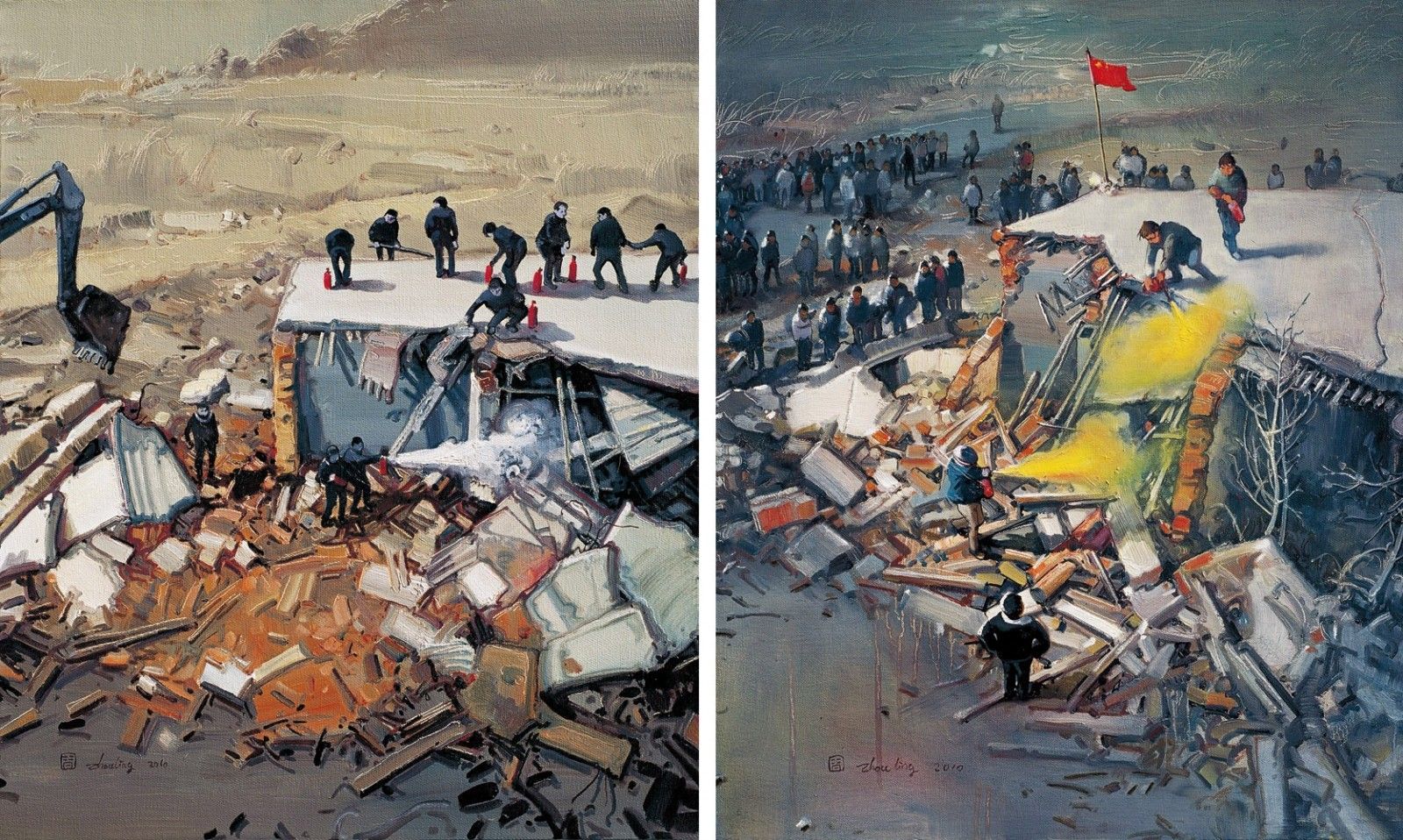
We are currently working on an exhibition entitled “Destiny” by artist Zhou Jin-hua. His solo exhibition examines the topic of forced demolition in China due to its rapid development of urban modernization, which has prompted numerous news headlines and heated debates. Over the past year or so a lot of art media has focused on stories concerning the demolition of art studios in particular, such as the Changdian Village in Chaoyang District. Art centres everywhere were being demolished due to urban-rural integration. It became so severe that in 2010, the police in Beijing broke up a protest by a group of artists as they attempted to march along Chang'an Avenue in the centre of the city shouting slogans such as, "Capital Beijing, brutal demolition!." Ai himself was part of this protest and managed to attract the attention of the international media.
This well publicised problem of land demolition runs deeper than just art studios and extends further afield to peasant and farming land, land that is taken with little or if any compensation, then sold on for re-development and for bigger bucks. I have been told stories of horrible suicides involving families who felt so abandoned as though they had nothing left to live for that they chose to rather burn themselves to death, a death so dramatic in the hope of raising some awareness of their own and other’s plight.
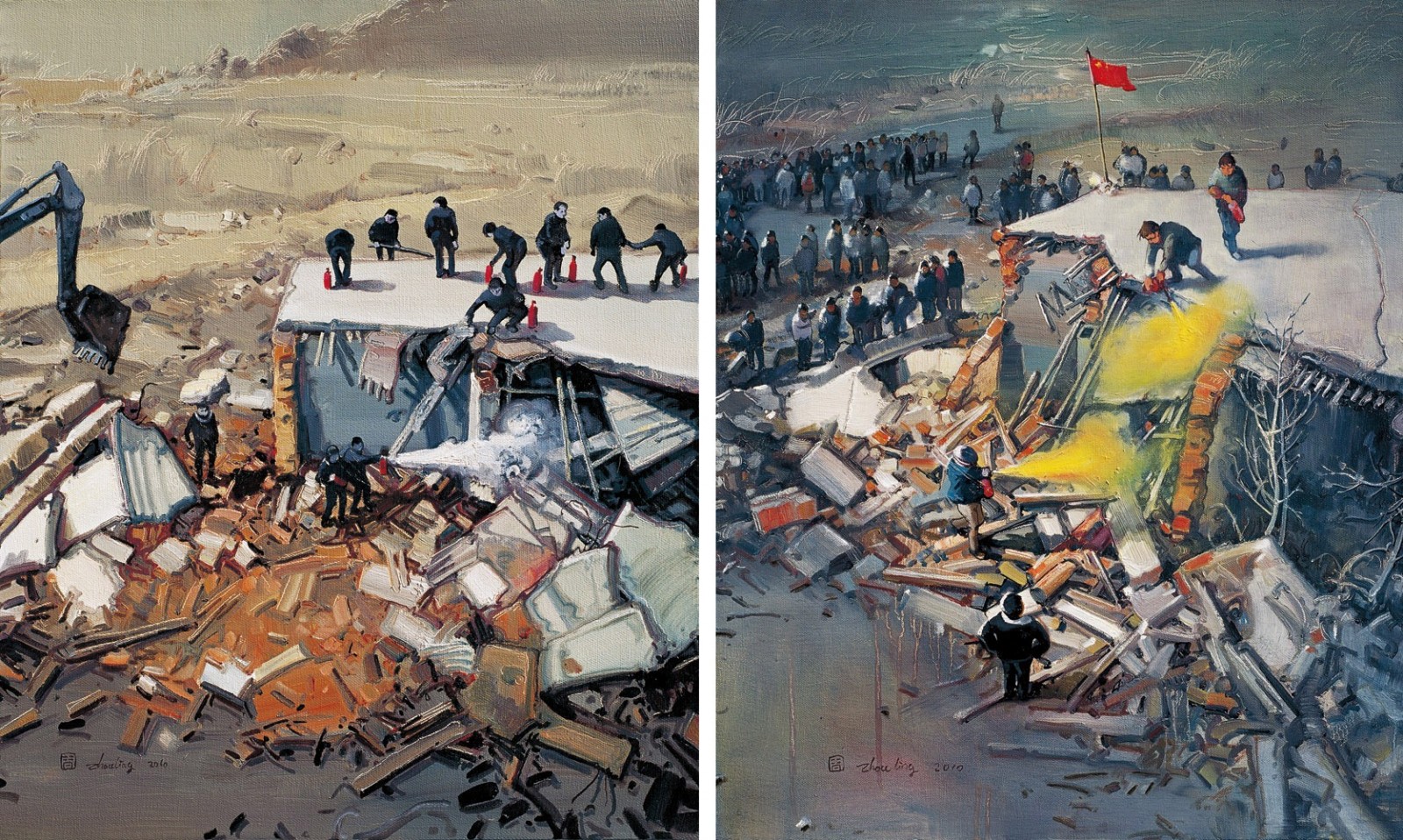
Involuntary Dispotiton Series No. 1 and 2 by Zhou Jin Hua.
Assuming it is still up, to see the actual footage that inspired the artist’s work, pls see below. Be ready though to be shocked and dismayed.
http://v.blog.sohu.com/u/vw/4202324
Last year, Zhou had his first child, a daughter, and the effect on him has clearly been profound. On my visits to his studio I felt that his already strong sense of social responsibility was ever more intense, the changes has not only affected him personally but a large group of China’s lower class population as well. His concern was one from the perspective of a father who was concerned about what kind of society his child would live in. In addition, Zhou Jin-hua comes from a farming background, and although not extreme, his parents had encountered such problems with their own land and had heard about such hardships from other families. Therefore, this phenomenon affected him deeply, and this solo exhibition is a result of it.
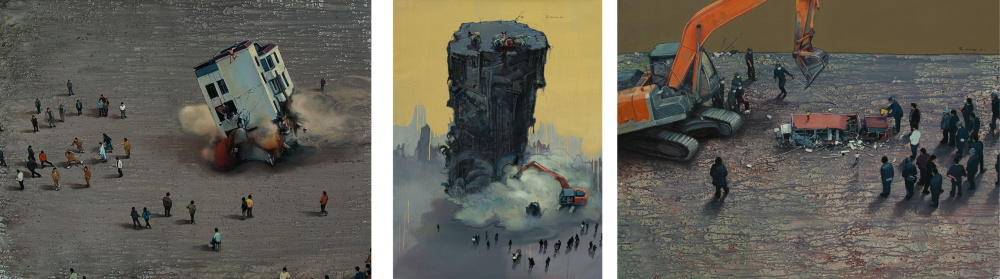
Zhou Jin-hua’s timely exhibition has such strong impact that it will take you on a journey of reflection once again on the “Chinese destiny.” In choosing forced demolition as the main theme, Zhou does not merely wish to raise the awareness of this social phenomenon, or to pass simple moral judgments against it. In fact, he wishes to explore the topic of human nature through an issue that involves political and social relevance.
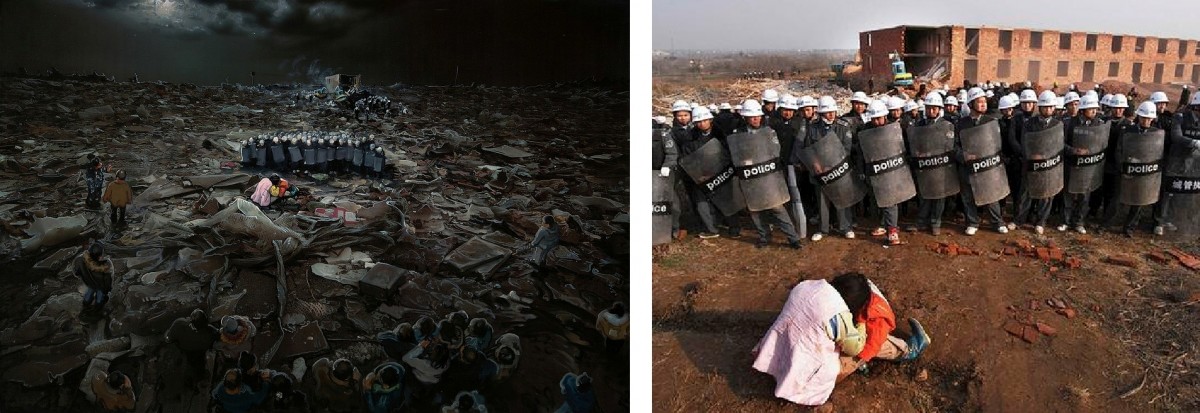
Involuntary Disposition Series No. 1(left)is a piece inspired by a photo published on the New York Times (right), in which a woman who tried to stop the demolition of her house in is being warded off by a hundred armed police. The demolition was to make way for a railway project.
This collection of works also includes works painted on bricks and terracotta pieces, taken from actual demolition sites. He wants to stress the minuteness of his characters that are sometimes even smaller than cigarette buds or a piece of garbage. The minuteness is a direct metaphor of the insignificant value of existence of the society’s lowest rung. He explains, “…and other works in this exhibition were painted on bricks and tiles, the theme of those paintings involves the grassroot level. These people are very much like bricks and tiles in nature and functionality. They are the most essential material required for the construction of the social building. Each piece seems crucial, but at the same time not indispensable. They don’t have an identity or personality, they are just a piece of material. When necessary, they can be placed in any position, and they can be discarded like garbage when they are not required.”
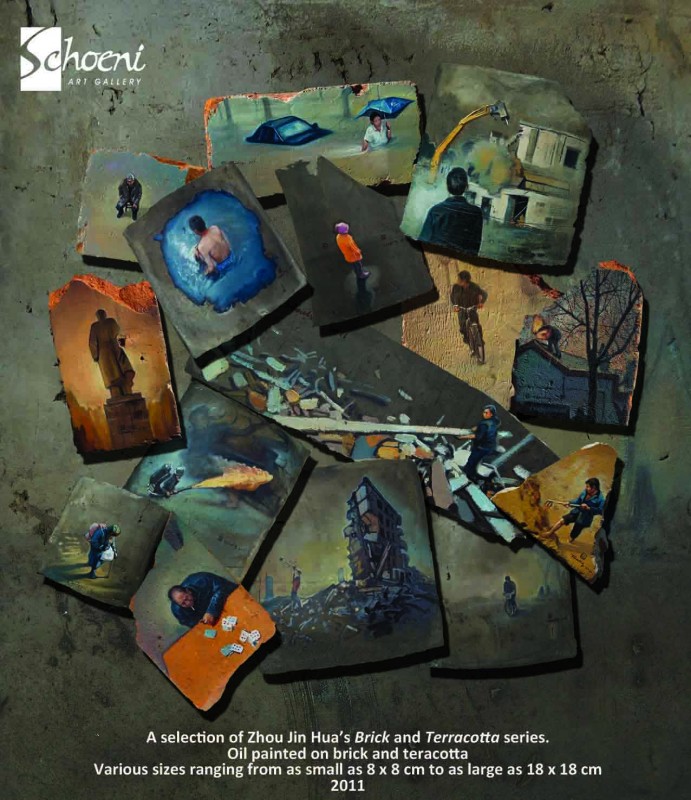
I am excited and also am in great anticipation with this exhibition. He will be coming to Hong Kong for the opening, and will be working in the gallery, to take his characters off the canvas to paint them onto our walls to further emphasis how small we all are in the big picture.
To end this, I’d like to leave you with a quote:
“Fate causes me to become like a stone, sometimes I am on the top of hill, whilst sometimes in the cesspit; luck turns me into a bird, I can fly freely but I can never escape from the eyes of the hunter.”
– Zhou Jin-hua, 2011





