

1 / 1
From battered to remarkable, we take a first look at Asia Society’s HK$385 million restoration project in Admiralty
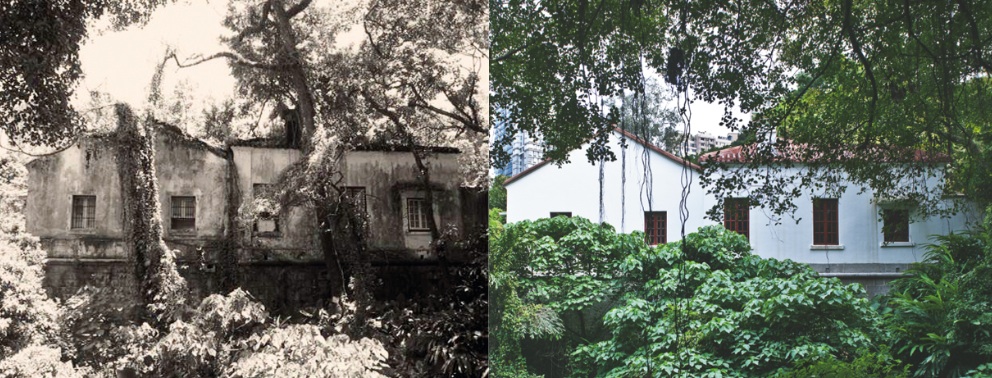
When architects Billie Tsien and Tod Williams first saw the site that was to become the Asia Society’s new headquarters in Hong Kong they were stunned: the battered colonial buildings that once comprised the explosives magazine in Admiralty had fallen into disrepair, their beauty choked by foliage from surrounding jungle.
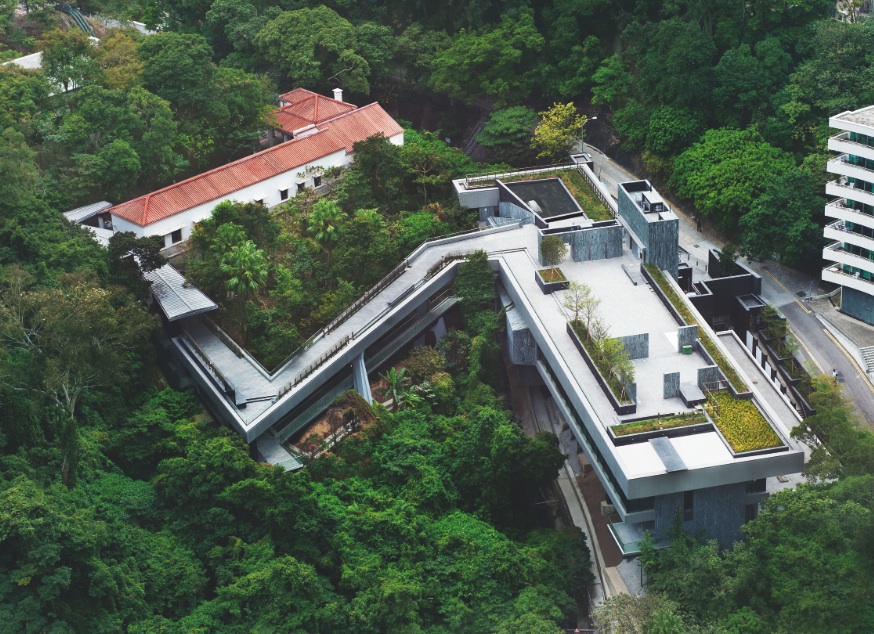
Fast forward to the present, however, and the picture is quite different. After a complete makeover, the society opens its doors on a spectacular HK$385 million restoration of the site, a group of four listed former British military buildings set in the heart of the urban landscape, yet surrounded by lush greenery.
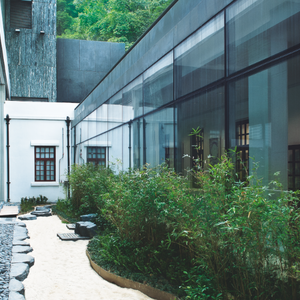
The new complex has a visitors’ centre, an innovative function room with soaring plate glass windows overlooking the city and The Peak, as well as a gallery, a 100-seat theatre and a café.
“This place will hugely enrich Hong Kong’s intellectual life and not just in the policy business of economics – but in art and culture too,” says Ronnie Chan, chairman of Hang Lung Properties and the Asia Society’s Hong Kong Center, and co-chair of the society worldwide.
Take a look at the crystalline Run Run Shaw Creative Media Centre in Kowloon Tong.
Founded in 1956 by John D. Rockefeller III in New York, the Asia Society is an educational organisation dedicated to furthering understanding of the countries and cultures of Asia. There are now 11 centres globally. The Hong Kong chapter was established in 1990 and has become a leading forum for discussion of regional and global affairs.
In 1999 the society decided it needed a permanent home in Hong Kong, and the government agreed to provide the Admiralty site on a long-term lease. “If the government had not had the foresight to give us the land we could never have done this,” admits Chan, who has been vice-chair of the board since 1998.
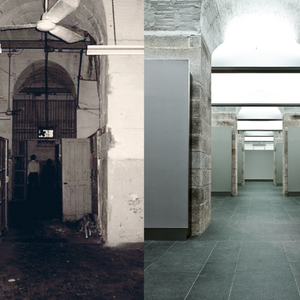
In 2001 an international competition was held for the design of the new centre, with an objective to preserve the buildings’ heritage while adapting them for a new use. Tod Williams Billie Tsien Architects won the competition; the New York-based firm had already created award-winning buildings, including the American Folk Art Museum in New York, and the C.V. Starr East Asian Library at the University of California, Berkeley.
Tsien says, “At its deepest level, the whole idea of the site is transformed; now it’s a place where people come and meet to share ideas, a place devoted to a sense of peace for different cultures. When we first saw it, it was truly a jungle we were hacking through. Now, it stills feels like a jungle, but it also has a web of civilisation that has been thrown across it, so you can feel comfortable walking around.”
Work on the restoration started in 2006 and took five years, owing to the challenges posed by the multi-level site and the constraints of working with heritage structures.
We also looked at the top designers hidden in Hong Kong.
A remarkable Z-shaped covered walkway connects the two levels. Envisaged initially as a straight bridge, it was redesigned to safeguard the habitat of fruit bats, squirrels and other wildlife.
Original features such as the ceiling fans on the verandah of the old laboratory have been studiously recreated and the rail tracks, once used to move explosives between the laboratory and storage magazines, remain intact.
The architects have made liberal use of natural materials that blend seamlessly with the environment, including granite for walls and floors in neutral shades of taupe, slate grey and a misty green that evokes the tones of bamboo. “This site enables a global Asia Society to have much more of an Asian presence,” says Chan.
“A lot of people used to complain that Hong Kong was a cultural desert,” says Chan, “but the reality is it has a lot of hidden cultural gems, including some of the best collections of Chinese artifacts, such as Hang dynasty bronzes and ceramics. We now have a gallery space that can exhibit these.”
The society’s aims for the future are to build membership (it has 1,500 members in Hong Kong) and to continue to provide the community with a rich and diverse programme of events.
It has a reputation for attracting high-calibre speakers to Hong Kong, including former US vice-president Al Gore; Nassim Nicholas Taleb, author of influential philosophical work The Black Swan; Robert Rubin, former US treasury secretary; and Amartya Sen, winner of the 1998 Nobel Prize for economics. “We probably bring more world-class speakers to Hong Kong than most institutions,” says Chan.
Learn about Michelle Ong's Charity First Initiative Foundation here.
Topics





