
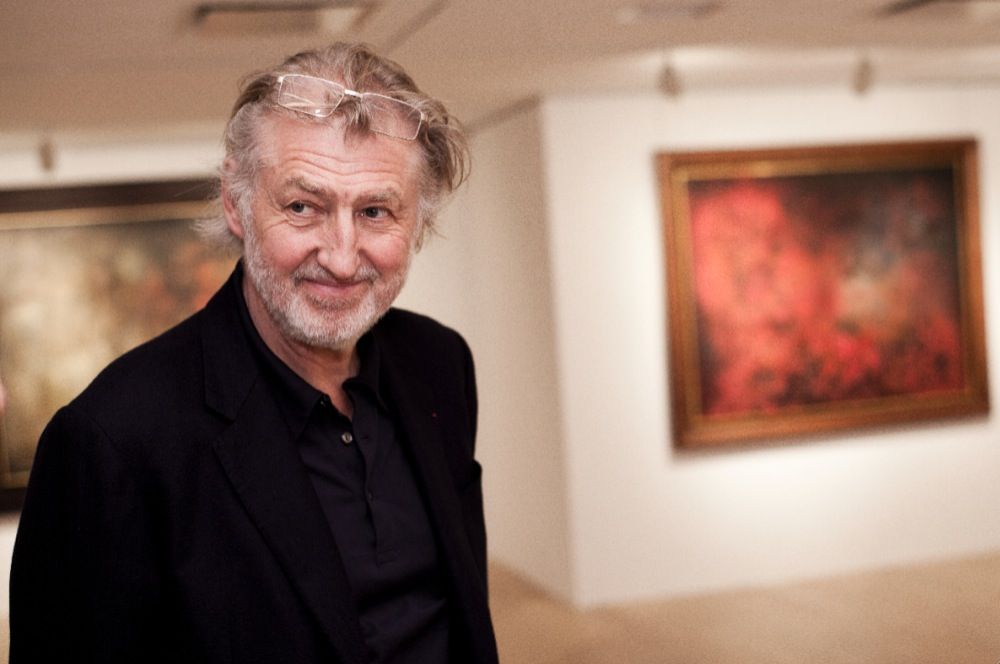
Cover The Artistic Chef: Pierre Gagnaire
The Artistic Chef: Pierre Gagnaire
1 / 1
We follow acclaimed French chef Pierre Gagnaire as he trolls Hong Kong’s art galleries in search of inspiration for a new dish
 With restaurants in Paris, London, Tokyo, Hong Kong, Seoul, Dubai and Las Vegas (and with more to come, "perhaps in Berlin"), Pierre Gagnaire is a busy man. Yet each of his culinary destinations manages to remain innovative, with a level of quality that never falters. This is due in large part to Gagnaire's vision: the motor that drives his empire's success. Taking on new challenges in a heartbeat, Gagnaire manages to please all of the senses with his dishes, creating little works of art on each plate. We follow him around for an afternoon of Hong Kong's art galleries, seeking inspiration for a new dish.
Ben Brown
We start at Ben Brown in Central's Pedder Building. The gallery is showing Tony Bevan, a British artist to be hung soon after in London's National Portrait Gallery. As we listen to the gallery's non-executive chairman Nicholas Coulson tell us about Bevan's inspiration, Gagnaire takes in the surprising, textural portraits. He stops at one piece in particular, drawn in charcoal. The giant, black expanse has a deep, velvety background, and already I am imagining Gagnaire creating a gothic pool of squid ink. Or liquorice.
 "That's not how it works," he replies as I ask him what flavours the picture inspires in him. "There's no logical explanation to inspiration.I am crazy about art, I love paintings, but there's no telling what I'll fall in love with or why I'll create a dish. There's no reason behind it; it just comes." It's this spontaneity that sparked the creation of Gagnaire's own art collection – of food-related photography. "Around eight years ago, I bought a photo by Marc Riboud that shows Chinese miners digging into their rice box lunches," he explains. "I then happened upon an artist called Willy Ronis, who I bought five signed photos from, also related to food. And so my collection began. I buy art that provokes a big reaction in me, and that's what art should be."
Opera Gallery
Considering his last remark, I wonder what Gagnaire will make of our next stop: Wellington Street's Opera Gallery, who are preparing a Warhol-esque pop art opening. The gallery's owner gives us the back story of the two popular French street artists the show features: Seen, who used to paint the cars of New York's subway; and Mister Brainwash, the artist who appears prominently in Bansky's recent documentary, Exit Through the Gift Shop. Gagnaire does not seem enamored by the collection. "I am not fascinated by this style," he explains. "There is definitely humour in it, but I feel that it is more decorative than artistic."
 Angela Li
We move on to our last gallery of the day. As we pass through the door of Angela Li Contemporary, the chatty Gagnaire suddenly falls silent. I watch him circle the paperwork pieces, all produced by modern Chinese women, using fine Chinese brushes. "This is very nice," Gagnaire whispers in front of one of Li Wenmin's brown paper mixed media pieces. "I like this. It's very light." Then Gagnaire's curiosity overcomes him again. "What's upstairs?" he asks, as he leads the way to the first floor's collection of permanent in-house artists. He is his playful, talkative self until again, quite suddenly, he comes over all deadly serious. "I like this, I like this a lot," he starts repeating, a glint of creativity in his eye. The image that has stopped him in his tracks, hidden away in a corridor under an air-conditioning unit, is a photograph by Chen Jiagang, titled Apprehension.
 Chen is an architect-turned-photographer who uses a custom-made, large-frame camera to create his eerie scenes. His images give the impression of a spontaneous moment in time, but on closer inspection, there is real complexity and attention to detail in each shot. "I really, really like this," Gagnaire continues. "It''s slightly menacing, like modernity itself, in a way. The foreground is blurry...I wonder what he meant to say by that. It's like a dream."
The Dish
A few weeks later, Gagnaire heads back to his kitchens in Paris to create his art-inspired dish, a nuoc-mam chicken broth with seashells and cuttlefish dim sum of langoustine. "It has a strong Asian influence," he says, only "a thin layer of cuttlefish is used rather than the usual dumpling wrapper. That's my twist." In terms of a translation of a photograph that shows a society in frenetic movement, overcome by what's coming at it while two figuresof tradition stand stoically and serenely, it's spot on.
 This is an excerpt taken from Hong Kong Tatler's Art Issue. For the full article, please pick up a copy of Hong Kong Tatler's May 2011 issue.





