1 / 1
As Bettys Kitschen becomes St Betty with new chef Shane Osborn at the helm, we talk to owner Alan Yau about the changes at his first Hong Kong restaurant
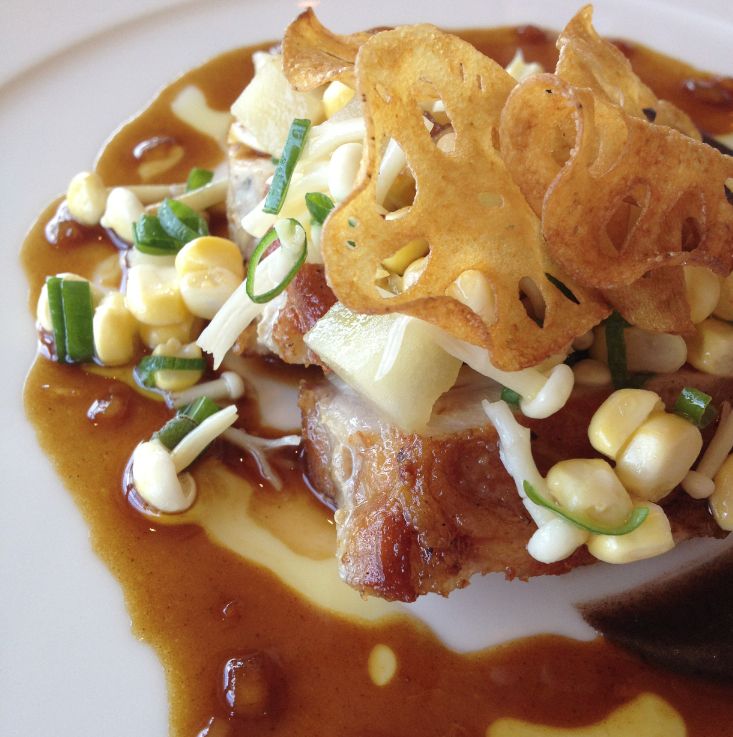
Usually, when a restaurant changes its name, gets a new chef and presents a whole new menu, there is an accompanying media blast. Journalists are sent press releases, invites are sent to come meet the new chef and taste the new menu. Intriguingly, when Bettys Kitschen in IFC changed its name to St Bettys and hired new Australian chef Shane Osborn, former chef and owner of Pied a Terre in London, there was very little noise. Just a quiet change on the website and that was that. So when we finally heard that owner and restaurateur Alan Yau was in town, we jumped at the chance to meet him and ask him what’s happening. In a candid interview, he gave us a lot more than just answers to our questions about the recent changes. He tells us about the difficulties he’s had opening a restaurant in Hong Kong, as well as his thoughts on “cakeage”. We also taste the new menu, and give you a sneak peek of the new dishes in the pictures below.
Hong Kong Tatler Dining: So why did you change the name of the restaurant from Bettys Kitschen to St Betty?
Alan Yau: I just got a bit tired of people writing to me, saying you spelled the name wrong. A lot of the ideas that I’m trying to do at Bettys and the cultural translation didn’t really come across that well, like the metaphor of the fruit and vegetable baskets at the front. Certain people perceive it as being quite cheap, whereas for me, it’s quite fun. It is what it is, if they don’t get it, they don’t get it. So I might as well change it.
HKTD: And chef Jerome Lagard has been replaced with Shane Osborn. How did you decide on Shane?
AY: I have known Shane’s cooking for a long time and I ate at Pied a Terre sporadically, partly because for me it’s a bit too French and too fine dining, but any chef who is capable of cultivating a two-Michelin star restaurant from nothing and more importantly to be able to hold the two stars consistently for five years, speaks a lot about his dedication and his ability to control the kitchen. When I heard that Shane wanted to move away from London and sell his shares in Pied a Terre, I had a chat with him and it just so happened that he wanted a new challenge of doing something less fine dining. For me, the most important thing is to deliver quality with consistency, day after day. And [I wanted] someone who can cook eclectic types of food, because to be honest, Bettys was never meant to be a French brasserie, it just sort of happened that our previous chef Jerome was French, so the dialogue became very French.

HKTD: Is the menu completely changed?
AY: We’re looking to change the entirety of the menu, in terms of both the dishes and the recipes because Shane’s cooking is very different. I think the only French thing left is the technique. I would say Shane’s cooking reflects his personality rather than of any European origins.
HKTD: And how would you describe Shane’s personality?
AY: Very Aussie, laid-back and not afraid of using different ingredients from different cultures. He doesn’t have a problem with using local produce and mixing it with something else. I think as long as the integrity of the cooking technique is there, that is quite nice to see. That’s true of a lot of good Australian chefs, in terms of their repertoire. And Shane doesn’t go so far as Neil Perry, whose stuff can be almost Chinese. For me, that’s a little bit too far. Compared to French cooking, it’s a lot lighter, a lot fresher. French cooking is extremely complicated, sophisticated and needs a lot of preparation. And some of the time, it’s a bit too heavy for me and my palate.

HKTD: Would you say St Bettys is now more of a modern Australian restaurant rather than European or French?
AY: Yes. Though it’s very hard to define someone like Shane with a one-liner. It’s definitely not French, I think his cooking represents more of the modern Sydney and Melbourne type of feeling. In terms of the way they deal with food, and like I said, in that they have no difficulties about using produce from everywhere. I’d rather eat barramundi which has been acquired in the region than with the last chef, who imported everything from Paris. Premium in name, but the quality of the fish is not there anymore because of transportation. To me, that’s a major shift from the last menu. You feel the quality, especially in the fish and seafood.

HKTD: So what other plans do you have?
AY: Ultimately, what we want to do is set up our own small farm in the New Territories, specialising in a few types of produce that we feel can be internalised. We’d love to have our own beehive. I think that’d make the project much more interesting.
HKTD: Bettys Kitschen was your first project in Hong Kong: what difficulties did you encounter?
AY: With this kind of business, it would have been a hundred times easier in London because there’s no learning curve. Aside from having to set up a new infrastructure and taking every item as a trial and error, the hardest thing for me to understand was the fact that I thought I was Hong Kong-Chinese, until I started this restaurant. Mentally, I’m a million miles away. In terms of certain idiosyncrasies of how people perceive food and their habits, that side you can only learn by doing it and being on the ground. Culturally, I like things that are a little bit pared down. Personally, if I drink a bottle of wine at home, I’d prefer to drink it out of a tumbler and that’s a personal preference. That’s why I like southern Portugal and Tuscany, where the experience is at a more human level. At the beginning, for Bettys Kitschen, I specified this Marc Newson wineglass, very petite, made by Alessi. Wow, the complaints I had, saying how dare you give us a wineglass like this! What they want is the huge wineglass: to me, those kind of nuances were hard.

HKTD: Do you find yourself compromising?
AY: At the end, you can only compromise. I think you can only fight back once you know the system. At the moment, I’m taking it in. I think once you’ve absorbed the entire culture, then you can fight back. I mean, “cakeage”. In the west, no way would you bring a Maxim’s cake into a restaurant and ask the restaurant to plate it for you after your main course. My god, even if they didn’t mind, I’d be so embarrassed. At the end of the day, you have to respect the establishment.
Curated for you
The stories, profiles, and cultural moments featured on our Instagram feed