1 / 1
The serial restaurateur tells us about Jing Yaa Tang, his latest project at The Opposite House in Beijing

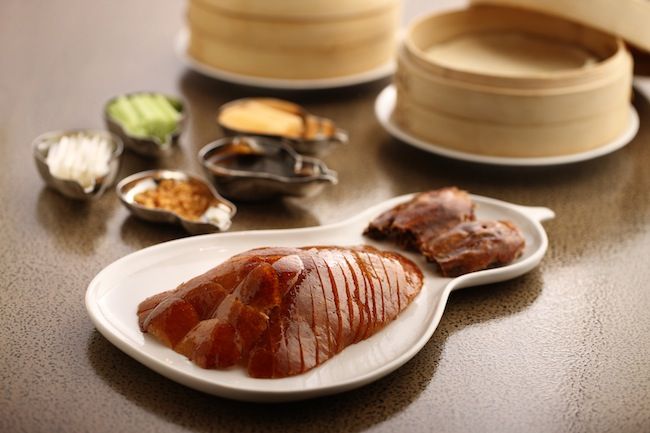
Talking about where to find the best Peking duck in the Chinese capital is a divisive subject. Adding fire to that age-old debate is the arrival of Jing Yaa Tang, whose perfectly roasted duck, with its crisp skin and rich, tender flesh has been causing Beijingers to reconsider their go-to for this classic dish.
The restaurant opened to much fanfare in September, thanks in part to the fact that serial restaurateur Alan Yau was drafted in by The Opposite House as lead designer and concept consultant. Leading the kitchen team is chef de cuisine, Li Dong, whose menu goes beyond the duck to encompass a concise menu of China’s all-time regional favourites, such as Sichuan dan dan noodles, kung pao chicken and Cantonese steamed scallops on tofu with black bean sauce.

Nonetheless, with roast duck being Jing Yaa Tang’s raison d’être, the fowl is placed centre stage behind a glassed-in kitchen, where a chef slings birds in and out of a specially built wood-burning oven. In fact, the whole space is reminiscent of a theatre: the restaurant doors open onto the bar area, tables in the centre have a direct view of the oven – “the stage”, so to speak – while tables along the sides are elevated on a platform, and a private booth is situated in each adjacent corner.
Here, Yau talks to us about the partnership with The Opposite House – and his first project in China.

Hong Kong Tatler Dining: How did the partnership with The Opposite House come about?
Alan Yau: Brian Williams, managing director of Swire Hotels, and I had an aborted project dating back to 1998, so it was nice to get reacquainted.
HKTD: Can you talk us through how you came up with the design for Jing Yaa Tang?
AY: I always wanted to do a restaurant with the metaphor for the scene likened to a theatrical stage. The spatial concept, which I have coined as the elevated U, distils the notion of the restaurant as theatre. The raised platform literally places the diners on a stage where they become a player in the experiential drama. On materiality, I wanted the retrospective look, something away from the modernist-appreciative culture, and I felt the French design aesthetics of chinoiserie was the right direction.
HKTD: Should we expect to see more projects from you in China and/or Hong Kong?
AY: Not at the moment, my immediate focus is on a number of projects in London.
HKTD: In Britain, you’re often credited with revolutionising communal dining and Asian food. Are you looking to achieve the same level of success in China, and what will you be bringing to the table?
AY: With Jing Yaa Tang I hope it remains an exquisitely complex and daringly subversive drama. The humble next to the precious. The profound next to the profane. The perfect meal is a life’s memory. On the big picture, I am planning nothing too ambitious at the moment. China is a big country and I would love to one day return and do a scalable project.

HKTD: You’ve been quoted in the past that you’re aware that Hakkasan and Yauatcha were criticised by some Chinese people for not being authentic, and that as a Chinese person returning to Hong Kong after years away and making it big with Asian cuisines, it could prove to be a kind of obstacle. How have you overcome that feeling to work on a Chinese restaurant in Beijing?
AY: Your question in point is a profound London problem. The dichotomy does not exist in Beijing, and it’s nice to do something local for a change.
HKTD: What are the most important things you have learnt from previous ventures and partnerships?
AY: The key subsets of semantics and nuisances keep cropping up. Namely: location, local taste and preference, the dynamics of a different business model and the art of compromise. C’est la vie!
HKTD: What would you buy to eat if you had £10 in London; HK$100 in Hong Kong; and RMB100 in Beijing or Shanghai?
London: Duck and rice from Goldmine, Queensway
Hong Kong: Dumpling noodle soup from Mak’s and beef brisket e-fu noodle soup from Kau Kee, Sheung Wan
Shanghai: Shenjianbao from Yang’s Dumpling
Topics
Curated for you
The stories, profiles, and cultural moments featured on our Instagram feed