
Cover How to Pair Chinese Food with Wine
How to Pair Chinese Food with Wine
1 / 1
Asia Tatler Dining has lunch with Paul Lo, director of F&B at the Grand Lisboa, to get his top tips on pairing Chinese food with wine
Recently, Asia Tatler Dining was invited to have lunch at The 8 at the Grand Lisboa in Macau. The purpose of the meal was for us to pick the brain of Paul Lo, the director of food and beverage for the Lisboa Group and overseer of the group's wine cellar which has over 7800 labels, on his tips on pairing wine with Chinese food. Pairing French or Italian cuisine with Western wines is something that Europeans have had hundreds of years of practice with. With Chinese food, however, wine pairing is still a relatively new phenomenon.
 So we decide to ask Lo what are some of the primary difficulties in pairing Chinese food with Western wines? "Chinese food sometimes use spices that aren't used in Western food and these herbs or spices such as chilli or Sichuan peppers can really damage some types of wine. For example, a dish that uses a lot of chilli is never going to match any wine", Lo states matter-of-factly.
On the other hand, as anyone that has ever dined at a Cantonese restaurant will tell you, more often than not there will be a plate of chilli sauce or X.O sauce there for dipping. Should we avoid all of that then? "No, but you just have to be aware of them. For example, X.O sauce could go with a red wine from a hotter region such as southern France, where the wines have a spicy and peppery tone, which would match the X.O", Lo explains.
As the assorted dim sum dishes start arriving, we ask Lo how it is possible to order a wine that would go well with all the different varieties of dim sum there are out there. Lo agrees that while dim sum can be tricky, and suggests sorting them by cooking method can make pairings easier. "White wine is generally good with steamed types of dim sum," and as if on cue, a steamer of shrimp dumplings arrive. Lo pours a glass of 2010 Cloudy Bay Sauvignon Blanc and says, "This Sauvignon Blanc is very refreshing, a little flowery with some lemon tones. This would be good for not only steamed dim sum, but also other light dishes such as consommé, broths, chicken, pan-fried fish, shrimps, crabmeat and beancurd".
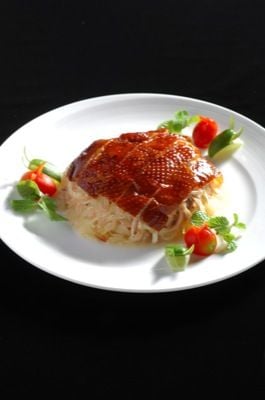
 When it comes to deep-fried dim sum such as spring rolls or taro puffs, Lo suggests Champagne as a pairing as the acidity of the wine will cut through a lot of the oil. As an extra tip, "Champagne is very useful if you want to drink only one wine with an entire Chinese meal," Lo adds. He also suggests as a perfect pairing for Champagne one of The 8's most popular chicken dishes, a crispy chicken with pomelo salad. The fruit offsets the oil of the chicken, and the skin has had the fat removed, making it a relatively light dish.
 After the plates have been cleared away, two of the heavier dishes of the meal appear: a sautéed lobster with egg, minced pork and black bean sauce and a suckling pig stuffed with fried rice and preserved meat. Lo opens a bottle of 1989 Egon Muller Scharzhofberger Riesling from Germany with these dishes, while explaining, "this Riesling is categorised as Auslese so it has a certain dryness with a sweet tone at the back. It's because of this sweetness in the body that the wine goes well with dishes like sautéed lobster".
 In fact, Riesling is one of the two grapes that Lo promises will usually go well with Cantonese food: "Cantonese food is always based on the concepts of lightness and sweetness. Within the wine culture, there are two grapes that can easily match it: Riesling and Gewurtzraminer because these two grapes also possess this property of lightness and sweetness".
Lo warns, however, that this is not the case for all Chinese food. Shanghainese food, for example, is oilier, which you'll need a good heavy-bodied Chardonnay to match. Another difficulty with Shanghianese food is the presence of vinegar, as vinegar doesn't match wines well. "It depends on the amount you add into your food, some people are very delicate and just use a few drops but some are heavy-handed out of habit. So if you plan to eat the dish with wine, you have to be careful about the amount of vinegar you put in", says Lo.
Finally, we ask Lo about the two other beverages often seen at Chinese banquets: tea and moutai. "Just like wine, tea also has tannins which can distort your taste buds. You can rinse your mouth with tea, that's fine, but don't drink the wine for thirty seconds after that". Regarding moutai, Lo says:
"Moutai is not a wine as it's not made with grapes and it's more of a spirit like a vodka. It's very heavy and when you have these levels of alcoholic content, it doesn't go with any food. It's more suitable as a digestif".





