
1 / 1
We try out three student-run restaurants in Hong Kong and Macau
When I was in culinary school, one of my fondest memories was of working in the school’s fine dining restaurant. This took place the last semester before we left for our internships, and consisted of six weeks of cooking in the kitchen, and six weeks of working in the dining room, taking orders, flambéing crepes and juggling trays of tall, iced waters. As students, we were often surprised by the quality of the food we managed to put out, given that our cooking experience was mostly restricted to just about one year of training, yet we were expected to offer a five-star dining experience. It was exhausting and nerve-wrecking, but undoubtedly good fun for both the students and the diners who came to be our guinea pigs.
On a recent visit to Hotel Icon, we walked by Bistro 1979, a restaurant run by students attending Hong Kong Polytechnic University’s School of Hotel and Tourism Management, and I couldn’t help but wonder how Hong Kong’s student-run restaurants measured up. So I went to visit Bistro 1979, while two of my colleagues visited the educational restaurant at the Instituto de Formacao Turistica (IFT) in Macau and The English-speaking Dining Society in Pok Fu Lam to see what the next generation of chefs were cooking up.
Bistro 1979 – visited by Lynn Fung
The School of Hotel and Tourism Management shares the same building as Hotel Icon in Tsim Sha Tsui, and as such, Bistro 1979, the student-run dining room, is easily accessible by either the school or hotel lobby. SHTM is not just a culinary school; rather it provides a management programme that encompasses all parts of hotel management, from front of house to human resources to wine pairings. The students who work at Bistro 1979 are only there once a week, for a total of seven days over the semester. When I learned that, I was a tad apprehensive. Would a meal prepared by a team of students that weren’t even culinarily-focussed be edible? The kitchen is led by the Australian chef Simone Nabbs and she designs the menu which changes on a weekly basis. The prices at Bistro 1979 are a real bargain: HK$95 for a two-course lunch or HK$105 for three courses. The restaurant is open to the public, but it runs on a club license, therefore HK$5 is added to your bill in order to qualify as a “member of the catering studies dining society”.

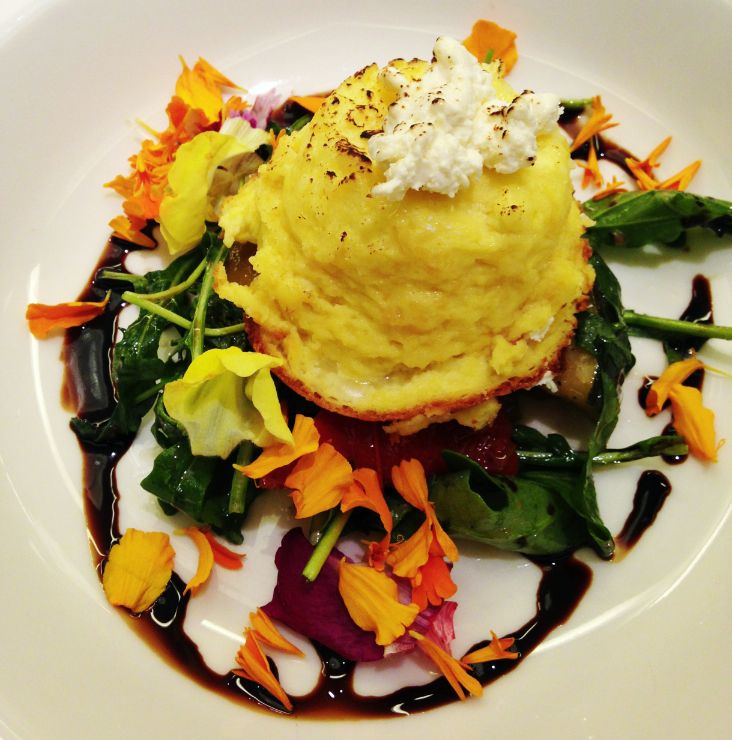
Our first course of Persian feta soufflé (cover image) was light, fluffy and delicious, accompanied by char-grilled courgette and peppers, with a healthy dash of balsamic glaze and rocket salad. The second course was a pan-fried barramundi (pictured above): again, the fish is expertly cooked and juicy, although it could have been a tad warmer, and the saffron potatoes and shaved fennel sides provided a good textural contrast. Dessert was the most disappointing: our tonka bean crème brulee had an unpleasant curdled texture, although the chocolate “emulsion” (really more of a mousse) on the side was rich and delicious. The servers were eager and attentive, although being trainees, there were such minor mistakes such as removing plates while others on the table were still eating; or putting the bread plate on the wrong side. However, to be honest, this was no worse than some of the real restaurants we have frequented in Hong Kong, and such quality food for that price is hard to beat.
B2, School of Hotel and Tourism Management, 17 Science Museum Road, Tsim Sha Tsui East. Tel: +852 3400-2300.
Institute for Tourism Studies - visited by Tim Cheung
Similar to the SHTM, the Institute for Tourism Studies (IFT) in Macau is more than a culinary school. Situated in the modest Colina de Mong-Há, IFT offers degrees and professional programmes in a wide array of tourism-related topics, from hotel management and sports recreation to heritage and culinary arts. But culinary programmes do play a big part in the school where students get their hands wet – and sometimes cut - preparing foods for anyone who braves the short hike to the mountaintop restaurant that is the Educational Restaurant.

The restaurant offers a bang-for-the-buck set menu (MOP180) with a starter, main and dessert buffet, each server is shadowed by a veteran staffer, who teaches everything from table setting to food and wine pairing. I was told that actual chefs are responsible for my dishes while students learn by watching and playing a supporting role in the kitchen, which explains my lovely starter.
The seared scallops with Portuguese black pudding and orange marmalade from the a la carte menu arrives perfectly seared, in a generous portion, with caramelised fringes to help bring out the aroma. The addition of black pudding and orange marmalade is a genius twist, giving a complementing savoury and sweetness to the fresh shellfish. The Educational restaurant also offers homemade bread and pasta, a large selection of Portuguese specialities and many vegetarian dishes. The homemade fettuccini pasta with truffles and Parmesan cheese (pictured below) is cooked al dente and the cream sauce is prepared just right without tasting excessively heavy. Also worth mentioning is that the restaurant offers solely Portuguese wines that range from under MOP200 to over MOP2,000 a bottle, all presented in an iPad app.

It is an unusual behind-the-scenes experience to witness an actual upbringing of the restaurant staff - a good reminder that every server in world-class restaurants was once a trainee. In a few years’ time, these servers who struggle to uncork a wine and present our dishes ever so gingerly now will be the ones catering to Macau’s booming tourism industry.
Institute for Tourism Studies, Colina de Mong-Há, Macau; Tel + 853 2856-1252.
The English-Speaking Dining Society – visited by Charmaine Mok
As part of the Vocational Training Council programme, The English-Speaking Dining Society (TDS) is housed within the Pok Fu Lam Training Centre Complex. As the name suggests, the restaurant promotes the effective use of English in a dining context, where trainees are encouraged to take orders and serve entirely in English, under the watchful eye of the instructors. Students run the show entirely, from the moment you step into the building, into the lift, and out into the restaurant. The only pupils we do not encounter are the chef trainees, who stay firmly behind the scenes.
There is an old-fashioned quality to the proceedings with students encouraged to refer to each guest as ‘lady’ or ‘gentleman’ at the end of nearly every sentence, which sends us into fits of giggles. The students are also, for the most part, very nervous – one, when asked to explain the dobosh cake, panicked and quickly reverted to Cantonese.
Our experience of TDS in the past has largely been positive – the dishes, a mash of continental classics and the odd Asian flair, are finished to a fine dining level, and while service can always be improved, it was largely competent. We’re afraid that this year, the standard has fallen far from our previous visits.

The best dish was a clear pigeon consommé with vegetable “spaghetti”, followed by a perfectly cooked beef wellington (above), blushing pink inside its casing of salty prosciutto and golden puff pastry. Less successful were the two fish dishes of the day – a slimy potato and herring terrine wrapped in layers of leek and an overcooked smoked cod with pea puree, served with incongruent shimeji mushrooms, too-sour wine-poached baby onions, and tiny red pepper dice. Desserts were even poorer, the aforementioned dobosh cake featuring dry sponge and a layer of chocolate cream that perspired in a way as to suggest it had come straight from the fridge.
Like the other two restaurants, the dishes and set lunches are extremely affordable, at HK$108 for three courses and HK$120 for four, with tea or coffee and petits fours included. The only catch is that you have to be a member to dine here, and that requires you to be involved within the hospitality or tourism industry. It’s not a high price to pay at all, but keep in mind that quality can vary from term to term – perhaps we’ll have better luck with the class of 2014.
1/F 145 Pok Fu Lam Road, Pok Fu Lam. Tel: +852 2550-6683.


Charmaine Mok was formerly the Content Director of Dining for Tatler Hong Kong, overseeing Tatler Dining, the Off Menu festivals and the annual Tatler Dining Guide and Awards. As well as penning the latest stories about the city's newest restaurant openings, dining trends and food culture, she's constantly searching for leads on new flavours, food personalities, and thrilling new culinary destinations. Follow her on Instagram @supercharz





