
1 / 1
Here's a look into the processes of how Glenfiddich’s fine whiskies are crafted, revealed step by step from malt to spirit.

The 3-day ‘Valley of the Deer’ distillery tour held by Glenfiddich recently allowed guests an exclusive look into the meticulous processes of how the brand’s fine whiskies are crafted from malt to spirit.
It is a long and tedious process, one made particularly difficult to perfect because it needs to reenact the very same steps taken by the first whiskymakers of Glenfiddich from 125 years ago.
Here’s what gives you the distinct taste and full-bodiedness of each glass of Glenfiddich’s fine whisky, revealed step by step.

Mashing & Fermentation
Step 1: Glenfiddich being a single malt whisky, is made from a single grain – barley. The barley harvested from Glenfiddich’s specialist maltsters is ground into a rough flour and mixed with heated Robbie Dhu springwater. What results is a thick, brown porridge-like mixture known as ‘mash’.
Step 2: The mash is then transferred into Glenfiddich’s giant mash tuns, in which rotating mash knives stir and lift the mash with its blades (pictured above) to encourage the barley starch to convert into fermentable sugar. During this process, the Robbie Dhu springwater also absorbs these sugars and after 6 hours or so, a dark syrupy liquid called ‘wort’ is obtained.
Step 3: The wort will after that be drained and cooled to 17°C before being pumped into giant wooden fermentation vats – each handbuilt by Glenfiddich’s Douglas Fir washbacks. Here is also where yeast is added and the temperature pumped up high so fermentation takes place, converting the sugar into alcohol.
Step 4: After 2 to 3 days, the temperature is let to die down. At the bottom of the vat, you will find a rich brown ‘wash’ with a 9% alcohol strength, awaiting the next step: distillation.

Distillation
Step 5: Following fermentation, the residual rich brown wash is run into wash stills, where it is heated slowly until it reaches an almost boiling point, causing the alcohol in the wash to vaporise into the narrowing necks. The gas, in turn, is guided down by a water-cooled condenser until the resultant liquid carries about 21% alcohol strength, by when it is known as the low wines.
Step 6: The low wines are then heated and condensed further in Glenfiddich’s spirit stills (pictured above), tall stills made of copper strictly identical to those first used when the first Glenfiddich distillery was founded. For Glenfiddich, it uses 2 stills of different shapes and then bring together their distillates equally to preserve the whisky character signature to Glenfiddich.
Step 7: When it reaches an exact point in the distillation, the distillation’s high cut point is executed. Here is where the heart of Glenfiddich’s whisky is captured – a spirit that is clear, light and fruity. Called the ‘new make’ spirit, it will then be transferred into the spirit safe where it will wait a little longer, ready for one more round of distillation. It needs to be redistilled one more time because the distillate at this point, called the ‘feints’ is not yet deemed to be pure enough for drinking.

Maturation
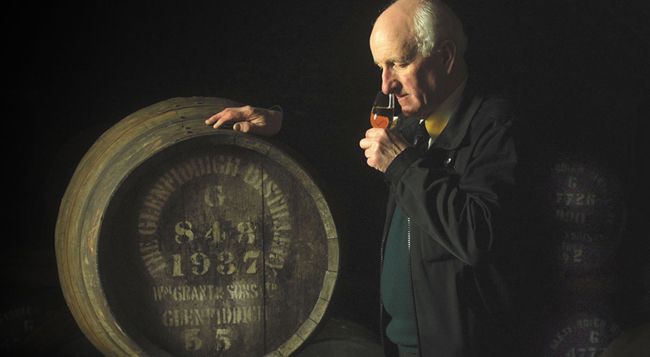
Step 8: When finally only the clearest, purest new make spirit is obtained, Robbie Dhu springwater is added to the spirit to total the alcohol strength to 63.5%. The spirit is then filled into Glenfiddich casks, most made of the finest hand-made American oak and Spanish Oloroso oak by Glenfiddich’s Head Cooper (pictured above).
Step 9: Here the waiting game begins. The casks will spend long years in Glenfiddich’s dark, damp warehouses, breathing in only fresh Highland air until they are primed for bottling. Watched over by Glenfiddich’s warehousemen, the casks of single malt will see its maturation imbued with character that can be found no where else outside of the glen.

Marrying & Bottling
Step 10: When the spirit reaches the desired maturity, selected casks will be emptied into large Portuguese oak marrying tuns. Here is where they will rest – or get married –with whiskies of the same age or older for up to 9 months while it mellows, smoothens and harmonises.
Step 11: Some expressions spend a few months in virgin oak casks or casks that used to contain other alcohols, before marrying. Intense aromas and flavours of good whiskies come from this process, giving them their unique characteristic finish.
Step 12: Lastly, Robbie Dhu springwater is added to create just the right alcohol by volume for each expression before the now fully crafted single malt is bottled.
To discover more of Glenfiddich's whiskies, log on to the official website here.
(Photos: Glenfiddich)
We recommend:





