
1 / 1
Whether it’s pub grub or fine dining, we meet the Hong Kong chefs who are bringing the greatness back to dishes from Great Britain
Bangers and mash, deep-fried Mars bars, toad-in-the-hole, pork scratchings. Absolutely delicious, to be sure, but it’s no surprise that British cuisine has historically received a bad rap compared to its more-celebrated continental cousins. But with chefs like Heston Blumenthal, Fergus Henderson, Jason Atherson, Angela Hartnett, Nigella Lawson, Jamie Oliver and many others proving the naysayers wrong, the tide has swiftly been changing.
According to some of Hong Kong’s culinary connoisseurs, British cuisine’s reputation is ridiculously undeserved in the modern age, with one of its most surprising advocates being French chef Renaud Marin from Hugo’s at the Hyatt Regency Hong Kong, Tsim Sha Tsui. “England is a beautiful country full of beautiful food,” he says. “Sadly, people around the world think British food is just fish and chips or cottage pie. That’s just pub grub. What about the Scottish langoustines, the Welsh organic lamb, the wild gooseberries, the Devon crab, Golden Cross goats cheese and wild game?”
Although French-born, Martin decamped to England in 2004 and spent six years working in some of London’s finest restaurants before moving to Hong Kong in 2010. “If you ask me to list my favourite British foods, I would be talking for hours. But I wouldn’t mention bangers and mash or toad-in-the-hole.”
Equally proud of his homeland’s gastronomic heritage is English native Anthony Fletcher, who trained under Michelin-starred chef Tom Aikens and now heads up the cooking team at The Pawn in Wan Chai. Fletcher says, “When it comes to food, Britain has grown immensely in recent years and is now incredibly focused on quality ingredients, whether it’s organic vegetables or free-range and high-welfare meat and fish. As a nation, we have become far more responsible about how we source our ingredients, and more and more people are choosing their produce with sustainability in mind.”

Fletcher has also noticed that diners are becoming more open-minded when it comes to British food. “Customers are ordering dishes that I wouldn’t have even put on the menu a few years ago,” he says, holding up a prime example: braised Berkshire pig’s cheek, one of his signature British dishes.
Equally fastidious about his legs and wings is Martin Cahill, the executive sous chef at the Mandarin Oriental, Hong Kong. “I really like the meats from the Rhug Estate organic farm in Wales. The owner, Lord Newborough, is such a perfectionist. I have visited his farm and they really look after their animals. As a result, the lamb and chicken, in particular, tastes so pure and clean.”
Cahill binds and bakes Rhug Estate produce into pork pies and steak-and-kidney pies in the hotel’s British-style bar and restaurant, The Chinnery. Also on the menu are Whitstable oysters from Kent, Lancashire hot pot and organic Scotch eggs. Not only are dishes made from tried and tested recipes, but they also showcase the best of British produce, including foraged herbs from the New Forest and mackerel from Eyemouth in Scotland.
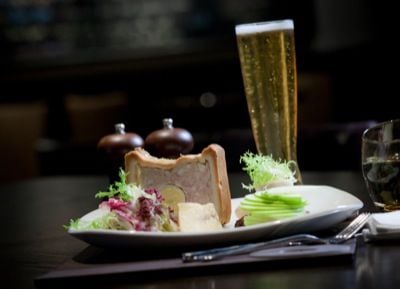
Childhood memories play a big part in the way James Williams, the executive sous chef from The Excelsior, Hong Kong who also oversees the hotel’s recently revamped British-style Dickens Bar, constructs his menu. “I’m from a village called Cotgrave in Nottingham. It’s near Cropwell Bishop, where the famous cheese is made,” Williams says. “As a lad, I used to cycle to the local farm to pick up fresh pork pies and Stilton cheese for the family dinner. I have fond memories of Sunday evenings, which were ‘salad nights’ at our house. We would eat the pies and cheese with vegetables and fruit that I’d grown myself.” To this day, Cropwell Bishop remains his cheese of choice. He serves generous slices in a ploughman’s salad alongside thick wedges of pork pie.

As executive chef of The Press Room group of restaurants, you might expect David Tamlyn to have adventurous tastes. But after pondering his favourite British dish, his answer is unexpectedly down-to-earth: “Ham, eggs and chips!” Of course, the dish must be cooked to absolute perfection to meet Tamlyn’s heady standards. “It needs to be honey-glazed ham, crispy homemade chips and the eggs must be runny,” explains the Welsh chef, who began his career under the wing of Marco Pierre White and went on to work at Michelin-starred London restaurants such as Pied à Terre and The Square.

With its pearly-white colonial facade and its fleet of Rolls-Royce Phantoms, The Peninsula Hong Kong is a natural champion of all things British. Particularly popular with ravenous Anglophiles is the hearty all-day English breakfast served with traditional trimmings such as pork sausages, black pudding, bacon, fried eggs, baked beans, mushrooms and grilled tomatoes. “I have tried black pudding from across Europe: morcilla from Spain, boudin noir from France, as well as German blutwurst, but the British sort comes out best,” explains Swiss-born Florian Trento, the hotel’s executive chef. “I use Lancashire sausages because they have 80 per cent meat content and are a perfect mix of pork, fat and spice, which makes for a tasty and juicy result on the plate.” Sadly, British eggs don’t make the grade. “I use organic eggs from New Zealand or France, I’m afraid.”

A dish made famous by one of England’s famous colleges has also proved a big hit with sweet-toothed Brits, Trento says. “It’s the quintessential light, fluffy, summery combination of juicy strawberries, chewy meringue and whipped cream. We have slightly souped it up in terms of presentation so that it’s less messy, but in essence and taste, you have the Eton mess.”
Though he’s from Switzerland, Trento speaks with great gusto about British cuisine. “It’s all about the quality of the ingredients, coupled with the consistency of the cooking technique. It’s not complicated food, so you have to focus on cooking the ingredients to perfection. One thing’s for certain: British food will never go out of fashion.”





