
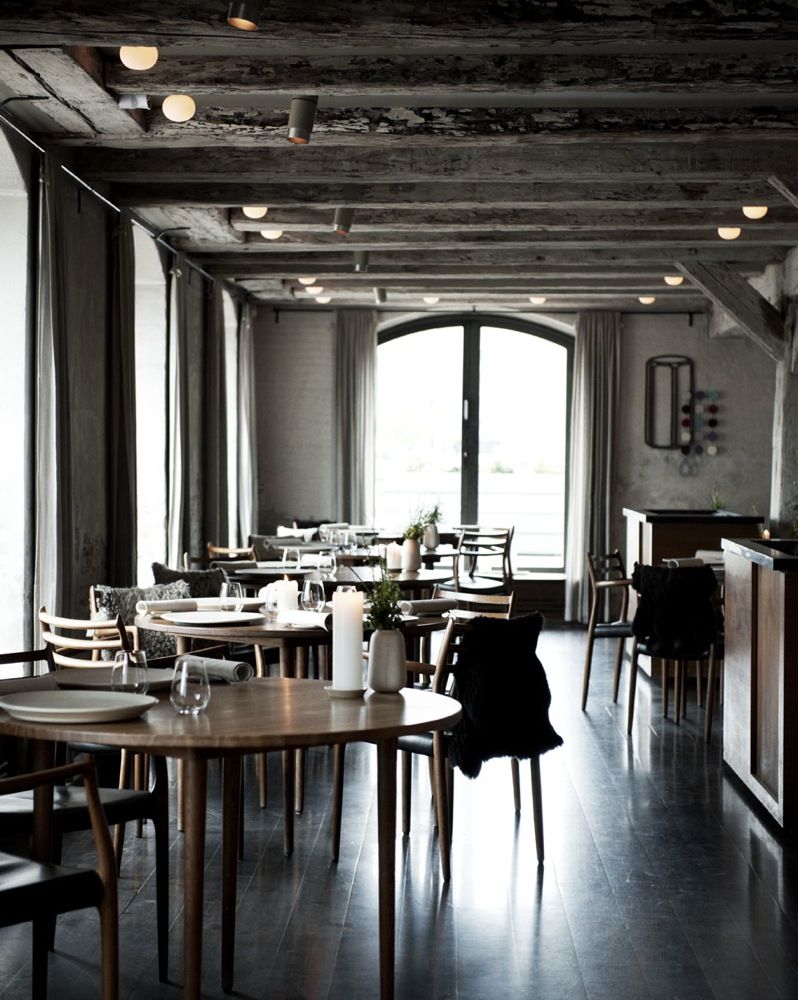
Cover Great Dane
Great Dane
1 / 1
A closer look at the revolutionary dishes of René Redzepi's Noma
 When a cook is said to be “in the weeds,” it means he is tangled up in too many orders. But on a recent afternoon about an hour’s drive from Copenhagen, Danish chef René Redzepi was, quite literally, in the weeds. And what he was doing was snacking like a rabbit, albeit a rabbit in charge of a restaurant that has set the culinary world abuzz.
Treating the windswept brush as an unkempt salad bar, he plucks a thin green blade. “This is how the Vikings got their vitamin C. It’s called scurvy grass. It has a horseradish tone,” says Redzepi, who regularly dispatches his staff to collect the scurvy grass, as well as wild garden sorrel, beach mustard and bellflowers. All of these make their way into his dishes, along with puffin eggs from Iceland and musk ox meat from Greenland.
He is omnivorous in his exoticism, but restrictive in his geography. If the Nordic region doesn’t yield it, Redzepi doesn’t serve it, with rare exceptions (coffee, say, or chocolate). That approach might well seem a recipe for obscurity, which is what many predicted for his restaurant, Noma, when it opened in Copenhagen in 2003. But seven years later, the restaurant is an international sensation, as is 32-year-old Redzepi. A fair share of the attention flows from Noma’s anointment in April as the best restaurant in the world, in an annual poll conducted by San Pellegrino. Most years, the survey draws little notice. But when it lifts a two Michelin-starred establishment in tiny, wintry Denmark above three-starred legends like El Bulli and The Fat Duck, there’s considerably more chatter.
A visitor to Noma is likely to be introduced to the peculiar astringency of sea buckthorn, an orange berry with an outrageous tang. Redzepi pairs a pulp of air-dried sea buckthorn with pickled rose hips in one amuse-bouche. It’s colourful, eccentric, absorbing. Danes long ago used the ashes of hay as a seasoning, so Redzepi does, too: they smell vaguely of popcorn, and have accessorised both an egg dish and one with king crab.
Does all this sound too insistently and grimly botanical? It isn’t. Noma wouldn’t be getting all this international love if Redzepi weren’t as amply devoted to the pleasure principle as to anything else; if he weren’t such an intelligent and extensively trained cook; and if he didn’t take such lavish advantage of the amazing seafood all around him. One of his signature starters combines long, thin tubes of parsley-encased razor-clam flesh with what he calls “snow” of frozen, grated horseradish and an emerald juice of parsley and clam that, when poured onto the plate, skitters and bubbles like something on a microscope slide. Since he interprets “local” in a more ethnically thematic than literal way, the fellow Nordic country of Iceland is fair game, and that’s where he gets fat, exquisite langoustine tails. They are cooked only briefly on a plancha, then served amid dabs of emulsified oyster puree and drifts of seaweed powder on hefty, craggy rocks instead of plates. A diner is denied utensils and instructed to use fingers to drag the langoustine through its ablutions.
Redzepi was born in Copenhagen, where his father, an immigrant from Macedonia, drove a cab and his mother, who is Danish, worked as a cleaning lady. At 15, he chose to go to a restaurant trade school simply because a friend was going there, too. There he discovered a talent and a passion at the stove. He went from school to a world-class restaurant in France and from there to El Bulli. What that famously experimental restaurant taught him, he says, was that rules could be tossed merrily out the window.
Later he travelled to California to work for a few months under Thomas Keller at The French Laundry. Keller’s haute takes on such Americana as macaroni cheese suggested the possibilities of working within and reworking a country’s culinary heritage. That’s what Noma is largely about, though it’s also about a relentless questioning of what should and can be eaten and whether the usual experience of an ingredient is in fact the best one.
During the months when the Nordic soil is stingy, Redzepi wonders about the real potential of a potato or carrot. He recently discovered that a potato on the verge of rotting in the earth sprouts a network of smaller potatoes around it, and that these satellite parasites are tender beyond belief and redolent of hazelnuts. So he is working to persuade a local farmer not to uproot his spuds when he usually would.
“It’s like the caviar of potatoes,” he said. “It’s going to be much more expensive, because you can’t touch the field for two years.” Such renegade, cerebral experiments fascinate many of his peers. His friend David Chang of Momofoku says, “He could have cooked anything he wanted to. He’s well-versed in high-end French, in progressive Spanish. But René said, ‘We’re going to focus on 53 or 58 indigenous horseradish plants in the Scandinavian region.’ I think that’s really brilliant.” Redzepi’s “laboratory” is a houseboat docked about 80m from the restaurant, with an upper deck that’s all kitchen. It’s where he and his team are working, for example, on a new venison dish. “We imagine ourselves being the deer,” he says. “What does it step on?” His answer: snails and fiddlehead ferns. “The flavours will go together,” he says. “Snails and deer: they live together. They have a symbiosis.”
And so he has put in an order for 2,000 snails from the professional foragers he uses to supplement what his cooks can scrounge up. And no doubt he’ll capture one or two himself. It’s his instinct, his way.





