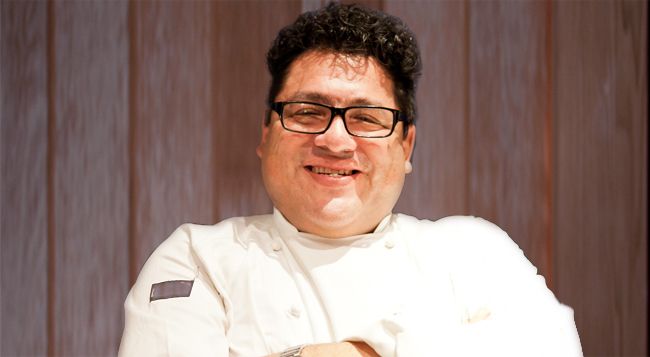
Cover Chef Eduardo Vargas
Chef Eduardo Vargas
1 / 1
How did a banker turn into a celebrity chef? We catch up with Shanghai's Chef Eduardo Vargas to find out.
Imagine growing up with Julia Child as your grandmother, you’d almost be certain to end up in the culinary world in one way or another. That was exactly what happened to Chef Eduardo Vargas, one of the most celebrated chefs in Shanghai, China.
His late grandmother, Teresa Ocampo, was considered the Peruvian Julia Child back in the 50s, when she was the host of prominent cooking shows like “Qué cocinaré?” and “Teresa y su cocina”.
“I grew up with my grandmother, known as “The Chef”, who was always on the television. Even though she looked like your typical grandmother, she was famous back in the day. So my whole world has revolved around food since I was young,” said Chef Eduardo.

A banker with other dreams
As a child, Chef Eduardo used to write down recipes to try out with his parents as he imagined what it would like to run his own restaurant.
On Sundays, he would cook for his parents and presented his meals to them in a proper restaurant-esque setting. He even insisted that they order from a handwritten menu that he had made beforehand.
You would think that his path to being a chef was clear and well lit, but that wasn’t the case. Despite having a culinary dream to fulfill, he ended up in Georgetown University studying economics to continue his father's legacy; the senior Vargas was an alumni of the school.
But as Eduardo was studying economics at Georgetown, he decided to continue pursuing his culinary path. So he started taking apprenticeships with some of the famous chefs of that time like Bobby Flay of Mesa Grill and Mark Miller of Red Sage. When he graduated, he went on to work two jobs – as a full time banker and part time chef-de-partier at the restaurants.
“When I was working with the chefs, they told me, ‘you’re in the wrong business working in a bank and you should change that.’ So they helped me out and enrolled me into a culinary school and that was it!” he said with a big grin on his face.
Progressing as a chef
Chef Eduardo never looked back after graduating culinary school; he's gone on to work in some of the finest hotels in the United States and in Asia. With his experience working as a chef-de-partier, he started his first full time job at Hawaii as a chef de cuisine, managing Roy's Waikaloa kitchen, one of the most famous restaurants on the island.
During his years in Hawaii, he dabbled at restaurant consultation during summer in Spain and Seychelles Island, which would prove to be of trememdous help for his future. After five years of cooking experience in Hawaii, he made another bold move by flying down to Asia for a chef consultation job in Singapore.
From Singapore, he was offered an opportunity to open the first tapas restaurant in China through a fellow Peruvian when a chef backed out from the project. The gamble turned out to be a huge success. From there, he has worked his way to becoming the owner of four celebrated restaurants in Shanghai including Azul Tapas Lounge, Ceviche Peruvian Cafe and Azul Urban. Now he is no longer just a chef, he is also a business man.
"Looking back at my younger years, I realised that my years in economics school wasnt a waste. It helped me realise that owning restaurants doesn't mean it's only cooking. It's a business and my knowledge from Georgetown has benefited me,' said Chef Eduardo.

Bringing Peruvian joy to Kuala Lumpur
With the hectic schedule of managing four restaurants on top of his consultation projects, Chef Eduardo incredibly has the time to do more. Just recently, the celebrated chef flew down to Kuala Lumpur to host a Peruvian culinary week at the Qba Latin Bar and Grill in The Westin Kuala Lumpur.
This collaboration was not only an event made to introduce Peruvian delicacies to the Malaysian scene but for Chef Eduardo, it was an opportunity to pass on his knowledge to the younger generation of culinary masters – something he has been adamant in doing since the earlier part of his career.
"One of my biggest achievements is seeing young chefs who has worked with me eight or nine years ago and now, seeing them as head chefs for established restaurants or owning their own restaurants. Teaching them things that I know can help them grow is something I enjoy doing a lot," he says proudly.
Between the multiple projects and businesses, one wonders how this man has the time to pass on his skill; when asked, he says without hesitation that there's more to come.
“I love doing what I’m doing, so I can do it for as long as I need to. Now I am looking into opening another new restaurant for charcoal chicken, a popular food concept in Australia. So stay tuned and you’ll see more!”
You may also be interested in:
- Featured chef: Rajesh Kanna, Sheraton Imperial Kuala Lumpur
- Culinary conversations with Andre Cointreau, CEO of Le Cordon Bleu
Topics
Curated for you
The stories, profiles, and cultural moments featured on our Instagram feed